

Archive position — measured, not model output
0 likes on Devpost
2,263 of the 7,850 archived projects have more likes, and 5,587 share exactly 0 — so this project's #3,988 place in the like-ranked listing is a tie-break inside that group, not a ranking.
Projects (log scale)
Likes on Devpost. ▲ marks this project's group.
Show the figures
| Likes | Projects | Share of archive |
|---|---|---|
| 0 | 5,587 | 71.2% |
| 1 | 1,758 | 22.4% |
| 2 | 284 | 3.6% |
| 3–4 | 132 | 1.7% |
| 5–9 | 75 | 1.0% |
| 10+ | 14 | 0.2% |
 User Stories BotA demo video on every pull request
Get a demo video on every new feature
GitHub App that watches your pull requests and records a narrated, captioned demo.
Save time on demo prep and make informed decisions faster with a video walkthrough of every new feature.
Executive Summary
What the company appears to be
Evidence Workbench is a self-reported technical search tool designed for internal engineering teams to find exact content within large PDF libraries. It claims to support offline, evidence-first search that answers ambiguous questions with precise page-level results and direct links to source documents.
What changed
The project was submitted as part of the OpenAI 2026 hackathon. The description indicates it is a proof-of-concept built in a short timeframe by two team members using AI-assisted coding tools like Codex and GPT-5.6, with no evidence of prior traction or commercial deployment.
Single most important open question
Is there any evidence that this tool has been validated in an actual engineering environment beyond the hackathon demo? The description states it is a prototype built for a hackathon and does not indicate whether it has moved past the experimental stage or been adopted by users.
What The Product Actually Is
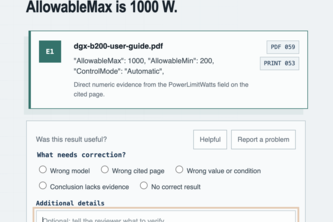
The description states that Evidence Workbench is an offline, evidence-first search experience for technical PDF libraries. It allows users to describe a model, symptom, parameter, table, or diagram without knowing the source document and returns results with exact physical page numbers, inspectable crops, and direct links to the source PDF.
It supports:
- Scanning existing PDF trees at startup
- Manual full-library refreshes that process only new or changed PDFs
- A bilingual English/Chinese UI
- A local feedback journal with an explicit human-review workflow
The system is built using:
- BGE-M3 dense+sparse retrieval
- Reranking
- Qdrant
- PostgreSQL
- Docker
- FastAPI
- pdfplumber
- Ubuntu
It uses a zero-egress model loading approach, meaning models are not sent outside the local server.
Inference The tool appears to be a search engine tailored for technical documentation stored in PDF format, with a focus on precision and traceability of results. It is not described as a general-purpose AI assistant or chatbot.
Positioning & Claim Evolution
The description states that Evidence Workbench was inspired by a real-world engineering problem: the inefficiency of searching large confidential libraries for specific technical content. The authors claim it solves issues with existing RAG workflows being too sensitive to prompt wording and failing on fuzzy questions.
Key claims:
- It turns fuzzy technical questions into exact PDF pages, tables, and diagrams
- It provides scoped answers with physical page numbers
- It returns inspectable crops of content
- It supports ambiguous queries by offering one necessary clarification instead of a guess
These claims are framed as improvements over current RAG systems, which the authors describe as failing on vague or contextual questions.
Inference The positioning is that of a specialized, precision-focused search tool for technical documentation, not a general-purpose AI assistant. It positions itself as solving a gap in how engineers access and retrieve knowledge from large internal libraries.
Target Customer & ICP
The description states the target user is an engineering team working with large technical-PDF libraries. The system is designed to be deployed on an approved internal server, suggesting it targets enterprise or internal engineering environments where confidentiality and control are paramount.
It is built for:
- Application Engineers
- Teams supporting AI server bring-up, deployments, and issue triage
The authors note that the tool is intended for a one-time deployment on an internal server, implying a small to medium-sized team or department, not a broad enterprise rollout.
Inference The ICP appears to be internal engineering teams in enterprises with large technical libraries, particularly those needing precise search and retrieval of PDF-based documentation.
Business Model & Pricing Evidence
Not evidenced.
The description does not contain any information about pricing, licensing, monetization, or business model.
Technical & Delivery Signals
The system is described as:
- Offline-first
- Built with zero-egress model loading
- Uses BGE-M3, bge-reranker-v2-m3, Codex, GPT-5.6, Qdrant, PostgreSQL, Docker, FastAPI, pdfplumber, Ubuntu
- Supports manual full-library refreshes that process only new or changed PDFs
- Includes a bilingual English/Chinese UI
- Has a local feedback journal with human review workflow
The authors also mention:
- A public demo using SHA-256-pinned public PDFs and lightweight deterministic retrieval
- 115 passing automated tests in the public release
- Use of Playwright journeys, privacy checks, and human review
Inference The tool is built with a strong emphasis on security, traceability, and reproducibility, using open-source or public tools where possible. It is not described as cloud-based or SaaS.
Traction & Maturity Signals
Not evidenced.
There is no mention of:
- Revenue
- Customers
- Adoption
- Usage metrics
- Product-market fit
- Prior deployments or internal use beyond the hackathon
The project is explicitly described as a hackathon submission, and no evidence suggests it has moved beyond prototype status.
Competitive Context
Not evidenced.
There is no mention of:
- Competitors
- Market analysis
- Differentiation from existing tools
- Industry benchmarks
The description does not reference any existing search or RAG tools in the market, nor does it compare Evidence Workbench to them.
Open Questions & Risks
- No traction or commercial validation: The tool is described as a hackathon project with no evidence of adoption or revenue.
- Limited scope: It is built for internal use only and not described as a SaaS or cloud-based solution.
- Unproven scalability: The system is designed for one-time deployment on an internal server, suggesting it may not be scalable to larger teams or organizations.
- AI-assisted development dependency: Heavy reliance on Codex and GPT-5.6 in development raises questions about whether the tool can be maintained without these tools or if it’s overly dependent on AI-generated code.
- No privacy or compliance evidence: While the authors mention privacy boundaries, there is no evidence of formal compliance or audit processes.
Questions the description leaves open
- Has this tool been tested in a real engineering environment beyond the hackathon?
- What are the actual use cases and workflows it supports in practice?
- Is there any plan to move beyond internal, one-time deployments to broader enterprise adoption?
- How is the system maintained or updated without relying on AI-assisted coding tools?
- Are there any plans for monetization or commercialization?
- What are the limitations of the current architecture in terms of scalability and performance?
Overall Assessment
Not evidenced.
The description does not provide sufficient evidence to assess whether this project is ready for investment or partnership. It is a self-reported hackathon prototype with no demonstrated traction, revenue, or market validation. The tool’s focus on internal engineering teams and offline deployment suggests it may be too niche or early-stage for general investment interest.
The authors describe the system as built in a short timeframe using AI-assisted tools, but there is no indication of long-term viability, scalability, or commercial potential beyond its initial use case.
User Stories BotA demo video on every pull request
Get a demo video on every new feature
GitHub App that watches your pull requests and records a narrated, captioned demo.
Save time on demo prep and make informed decisions faster with a video walkthrough of every new feature.
Source
Submitted to the OpenAI 2026 hackathon on Devpost. Project home on Devpost. Back to the full gallery on Devpost.
This competitive analysis was produced by top-founders.com (opens in a new tab)
Generated by a language model from this project's public Devpost page — its tagline, the author's own write-up and any built-with tags listed there — as captured in August 2026. Short quotations are the author's words. It is an opinion on the idea as a business, not on the people behind it, and it reflects the description as published then. If the project has moved on, request a correction below. The analysis is not independent research and contains no verified traction, revenue or customer data.
An independent guide by KFG International LLC — not affiliated with, endorsed by, or connected to Devpost or OpenAI.