

Archive position — measured, not model output
0 likes on Devpost
2,263 of the 7,850 archived projects have more likes, and 5,587 share exactly 0 — so this project's #3,939 place in the like-ranked listing is a tie-break inside that group, not a ranking.
Projects (log scale)
Likes on Devpost. ▲ marks this project's group.
Show the figures
| Likes | Projects | Share of archive |
|---|---|---|
| 0 | 5,587 | 71.2% |
| 1 | 1,758 | 22.4% |
| 2 | 284 | 3.6% |
| 3–4 | 132 | 1.7% |
| 5–9 | 75 | 1.0% |
| 10+ | 14 | 0.2% |
 User Stories BotA demo video on every pull request
Get a demo video on every new feature
GitHub App that watches your pull requests and records a narrated, captioned demo.
Save time on demo prep and make informed decisions faster with a video walkthrough of every new feature.
Executive Summary
What the company appears to be
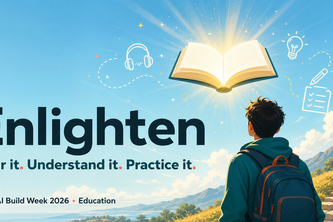
Enlighten is a self-reported Android app that turns study material into spoken lessons, flashcards, quizzes, and private local tutoring. It uses local AI (via Ollama + Llama) to process text from various formats (OCR, PDF, DOCX, screenshots), with offline speech synthesis and interactive features like word highlighting and sentence playback controls.
What changed
The project is a self-developed personal tool built for the OpenAI 2026 hackathon. It represents a single-person effort focused on solving a personal learning problem — studying while commuting or doing other tasks — using local AI to avoid cloud-based APIs and maintain privacy.
Single most important open question
Is there evidence of any traction, revenue, or customer adoption beyond the author's own use case? The description does not indicate any such evidence.
What The Product Actually Is
The description states that Enlighten is an Android app designed to help students learn from study material while commuting, exercising, or doing other tasks. It accepts pasted text, up to ten screenshots, camera photos, PDFs, DOCX, or TXT files. The app extracts text using ML Kit and reads it aloud using Android TextToSpeech. When enabled, it generates AI explanations via Ollama running a Llama3.2 model on the user’s local machine.
It supports:
- Sentence-level playback controls
- Word highlighting during speech
- Flashcard generation
- Quiz mode
- Tutor-style chat grounded in the source material
- Local storage of study sets
The app runs entirely on-device, with no cloud-based inference APIs used. It communicates directly with Ollama through local endpoints.
Evidence
- The author describes how the app works.
- Technology stack includes Kotlin, Jetpack Compose, ML Kit, Android PdfRenderer, DOCX parsing, and Ollama integration.
- The AI runs locally using a quantized 3.2B Llama model (Llama3.2:3b).
- Speech is generated via Android TextToSpeech with word-level callbacks.
Inference The app appears to be a proof-of-concept or prototype built for a hackathon, not yet commercialized.
Positioning & Claim Evolution
The author positions Enlighten as a study companion that helps students learn without screen time — especially useful during commuting or other non-traditional study times. It aims to simplify the process of turning dense material into digestible lessons by integrating OCR, reading, explanation, flashcards, and quizzes in one workflow.
It emphasizes:
- Privacy (no cloud processing)
- Offline functionality
- Accessibility features (word highlighting, adjustable speed)
- Local AI use for educational output
Evidence
- The tagline: “Turn study material into spoken lessons, clear explanations, flashcards, quizzes, and a private local tutor.”
- The author’s inspiration is rooted in personal experience of fatigue from reading dense material.
- The app avoids paid inference APIs by using Ollama locally.
Inference The positioning reflects a niche educational use case rather than broad market appeal. It is not claimed to be scalable or used by many users beyond the founder.
Target Customer & ICP
The description states that Enlighten targets students who study while commuting, exercising, or doing everyday tasks — particularly those who find traditional reading tiring or inconvenient.
It also implies a focus on:
- Users with access to Android phones and local computers
- Individuals interested in privacy-preserving tools
- Learners who want structured learning workflows (e.g., flashcards, quizzes)
Evidence
- The author’s personal motivation was studying cybersecurity while driving Uber.
- The app supports OCR from screenshots, PDFs, DOCX files — common formats for student materials.
- It is designed to work with local AI infrastructure.
Inference There is no evidence of a defined customer segment beyond the founder's own use case. No target personas or market segmentation are described.
Business Model & Pricing Evidence
Not evidenced.
The description does not mention any pricing model, monetization strategy, or business model. The app appears to be built for personal use and hackathon submission, with no indication of commercial intent or revenue streams.
Technical & Delivery Signals
The author reports:
- Native Android app written in Kotlin using Jetpack Compose
- Uses ML Kit for OCR, Android PdfRenderer for PDFs, DOCX parsing via XML
- Speech synthesis via Android TextToSpeech
- Communication with Ollama over local network
- Model used: Llama3.2:3b (quantized 3B)
- Performance benchmarked at ~133 tokens/sec on RTX 3070
Evidence
- The app is built for Android using modern tooling.
- It uses offline AI inference via Ollama.
- Includes state management with StateFlow and ViewModel.
- Supports multiple input formats (OCR, PDF, DOCX, screenshots).
- Has real-device testing on Pixel 9.
Inference The technical approach suggests a functional prototype but lacks evidence of scalability or production-grade delivery.
Traction & Maturity Signals
Not evidenced.
There is no mention of:
- Users
- Customers
- Revenue
- Adoption metrics
- Product usage data
- Any form of traction beyond the author’s own development and testing.
The project is described as a hackathon submission, not a commercial product.
Competitive Context
Not evidenced.
No information is provided about competitors or existing solutions in the educational AI or study tool space. The description does not reference similar products or platforms.
Open Questions & Risks
- Single-person development: Only one team member (the founder) is listed.
- No traction or revenue: No evidence of customers, users, or monetization.
- Limited scope: Built for a hackathon; no indication of commercial viability or scalability.
- Privacy trade-offs: Requires local setup and network configuration — may not be user-friendly.
- AI performance constraints: The app relies on a 3B model that is not optimized for mobile use, despite being benchmarked on desktop hardware.
Inference The project lacks commercial readiness or evidence of market demand. It appears to be an experimental tool rather than a scalable product.
Questions the description leaves open
- What is the actual user base beyond yourself?
- Have you tested the app with other students or users outside your own experience?
- How do you plan to scale this beyond a single-person prototype?
- Are there any plans for monetization or commercial use?
- What are the technical limitations of running Llama3.2:3b on mobile devices?
- Is there any feedback from potential users about usability or adoption?
Overall Assessment
Not evidenced.
There is no evidence of:
- Revenue
- Customers
- Traction
- Product-market fit
- Commercial viability
The project is described as a hackathon submission, not a commercial product. It shows technical capability but lacks any signal of business potential or market demand.
Confidence Level Low — based entirely on self-reported information with no external validation or data points.
User Stories BotA demo video on every pull request
Get a demo video on every new feature
GitHub App that watches your pull requests and records a narrated, captioned demo.
Save time on demo prep and make informed decisions faster with a video walkthrough of every new feature.
Source
Submitted to the OpenAI 2026 hackathon on Devpost. Project home on Devpost. Back to the full gallery on Devpost.
This competitive analysis was produced by top-founders.com (opens in a new tab)
Generated by a language model from this project's public Devpost page — its tagline, the author's own write-up and any built-with tags listed there — as captured in August 2026. Short quotations are the author's words. It is an opinion on the idea as a business, not on the people behind it, and it reflects the description as published then. If the project has moved on, request a correction below. The analysis is not independent research and contains no verified traction, revenue or customer data.
An independent guide by KFG International LLC — not affiliated with, endorsed by, or connected to Devpost or OpenAI.