

Archive position — measured, not model output
0 likes on Devpost
2,263 of the 7,850 archived projects have more likes, and 5,587 share exactly 0 — so this project's #3,930 place in the like-ranked listing is a tie-break inside that group, not a ranking.
Projects (log scale)
Likes on Devpost. ▲ marks this project's group.
Show the figures
| Likes | Projects | Share of archive |
|---|---|---|
| 0 | 5,587 | 71.2% |
| 1 | 1,758 | 22.4% |
| 2 | 284 | 3.6% |
| 3–4 | 132 | 1.7% |
| 5–9 | 75 | 1.0% |
| 10+ | 14 | 0.2% |
 User Stories BotA demo video on every pull request
Get a demo video on every new feature
GitHub App that watches your pull requests and records a narrated, captioned demo.
Save time on demo prep and make informed decisions faster with a video walkthrough of every new feature.
Executive Summary
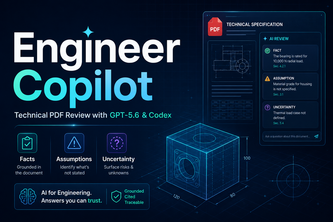
What the company appears to be: Engineer Copilot is a self-reported technical document review tool built as a prototype for the OpenAI 2026 hackathon. It processes technical PDFs using GPT-5.6 and presents structured outputs that separate facts, assumptions, and uncertainty. The product is described as a browser-based application with no permanent storage, user accounts, or database.
What changed: The project was submitted to the OpenAI 2026 hackathon, indicating it was developed in a short timeframe as a proof-of-concept prototype. It has been publicly deployed on Vercel and open-sourced under MIT license.
Single most important open question: Is there any evidence of commercial traction or product-market fit beyond this prototype? The description states no revenue, customers, or adoption data exist.
What The Product Actually Is
The description states that Engineer Copilot is a browser-based application that processes technical PDFs using GPT-5.6 and presents structured engineering reviews. It allows users to:
- Preview technical PDFs locally in the browser
- Explicitly initiate AI processing only through user action
- Generate structured document analysis
- Separate facts from assumptions and uncertain information
- Run five focused engineering actions:
- Summarize document
- Detect components
- Find risks and open points
- Generate assembly instructions
- Create purchasing list
- Ask document-grounded follow-up questions
The application uses Next.js, React, TypeScript, Tailwind CSS, OpenAI JavaScript SDK, Zod, and Vercel. It is built to process PDFs temporarily and delete them after processing, with no permanent storage or user accounts.
Evidence: The author's own write-up describes the functionality in detail.
Inference: This appears to be a prototype for a technical document review tool that emphasizes transparency around AI outputs.
Positioning & Claim Evolution
The description states that Engineer Copilot was created to make technical document review faster while keeping evidence, uncertainty, and professional responsibility visible. It aims to avoid the problem where conventional AI summaries present assumptions as confirmed facts.
It positions itself as a tool for engineers, technicians, and technical project teams who spend significant time searching through drawings, data sheets, specifications, and assembly documents.
Evidence: The author's own write-up describes the inspiration and intended use case.
Inference: The positioning is focused on improving document review workflows by making AI outputs more transparent and responsible.
Target Customer & ICP
The description states that Engineer Copilot targets engineers, technicians, and technical project teams who spend significant time searching through drawings, data sheets, specifications, and assembly documents.
It also notes that the tool is not an approval or production-release system, and confidential documents should not be uploaded to the public demo.
Evidence: The author's own write-up describes the target audience.
Inference: The primary customer segment appears to be technical professionals working with engineering documentation who need structured review capabilities.
Business Model & Pricing Evidence
Not evidenced. The description does not contain any information about pricing, monetization strategy, or business model.
Evidence: No mention of revenue, pricing, or commercialization plans in the author's write-up.
Technical & Delivery Signals
The application is built with Next.js, React, TypeScript, Tailwind CSS, OpenAI JavaScript SDK, Zod, and Vercel. It uses the OpenAI Responses API and Files API with GPT-5.6.
Key technical features include:
- Temporary file processing
- Disabled response storage (store: false)
- Server-side validation of files
- Schema-constrained responses using Zod
- No database, user accounts, or permanent document history
The application has 101 automated tests and passes lint, TypeScript, and production-build checks.
Evidence: The author's own write-up describes the technical implementation.
Inference: The architecture is designed for security and privacy with temporary processing and no persistent data storage.
Traction & Maturity Signals
Not evidenced. The description does not contain any information about revenue, customers, usage metrics, or adoption beyond the prototype stage.
The project is described as a publicly deployed prototype submitted to a hackathon, with no mention of commercial traction or user base.
Evidence: No data on users, revenue, or market adoption in the author's write-up.
Competitive Context
Not evidenced. The description does not contain any information about competitors or competitive landscape.
Evidence: No mention of existing solutions or competitive positioning in the author's write-up.
Open Questions & Risks
- Prototype-only status: The product is described as a hackathon prototype with no commercial traction, suggesting it may not have reached market validation.
- No revenue or customers: There is no evidence of any revenue generation or customer base.
- Limited functionality: The tool only supports five specific engineering actions and document-grounded chat, which may limit its utility.
- No permanent storage or user accounts: While this enhances privacy, it also limits long-term use cases and collaboration features.
- Self-reported claims: All information is self-reported and unverified.
Evidence: The author's own write-up describes the prototype nature of the product and lack of commercial data.
Questions the description leaves open
- What specific market pain points does Engineer Copilot solve, and how do you know?
- Have you conducted any user research or interviews with engineers or technical teams?
- What is your plan for monetization beyond the prototype?
- How do you intend to scale this product if it gains traction?
- Are there any legal or compliance considerations around processing technical documents in this way?
- What are the limitations of GPT-5.6 in handling complex engineering documentation?
Evidence: These questions are based on the self-reported nature of the project and lack of commercial evidence.
Overall Assessment
Not evidenced. The description does not contain any information about investment interest, partnership opportunities, or financial backing.
Evidence: No mention of funding rounds, investors, or partnership discussions in the author's write-up.
User Stories BotA demo video on every pull request
Get a demo video on every new feature
GitHub App that watches your pull requests and records a narrated, captioned demo.
Save time on demo prep and make informed decisions faster with a video walkthrough of every new feature.
Source
Submitted to the OpenAI 2026 hackathon on Devpost. Project home on Devpost. Back to the full gallery on Devpost.
This competitive analysis was produced by top-founders.com (opens in a new tab)
Generated by a language model from this project's public Devpost page — its tagline, the author's own write-up and any built-with tags listed there — as captured in August 2026. Short quotations are the author's words. It is an opinion on the idea as a business, not on the people behind it, and it reflects the description as published then. If the project has moved on, request a correction below. The analysis is not independent research and contains no verified traction, revenue or customer data.
An independent guide by KFG International LLC — not affiliated with, endorsed by, or connected to Devpost or OpenAI.