

Archive position — measured, not model output
0 likes on Devpost
2,263 of the 7,850 archived projects have more likes, and 5,587 share exactly 0 — so this project's #5,893 place in the like-ranked listing is a tie-break inside that group, not a ranking.
Projects (log scale)
Likes on Devpost. ▲ marks this project's group.
Show the figures
| Likes | Projects | Share of archive |
|---|---|---|
| 0 | 5,587 | 71.2% |
| 1 | 1,758 | 22.4% |
| 2 | 284 | 3.6% |
| 3–4 | 132 | 1.7% |
| 5–9 | 75 | 1.0% |
| 10+ | 14 | 0.2% |
 User Stories BotA demo video on every pull request
Get a demo video on every new feature
GitHub App that watches your pull requests and records a narrated, captioned demo.
Save time on demo prep and make informed decisions faster with a video walkthrough of every new feature.
Executive Summary
What the company appears to be
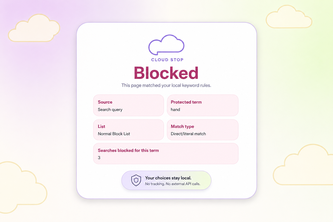
The project described is a self-reported Chrome browser extension named "Personal Keyword Blocker". The author states it is designed to help users manage internet use by blocking keywords and phrases with semantic protection, using local processing without external APIs or data transmission. It includes features like synonym review, custom alias support, and an optional "Break Search Loop" that pauses search-result pages for one hour after a protected search.
What changed
The author reports building this extension during the OpenAI Build Week hackathon in 2026. The project evolved from an initial prototype into a more controlled semantic protection system using local data, explicit user approval, and deterministic matching logic. It was built with Chrome Manifest V3 and integrated tools like GPT-5.6 (via Codex) for engineering assistance.
The single most important open question
Is there any evidence of user adoption or feedback beyond the author’s personal use case? The description provides no data on downloads, retention, usage metrics, or external validation.
What The Product Actually Is
The description states that Personal Keyword Blocker is a Chrome Manifest V3 extension. It runs entirely within the browser and uses local processing for keyword matching, synonym review, and semantic protection.
Key technical elements include:
- Use of Chrome APIs such as
chrome-alarms-api,chrome-scripting-api,chrome-storage-api - Integration with Open English WordNet 2025 Core index (packaged locally)
- Support for user-created custom synonym groups
- Implementation of a six-stage matching order for detecting blocked terms
- Optional feature called Break Search Loop, which pauses supported search-result pages for one hour after a protected search
The author claims the extension does not send data to external AI services or APIs, and all logic runs locally in the browser.
The description states: “It is a Chrome Manifest V3 extension. Its matching, synonym review, storage, and search-protection logic run locally inside the browser.”
Positioning & Claim Evolution
The author positions Personal Keyword Blocker as a privacy-focused, self-control tool for managing internet use. It is described as:
- Not relying on external APIs or AI services
- Offering semantic protection beyond literal keyword matching
- Providing intentional friction to prevent bypass loops
- Designed for personal use and self-improvement
The product evolved from a basic blocker into one that supports reviewed vocabulary packs, explicit synonym approval, and custom aliases. The author notes they initially considered using an AI API but rejected it due to privacy concerns.
The description states: “I wanted a blocker that I could not easily bypass through small spelling changes... I did not want my searches or blocked terms to be sent to an AI service or an external dictionary API.”
Target Customer & ICP
The author describes the product as being for individuals who struggle with self-control around internet use and want stronger, more intentional boundaries.
There is no explicit segmentation beyond this personal motivation. No mention of:
- Demographics
- Industry verticals
- Use cases beyond individual self-management
- Specific user personas or buyer profiles
The description states: “I made Personal Keyword Blocker because I genuinely needed something that could help me manage my internet use...”
Business Model & Pricing Evidence
The author does not state a business model or pricing strategy. The extension is described as:
- Free to use
- Not monetized in any way
- Intended for personal use, not commercial deployment
There is no indication of plans to charge users, offer premium tiers, or integrate with other platforms.
The description states: “I hope Personal Keyword Blocker can help more people... keep the extension free.”
Technical & Delivery Signals
The author reports:
- Built using Chrome Manifest V3
- Uses local processing via browser APIs
- Implements a six-stage matching order for detection logic
- Includes Break Search Loop controlled by service workers
- Utilizes GPT-5.6 (via Codex) for engineering support during development
The extension is said to be:
- Deterministic and explainable
- Privacy-focused, with no data leaving the browser
- Designed to avoid race conditions and tab restoration issues
The description states: “It checks the original blocked words first, then reviewed synonyms, and finally the WordNet or custom aliases that the user personally approved.”
Traction & Maturity Signals
There is no evidence of traction or maturity signals such as:
- Downloads
- User feedback or reviews
- Customer acquisition metrics
- Retention data
- Product usage analytics
- Revenue or monetization
The author only mentions personal use and ongoing plans for promotion.
The description states: “I still use it in my daily life.” — this is not evidence of broader adoption.
Competitive Context
No competitive analysis or market positioning is provided. The author does not reference:
- Existing tools or products in the self-control or keyword-blocking space
- Competitors or substitutes
- Market size or opportunity
The description states: “I made Personal Keyword Blocker because I genuinely needed something...” — no mention of alternatives.
Open Questions & Risks
Risk 1
The extension is described as a single-person project, with no team or organizational structure. This raises questions about scalability, maintenance, and long-term viability.
Risk 2
The author states that the product was built during a hackathon and has not yet been tested on other browsers (e.g., Edge). This limits its reach and robustness.
Risk 3
While privacy is emphasized, the lack of external validation or third-party audits makes it difficult to assess whether the claims about local processing are fully realized.
The description states: “Team size: 1” — this indicates a solo developer effort with no team structure.
Questions the description leaves open
- What is the actual user experience like for someone trying to set up and use the extension?
- How many people are currently using the extension, if any?
- Are there any known edge cases or bugs in how the matching logic works?
- Has the extension been tested on browsers other than Chrome?
- Is there a plan to monetize the extension, or is it intended to remain free forever?
- What specific feedback has the author received from others who have tried the extension?
Overall Assessment
There is no evidence of commercial traction, revenue, or customer adoption beyond the author’s personal use.
The project is described as a self-built tool for personal self-control, not a scalable product or business. It lacks:
- Market validation
- Product-market fit indicators
- Financials or growth metrics
- Team structure or organizational backing
The description states: “This was something I deeply needed for myself.” — this implies no external demand or commercial intent.
Assessment Not evidenced as a viable investment or partnership opportunity at this stage.
User Stories BotA demo video on every pull request
Get a demo video on every new feature
GitHub App that watches your pull requests and records a narrated, captioned demo.
Save time on demo prep and make informed decisions faster with a video walkthrough of every new feature.
Source
Submitted to the OpenAI 2026 hackathon on Devpost. Project home on Devpost. Back to the full gallery on Devpost.
This competitive analysis was produced by top-founders.com (opens in a new tab)
Generated by a language model from this project's public Devpost page — its tagline, the author's own write-up and any built-with tags listed there — as captured in August 2026. Short quotations are the author's words. It is an opinion on the idea as a business, not on the people behind it, and it reflects the description as published then. If the project has moved on, request a correction below. The analysis is not independent research and contains no verified traction, revenue or customer data.
An independent guide by KFG International LLC — not affiliated with, endorsed by, or connected to Devpost or OpenAI.