

Archive position — measured, not model output
1 like on Devpost
505 of the 7,850 archived projects have more likes, and 1,758 share exactly 1 — so this project's #989 place in the like-ranked listing is a tie-break inside that group, not a ranking.
Projects (log scale)
Likes on Devpost. ▲ marks this project's group.
Show the figures
| Likes | Projects | Share of archive |
|---|---|---|
| 0 | 5,587 | 71.2% |
| 1 | 1,758 | 22.4% |
| 2 | 284 | 3.6% |
| 3–4 | 132 | 1.7% |
| 5–9 | 75 | 1.0% |
| 10+ | 14 | 0.2% |
 User Stories BotA demo video on every pull request
Get a demo video on every new feature
GitHub App that watches your pull requests and records a narrated, captioned demo.
Save time on demo prep and make informed decisions faster with a video walkthrough of every new feature.
Executive Summary
What the company appears to be
EchoWorld is a native iOS app that allows users to turn photographs into spatial worlds using AI and AR technologies. The project was built as part of an OpenAI 2026 hackathon submission.
What changed
The description indicates this is a prototype or proof-of-concept, not a commercial product with traction or customers. It represents a self-reported technical demonstration rather than a market-ready offering.
Single most important open question
Is there any evidence of commercial viability beyond the hackathon context? The description provides no information about revenue, customers, or adoption — only a self-reported technical implementation.
What The Product Actually Is
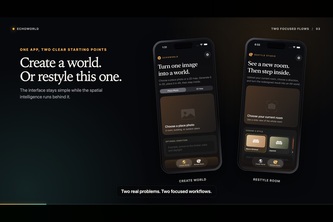
The description states that EchoWorld is a native iPhone app with two workflows:
- Create World: Starts with a place photograph or 2D map. It prepares a spatial generation prompt, creates a World Labs environment, anchors a portal to the real floor, and lets users enter the result in augmented reality.
- Restyle Room: Starts with a photograph of the user's current room. The user chooses a style, GPT Image 2 creates a redesign while preserving the room's permanent architecture, and World Labs turns the approved direction into a spatial world that can be experienced at human scale.
Both workflows include deterministic, on-device demos created from real API outputs so judges can experience the complete product without waiting for generation or spending credits.
Evidence Self-reported by author. No independent verification.
Positioning & Claim Evolution
The description states that EchoWorld began with one question: "what if a flat image could become somewhere you could revisit, inspect, and move through?"
It also claims:
- Photos are good at preserving how a place looked from one position, but not how it felt to be surrounded by it.
- The same limitation appears in interior design: a beautiful concept image can still leave you guessing about scale, circulation, and whether the room will feel right in real life.
The project positions itself as solving limitations of static images and 2D design concepts through AR and AI.
Evidence Self-reported claims. No evidence of market validation or customer feedback.
Target Customer & ICP
Not evidenced.
The description does not identify specific target customers, personas, or ideal customer profiles (ICPs). It describes general use cases but does not name who would buy or use this product.
Business Model & Pricing Evidence
Not evidenced.
There is no mention of pricing models, monetization strategies, or business model assumptions in the provided description.
Technical & Delivery Signals
The app is built in Swift and SwiftUI for iOS. GPT-5.6 runs behind the interface as a structured prompt orchestrator: it translates the source image, map, style choice, and user direction into controlled instructions for GPT Image 2 and World Labs. GPT-5.6 does not render the image or the world itself.
GPT Image 2 produces the redesigned-room image. World Labs Marble 1.1 generates panoramic imagery, a mobile collider GLB, and an SPZ Gaussian-splat asset.
ARKit supplies the phone's changing six-degree-of-freedom pose, while native Metal and MetalSplatter render up to roughly 500,000 splats. SceneKit and GLTFKit2 handle portal placement and the invisible spatial anchor.
Generated assets are cached locally so interrupted workflows can resume.
Codex was used as a development partner across the build, helping with architecture, client implementation, diagnostics, integration of Metal splat renderer, calibration, refinement, and demo assembly.
Evidence Self-reported technical details. No evidence of production deployment or performance metrics.
Traction & Maturity Signals
Not evidenced.
There is no mention of revenue, customers, user adoption, or any traction indicators beyond the hackathon submission. The project is described as a prototype or demo.
Competitive Context
Not evidenced.
The description does not reference existing competitors or market positioning relative to other AR/3D design tools or AI-powered spatial applications.
Open Questions & Risks
- No commercial traction: This is a hackathon submission with no evidence of revenue, customers, or adoption.
- Unverified claims: All statements are self-reported and unverified; there is no independent validation of the product’s functionality or market demand.
- Limited scope: The app is described as a native iOS app with on-device demos, suggesting it may not scale beyond this environment.
- Dependency on external APIs: Heavy reliance on GPT-5.6, World Labs, and other third-party services introduces risk if those APIs change or become unavailable.
Questions the description leaves open
- What is the actual business model behind EchoWorld? Is there a plan to monetize this beyond the hackathon?
- Have you tested the product with real users outside of the development team?
- How do you intend to scale beyond iOS and native ARKit support?
- Are there any plans for backend infrastructure or data storage?
- What is your path to market, and how do you plan to reach potential customers?
Overall Assessment
Not evidenced.
There is no evidence of a commercial product, revenue, customer base, or traction that would support an investment or partnership decision. The description presents only a self-reported technical prototype with no indication of market readiness or business viability.
User Stories BotA demo video on every pull request
Get a demo video on every new feature
GitHub App that watches your pull requests and records a narrated, captioned demo.
Save time on demo prep and make informed decisions faster with a video walkthrough of every new feature.
Source
Submitted to the OpenAI 2026 hackathon on Devpost. Project home on Devpost. Back to the full gallery on Devpost.
This competitive analysis was produced by top-founders.com (opens in a new tab)
Generated by a language model from this project's public Devpost page — its tagline, the author's own write-up and any built-with tags listed there — as captured in August 2026. Short quotations are the author's words. It is an opinion on the idea as a business, not on the people behind it, and it reflects the description as published then. If the project has moved on, request a correction below. The analysis is not independent research and contains no verified traction, revenue or customer data.
An independent guide by KFG International LLC — not affiliated with, endorsed by, or connected to Devpost or OpenAI.