

Archive position — measured, not model output
1 like on Devpost
505 of the 7,850 archived projects have more likes, and 1,758 share exactly 1 — so this project's #987 place in the like-ranked listing is a tie-break inside that group, not a ranking.
Projects (log scale)
Likes on Devpost. ▲ marks this project's group.
Show the figures
| Likes | Projects | Share of archive |
|---|---|---|
| 0 | 5,587 | 71.2% |
| 1 | 1,758 | 22.4% |
| 2 | 284 | 3.6% |
| 3–4 | 132 | 1.7% |
| 5–9 | 75 | 1.0% |
| 10+ | 14 | 0.2% |
 User Stories BotA demo video on every pull request
Get a demo video on every new feature
GitHub App that watches your pull requests and records a narrated, captioned demo.
Save time on demo prep and make informed decisions faster with a video walkthrough of every new feature.
Executive Summary
What the company appears to be
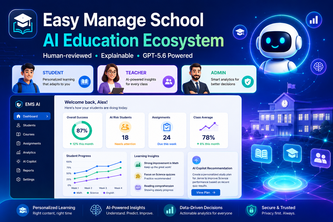
The description states that Easy Manage School AI Education Ecosystem is an "explainable, human-reviewed AI ecosystem" designed for use in schools. It claims to help school leaders identify learning patterns, teachers take informed action, and students improve through guided support.
What changed
This project was submitted as part of the OpenAI 2026 hackathon, indicating it is a prototype or early-stage product with no evidence of prior traction or commercial deployment.
The single most important open question
Is there any evidence that this system has been tested in real schools, and if so, what were the outcomes?
What The Product Actually Is
The description states: “Easy Manage School AI Education Ecosystem” is an “explainable, human-reviewed AI ecosystem.” It is built using technologies such as GPT-5.6, OpenAI, PHP, JavaScript, HTML5, CSS3, MariaDB, MySQL, REST APIs, and PWA.
Inference Based on the technology stack and the tagline, it appears to be a web-based or mobile application that integrates AI tools for educational use cases within school environments.
Not evidenced There is no clear indication of how exactly the system works, what data it processes, or whether it includes features like dashboards, teacher tools, student learning paths, or integration with existing school systems.
Positioning & Claim Evolution
The tagline says: “An explainable, human-reviewed AI ecosystem that helps school leaders identify learning patterns, teachers take informed action, and students improve through guided support.”
Claim
The product positions itself as a tool for improving education outcomes by leveraging AI in a way that is transparent and reviewed by humans.
Not evidenced There is no evidence of prior positioning or evolution of claims beyond the single tagline. No mention of competitors, market differentiation, or historical development.
Target Customer & ICP
The description states: “helps school leaders identify learning patterns, teachers take informed action, and students improve through guided support.”
Claim
The primary users are school leaders (e.g., administrators), teachers, and students.
Inference It appears to target K-12 or higher education institutions where AI can be used to enhance teaching and learning processes.
Not evidenced No specific customer segments, personas, or use cases beyond general roles in schools are described. No evidence of segmentation strategy or early adopters.
Business Model & Pricing Evidence
The description does not contain any information about pricing, monetization, or business model.
Not evidenced There is no mention of how the product will be sold, whether it’s free, subscription-based, or funded through grants or institutional contracts.
Technical & Delivery Signals
Built with (author-declared): actions, android, api, codex, css3, github, gpt-5.6, html5, javascript, json, mariadb, mysql, openai, php, pwa, responses, responsible, rest, schema
Claim
The system uses AI models like GPT-5.6 and integrates with databases (MariaDB, MySQL), APIs (REST), and front-end frameworks (HTML5, CSS3, JavaScript).
Inference It seems to be a hybrid application combining AI capabilities with traditional web/mobile development practices.
Not evidenced No details on architecture, scalability, deployment method, or delivery mechanism beyond the tech stack listed.
Traction & Maturity Signals
Submitted to the OpenAI 2026 hackathon on Devpost. The author states: “Team size: 1” and “Members: HarisH KhobragadE.”
Claim
This is a hackathon submission, likely a prototype or proof-of-concept.
Not evidenced There is no evidence of any traction, user feedback, pilot programs, or commercial adoption. No mention of beta users, customer interviews, or product iterations.
Competitive Context
The description does not reference any competitors or existing solutions in the education AI space.
Not evidenced No competitive analysis, market positioning, or awareness of similar tools is provided.
Open Questions & Risks
- Unproven concept: Submitted to a hackathon; no evidence of real-world testing.
- Single founder: Team size is listed as one, raising questions about execution capability.
- Lack of clarity: No clear explanation of how the AI is used or what value it delivers beyond generic claims.
- No business model: No indication of how this will be monetized or scaled.
Questions the description leaves open
- What specific problems in education are you solving, and how do you know?
- Have you tested this with actual teachers or students? If so, what were the results?
- How does your AI system ensure explainability and human review?
- What is your go-to-market strategy for schools?
- Are there any existing partnerships or pilot programs in place?
Overall Assessment
Not evidenced There is insufficient evidence to assess whether this project is ready for investment or partnership.
Confidence level Low — based on the thinness of the self-reported description, lack of traction, and absence of any commercial or technical validation.
Inference If this were a real product, it would likely be in an early-stage prototype phase. However, due to the lack of evidence, no conclusion can be drawn about its viability or potential for growth.
User Stories BotA demo video on every pull request
Get a demo video on every new feature
GitHub App that watches your pull requests and records a narrated, captioned demo.
Save time on demo prep and make informed decisions faster with a video walkthrough of every new feature.
Source
Submitted to the OpenAI 2026 hackathon on Devpost. Project home on Devpost. Back to the full gallery on Devpost.
This competitive analysis was produced by top-founders.com (opens in a new tab)
Generated by a language model from this project's public Devpost page — its tagline and any built-with tags listed there, since the author published no write-up — as captured in August 2026. Short quotations are the author's words. It is an opinion on the idea as a business, not on the people behind it, and it reflects the description as published then. If the project has moved on, request a correction below. The analysis is not independent research and contains no verified traction, revenue or customer data.
An independent guide by KFG International LLC — not affiliated with, endorsed by, or connected to Devpost or OpenAI.