

Archive position — measured, not model output
0 likes on Devpost
2,263 of the 7,850 archived projects have more likes, and 5,587 share exactly 0 — so this project's #3,821 place in the like-ranked listing is a tie-break inside that group, not a ranking.
Projects (log scale)
Likes on Devpost. ▲ marks this project's group.
Show the figures
| Likes | Projects | Share of archive |
|---|---|---|
| 0 | 5,587 | 71.2% |
| 1 | 1,758 | 22.4% |
| 2 | 284 | 3.6% |
| 3–4 | 132 | 1.7% |
| 5–9 | 75 | 1.0% |
| 10+ | 14 | 0.2% |
 User Stories BotA demo video on every pull request
Get a demo video on every new feature
GitHub App that watches your pull requests and records a narrated, captioned demo.
Save time on demo prep and make informed decisions faster with a video walkthrough of every new feature.
Executive Summary
What the company appears to be
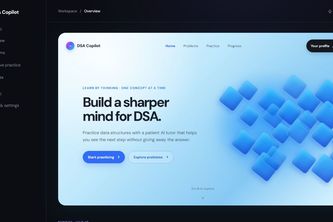
DSA Copilot is an AI-assisted learning platform for Data Structures and Algorithms (DSA) that allows students to write code, receive AI feedback, hints, and complexity analysis without revealing full solutions. It is described as a workspace that guides learners toward correct steps through Socratic questioning, visualizations, and progress tracking.
What changed
The project was submitted as part of the OpenAI 2026 hackathon. No prior version or commercial product is evidenced; this is a self-reported prototype or proof-of-concept.
Single most important open question
Is there evidence that users engage with the system beyond initial experimentation, and does it demonstrate measurable learning improvement over time?
What The Product Actually Is
The description states that DSA Copilot is an AI-guided workspace for DSA learning. It includes:
- A coding environment where users can write or paste code in C, Python, or Java
- Problem selection by topic, difficulty, or completion status
- Test case execution (visible and hidden)
- AI analysis of submitted code including Socratic hints and Big-O complexity
- Visualizations for data structures like arrays, linked lists, stacks, trees, and graphs
- Progress tracking features such as solved problems, mastery, streaks, and activity history
It is built using Next.js, React, TypeScript, CSS, and integrates with the Gemini API and GPT-5.6 Luna.
Inference The system appears to be a web-based educational tool designed for self-paced DSA practice, not a commercial product or service yet.
Positioning & Claim Evolution
The author claims that many students understand DSA concepts theoretically but struggle to convert them into working code. They state that most platforms only return “Wrong Answer” or reveal full solutions, which they aim to avoid.
They position DSA Copilot as a platform that helps learners understand their mistakes without removing the thinking process.
Inference This is a self-positioned educational tool focused on scaffolding learning through AI feedback and guided problem-solving. It does not claim to be a replacement for traditional education or a scalable SaaS offering.
Target Customer & ICP
The description states that DSA Copilot targets students who understand DSA concepts but have difficulty translating them into working code.
It is implied that the primary user base consists of learners preparing for technical interviews, coding bootcamps, or academic coursework in computer science.
Inference The target customer is likely a student or junior developer seeking structured practice and feedback on algorithmic problems. No evidence of enterprise customers or institutional adoption.
Business Model & Pricing Evidence
No business model or pricing information is provided in the description.
Not evidenced
Technical & Delivery Signals
The system was built using:
- Framework: Next.js, React
- Language: TypeScript, JavaScript
- Backend: Node.js, API routes
- AI Integration: Gemini API, GPT-5.6 Luna
- Hosting: Vercel
- Database/Storage: Supabase
- Tools Used: Codex, OpenAI
The application includes:
- Dashboard
- Problem library
- Editable coding workspace
- Visualizer
- Complexity analysis panel
- Progress dashboard
- Authentication flows
Inference It is a full-stack web application with AI integration and user progress tracking. It uses server-side API routes to keep the Gemini API key private.
Traction & Maturity Signals
There is no evidence of revenue, customers, or usage metrics beyond the fact that it was submitted as a hackathon project.
The team size is listed as two members (Ayushman Sahoo and Omm Biswajit Kanungo), and the project was built over a short period for a hackathon.
Not evidenced
Competitive Context
No direct competitors or market positioning are mentioned in the description.
It references platforms like LeetCode and tutorials, but does not compare itself to existing tools or define its competitive advantage.
Inference It likely competes with general coding practice platforms (e.g., LeetCode) or educational AI tools, though no such comparison is made.
Open Questions & Risks
- No commercial traction: The project is a hackathon submission with no evidence of adoption or monetization.
- Unverified claims: The description makes strong claims about learning effectiveness and AI guidance without data to support them.
- Limited team size: A two-person team may not be sufficient for building a scalable product.
- Dependency on AI APIs: Reliance on external services like Gemini and GPT-5.6 Luna introduces risk if those APIs change or become unavailable.
- Lack of user feedback loop: No evidence that users interacted with the system beyond initial testing.
Questions the description leaves open
- What specific learning outcomes have you observed from early users?
- How do you plan to scale beyond a hackathon prototype?
- Have you conducted any usability studies or gathered feedback from students?
- Is there a roadmap for monetization or product development?
- What are the technical limitations of your current AI integration?
Overall Assessment
This is a self-reported hackathon project with no evidence of revenue, customers, or traction.
It represents an idea that could evolve into an educational tool but currently lacks commercial viability or maturity indicators.
Confidence: Low
There is insufficient evidence to assess whether this project has potential for investment or partnership. It remains in the concept phase and requires further development and validation before any strategic decision can be made.
User Stories BotA demo video on every pull request
Get a demo video on every new feature
GitHub App that watches your pull requests and records a narrated, captioned demo.
Save time on demo prep and make informed decisions faster with a video walkthrough of every new feature.
Source
Submitted to the OpenAI 2026 hackathon on Devpost. Project home on Devpost. Back to the full gallery on Devpost.
This competitive analysis was produced by top-founders.com (opens in a new tab)
Generated by a language model from this project's public Devpost page — its tagline, the author's own write-up and any built-with tags listed there — as captured in August 2026. Short quotations are the author's words. It is an opinion on the idea as a business, not on the people behind it, and it reflects the description as published then. If the project has moved on, request a correction below. The analysis is not independent research and contains no verified traction, revenue or customer data.
An independent guide by KFG International LLC — not affiliated with, endorsed by, or connected to Devpost or OpenAI.