

Archive position — measured, not model output
1 like on Devpost
505 of the 7,850 archived projects have more likes, and 1,758 share exactly 1 — so this project's #977 place in the like-ranked listing is a tie-break inside that group, not a ranking.
Projects (log scale)
Likes on Devpost. ▲ marks this project's group.
Show the figures
| Likes | Projects | Share of archive |
|---|---|---|
| 0 | 5,587 | 71.2% |
| 1 | 1,758 | 22.4% |
| 2 | 284 | 3.6% |
| 3–4 | 132 | 1.7% |
| 5–9 | 75 | 1.0% |
| 10+ | 14 | 0.2% |
 User Stories BotA demo video on every pull request
Get a demo video on every new feature
GitHub App that watches your pull requests and records a narrated, captioned demo.
Save time on demo prep and make informed decisions faster with a video walkthrough of every new feature.
Executive Summary
Company: DreamTrail AI
Self-reported basis: The description is entirely self-reported by the project team, unverified, and submitted as part of a hackathon entry. No independent evidence of traction, revenue, customers or funding exists.
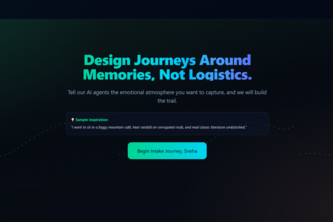
What it appears to be: A travel planning tool that uses AI to generate trip itineraries from emotional or descriptive prompts, rather than traditional destination searches.
What changed: The project is in early development, likely a prototype built for a hackathon. It has no evidence of commercial traction or product-market fit.
Single most important open question: Is there a viable market need for this type of AI-powered travel planning tool, and can it be scaled beyond a hackathon prototype?
What The Product Actually Is
The description states that DreamTrail AI is an application that allows users to describe the kind of trip they want in plain language. It then generates a full itinerary including destination, day-by-day plan, budget breakdown, savings tips, and a pre-trip story in a chosen style. Users can request changes in natural language and later turn their own photos and notes into a post-trip story.
- Functionality: AI-generated trip planning from emotional or descriptive prompts.
- Output: Destination, day-by-day itinerary, budget breakdown with savings tips, pre-trip story, post-trip photo story.
- User interaction: Natural language input for trip description, changes, and feedback.
- Technology stack: Frontend (React + TypeScript + Vite + Tailwind), backend (Python + FastAPI + Pydantic), AI (Google Gemini).
Not evidenced: No data on actual user adoption, usage frequency, or product performance beyond the prototype stage.
Positioning & Claim Evolution
The project’s positioning is that it starts from a feeling rather than a destination — for example, “I want to feel calm” or “I want an adventure.” It claims to turn emotional wishes into usable trip plans.
- Core claim: Travel planning based on emotion and intent, not just location.
- Evolution of the idea: Started as a hackathon project with a focus on end-to-end flow from prompt to story. The team notes they shipped a post-trip photo story feature, which was initially a stretch goal.
- Narrative: The product is positioned as an emotional travel companion that simplifies planning by focusing on user feelings.
Inference: The positioning suggests a niche in the travel market where users want more personalized or experiential planning. However, this is not validated by any external data.
Target Customer & ICP
The description does not clearly define a specific customer segment or ideal customer profile (ICP). It implies that users are people who want to plan trips based on feelings rather than destinations.
- Implicit target: Travelers who value emotional or experiential planning.
- User persona: Someone who doesn’t know where they want to go but knows how they want to feel during the trip.
- Not evidenced: No explicit segmentation, demographics, or behavioral data about users.
Inference: The product may appeal to younger, tech-savvy travelers or those seeking unique experiences. However, this is speculative without evidence of actual user behavior or market research.
Business Model & Pricing Evidence
The description does not provide any information on pricing, monetization, or business model.
- Monetization: Not stated.
- Pricing structure: Not stated.
- Revenue streams: Not stated.
Not evidenced: No evidence of a business model, pricing strategy, or revenue generation mechanism.
Technical & Delivery Signals
The team built the product using a modern stack: React + TypeScript + Vite for frontend and Python + FastAPI + Pydantic for backend. AI is powered by Google Gemini, with structured output validation to ensure reliability.
- Tech stack: React + TypeScript + Vite (frontend), Python + FastAPI + Pydantic (backend), Google Gemini (AI).
- Validation approach: Structured JSON output and strict validation of AI responses.
- Challenges addressed: AI output consistency, endpoint mismatches, photo upload handling.
- Testing practices: Emphasis on clear contracts between frontend and backend, and testing each endpoint.
Inference: The team shows technical competence in building a full-stack product with AI integration. However, this is based on a hackathon prototype, not production-grade delivery.
Traction & Maturity Signals
The project was submitted to the OpenAI 2026 hackathon and is described as a prototype built in a short timeframe.
- Maturity: Prototype-level, likely built for a hackathon.
- Traction: Not evidenced. No user base, revenue, or adoption metrics.
- Product development stage: Early-stage, with features like post-trip story and budget trade-offs shipped as part of the core flow.
Not evidenced: No evidence of real-world usage, customer feedback, or product-market fit beyond the hackathon submission.
Competitive Context
The description does not mention competitors or how DreamTrail AI fits into the existing travel planning market.
- Competitive landscape: Not described.
- Differentiation: The emotional or feeling-based approach is a stated differentiator.
- Market positioning: Not clear in relation to existing travel apps or platforms.
Not evidenced: No competitive analysis, market size, or positioning relative to other tools.
Open Questions & Risks
Several risks and open questions are evident from the self-reported description:
- Unproven market demand: No evidence of user need or adoption.
- Prototype-only development: The product is described as a hackathon prototype with no commercial traction.
- AI reliability concerns: Despite validation efforts, AI output consistency remains a challenge.
- Scalability: No mention of how the product would scale beyond a small team or prototype.
- Business model uncertainty: No indication of monetization strategy.
Inference: The project lacks commercial viability without further development and market testing.
Questions the description leaves open
- What specific user feedback have you received, if any, on the emotional trip planning concept?
- How do you plan to validate demand for this type of product in the real world?
- What is your strategy for monetization and pricing?
- Have you tested the AI output reliability with real users or at scale?
- What are the technical challenges you expect to face when scaling beyond a prototype?
- Are there any legal or privacy considerations related to storing user photos and trip data?
Overall Assessment
The project is in an early, unproven stage — a hackathon prototype with no evidence of traction, revenue, or customer adoption.
- Investment potential: Low, unless the team demonstrates clear market validation and product-market fit.
- Partnership opportunity: Limited, as there is no commercial readiness or established user base.
- Next steps: If the founders are planning to iterate beyond the prototype, they should focus on early user testing, validating demand, and building a sustainable business model.
Not evidenced: No data on market size, customer validation, or financials. The project remains unproven in terms of commercial viability.
User Stories BotA demo video on every pull request
Get a demo video on every new feature
GitHub App that watches your pull requests and records a narrated, captioned demo.
Save time on demo prep and make informed decisions faster with a video walkthrough of every new feature.
Source
Submitted to the OpenAI 2026 hackathon on Devpost. Project home on Devpost. Back to the full gallery on Devpost.
This competitive analysis was produced by top-founders.com (opens in a new tab)
Generated by a language model from this project's public Devpost page — its tagline, the author's own write-up and any built-with tags listed there — as captured in August 2026. Short quotations are the author's words. It is an opinion on the idea as a business, not on the people behind it, and it reflects the description as published then. If the project has moved on, request a correction below. The analysis is not independent research and contains no verified traction, revenue or customer data.
An independent guide by KFG International LLC — not affiliated with, endorsed by, or connected to Devpost or OpenAI.