

Archive position — measured, not model output
0 likes on Devpost
2,263 of the 7,850 archived projects have more likes, and 5,587 share exactly 0 — so this project's #3,929 place in the like-ranked listing is a tie-break inside that group, not a ranking.
Projects (log scale)
Likes on Devpost. ▲ marks this project's group.
Show the figures
| Likes | Projects | Share of archive |
|---|---|---|
| 0 | 5,587 | 71.2% |
| 1 | 1,758 | 22.4% |
| 2 | 284 | 3.6% |
| 3–4 | 132 | 1.7% |
| 5–9 | 75 | 1.0% |
| 10+ | 14 | 0.2% |
 User Stories BotA demo video on every pull request
Get a demo video on every new feature
GitHub App that watches your pull requests and records a narrated, captioned demo.
Save time on demo prep and make informed decisions faster with a video walkthrough of every new feature.
Executive Summary
What the company appears to be
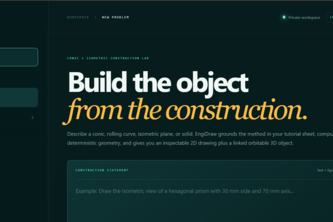
EngiDraw- Drawing Studio is a self-reported engineering-drawing assistant that takes text or image prompts and produces step-by-step 2D SVG constructions and interactive 3D models. It uses a multimodal neuro-symbolic pipeline, with GPT-5.6 interpreting input and a deterministic geometry kernel generating verified output.
What changed
The project description is a single self-reported submission to an OpenAI hackathon. There is no evidence of prior development, funding, traction or commercial activity beyond the author’s own account.
Single most important open question
Is there any evidence that this product has been used by students or educators in real-world settings, or whether it has achieved any adoption or feedback from users outside the author?
What The Product Actually Is
The description states that EngiDraw is a multimodal neuro-symbolic pipeline for engineering drawing. It takes input as text or image and produces:
- Step-by-step 2D construction drawings (SVG)
- An orbitable, animated 3D view of the same object on canvas
- Dimensions, axes, hidden lines, centre lines, and construction guides
- Conic and cycloidal curves with tangent/normal construction
- Isometric views, scale, planes, circles, prisms, pyramids, cylinders, cones, frustums, and composite solids
- Orthographic-to-isometric reconstruction for complex profiles
- Export formats: SVG, PNG, JSON
The system is described as not using a language model to draw geometry directly. Instead, GPT-5.6 interprets the prompt or image and returns a structured geometry spec, which is then processed by a deterministic kernel in the browser.
Inference The product appears to be a prototype or proof-of-concept tool built for an academic hackathon, not a commercial offering.
Positioning & Claim Evolution
The author claims that EngiDraw was inspired by personal struggle with engineering drawing and aims to turn confusing drawing questions into inspectable, verifiable constructions rather than black-box images.
It positions itself as a tool that helps students understand geometry through interactive visualizations. The description emphasizes:
- A structured, educational approach
- Transparency in how output is generated (via GPT + deterministic kernel)
- Verification gate to avoid overconfidence on ambiguous inputs
The claim evolution shows a shift from a personal problem-solving tool to a broader educational assistant — but no evidence of market testing or user feedback beyond the author’s own experience.
Inference The positioning reflects an academic or student-focused intent, not a commercial one.
Target Customer & ICP
The description states that the inspiration came from first-semester engineering students struggling with drawing problems. It is implied that the primary users are:
- Engineering students
- Educators teaching engineering drawing
- Possibly instructors looking for tools to demonstrate concepts or assess student work
There is no mention of enterprise customers, professional engineers, or commercial use cases.
Inference The ICP appears to be undergraduate-level engineering students and educators, but this is not explicitly defined.
Business Model & Pricing Evidence
No evidence of a business model or pricing structure is provided. The description does not state whether the tool will be offered as:
- A freemium SaaS product
- A one-time purchase
- An educational licensing model
- A free tool with optional paid features
There is no mention of monetization, subscriptions, or revenue streams.
Inference No business model or pricing evidence exists in the description.
Technical & Delivery Signals
The system uses:
- GPT-5.6 for interpretation (server-side)
- Deterministic geometry kernel in browser
- OpenCV.js for image processing (not final output)
- Canvas and SVG for rendering 2D and 3D views
- Multimodal AI pipeline: text + image input
- Neuro-symbolic architecture: symbolic verification of geometric output
It is described as a local application with fallbacks when API keys are not present.
Inference The technical stack suggests a hybrid approach combining LLM interpretation and deterministic geometry, which may be novel for this domain but lacks evidence of production deployment or scalability.
Traction & Maturity Signals
There is no evidence of traction, customers, or adoption. The project is described as:
- A hackathon submission
- Built by a single person (team size: 0)
- Not yet monetized or deployed in any real-world setting
No data on usage, user feedback, or product maturity beyond the author’s own account.
Inference No traction or maturity signals are evident.
Competitive Context
The description does not mention competitors. However, it implies a niche in engineering education tools, where similar products may include:
- CAD software (e.g., AutoCAD, SolidWorks)
- Educational platforms for engineering drawing
- AI-powered tutoring systems
It is unclear whether EngiDraw competes with any existing tools or fills a gap in the market.
Inference No competitive landscape is described; no evidence of prior products or market positioning.
Open Questions & Risks
- No commercial traction or adoption: The tool is a hackathon submission, not a product in use.
- Unverified claims: All assertions are self-reported and uncorroborated.
- Single-person team: No evidence of development team or support structure.
- No pricing or monetization model: Unclear how the product would be sold or funded.
- Limited scope: The system is described as a prototype, not a full solution.
Inference High risk due to lack of real-world validation and commercial viability.
Questions the description leaves open
- What was the actual user feedback during the hackathon?
- Has this tool been tested with students or educators outside of your own experience?
- Are there any plans for monetization, and how will it be priced?
- How is the deterministic geometry kernel validated or tested?
- What are the technical limitations of the current prototype that would need to be addressed before commercial release?
- Is there a plan to scale beyond the current scope (e.g., more drawing types, export formats)?
- What is the long-term vision for this product — is it intended as an educational tool or a professional-grade solution?
Overall Assessment
Not evidenced.
There is no evidence of revenue, customers, traction, or commercial readiness to support any investment or partnership decision.
The project is described as a self-reported hackathon prototype, built by a single individual with no team, funding, or market validation.
Inference The product is in an early stage and not suitable for investment or partnership at this time. Any future value would depend on further development, user testing, and commercial execution — none of which are evident in the description.
User Stories BotA demo video on every pull request
Get a demo video on every new feature
GitHub App that watches your pull requests and records a narrated, captioned demo.
Save time on demo prep and make informed decisions faster with a video walkthrough of every new feature.
Source
Submitted to the OpenAI 2026 hackathon on Devpost. Project home on Devpost. Back to the full gallery on Devpost.
This competitive analysis was produced by top-founders.com (opens in a new tab)
Generated by a language model from this project's public Devpost page — its tagline, the author's own write-up and any built-with tags listed there — as captured in August 2026. Short quotations are the author's words. It is an opinion on the idea as a business, not on the people behind it, and it reflects the description as published then. If the project has moved on, request a correction below. The analysis is not independent research and contains no verified traction, revenue or customer data.
An independent guide by KFG International LLC — not affiliated with, endorsed by, or connected to Devpost or OpenAI.