

Archive position — measured, not model output
0 likes on Devpost
2,263 of the 7,850 archived projects have more likes, and 5,587 share exactly 0 — so this project's #3,775 place in the like-ranked listing is a tie-break inside that group, not a ranking.
Projects (log scale)
Likes on Devpost. ▲ marks this project's group.
Show the figures
| Likes | Projects | Share of archive |
|---|---|---|
| 0 | 5,587 | 71.2% |
| 1 | 1,758 | 22.4% |
| 2 | 284 | 3.6% |
| 3–4 | 132 | 1.7% |
| 5–9 | 75 | 1.0% |
| 10+ | 14 | 0.2% |
 User Stories BotA demo video on every pull request
Get a demo video on every new feature
GitHub App that watches your pull requests and records a narrated, captioned demo.
Save time on demo prep and make informed decisions faster with a video walkthrough of every new feature.
Executive Summary
What the company appears to be
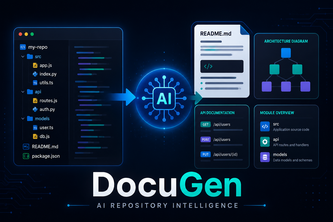
DocuGen — AI Repository Intelligence is a self-reported tool that claims to automatically generate documentation for software repositories using AI. The author states it can process ZIP files or Git URLs, and produce READMEs, architecture diagrams (in Mermaid format), folder/file docs, and API references.
What changed
The project was submitted as part of the OpenAI 2026 hackathon. It is described as a proof-of-concept MVP built by one developer using FastAPI, Next.js, and AI models like OpenAI, Anthropic, and Ollama.
Single most important open question
Is there any evidence of real-world usage or traction beyond the author's own testing? The description contains no data on customers, revenue, adoption, or product-market fit.
What The Product Actually Is
The description states that DocuGen:
- Accepts either a ZIP file upload or a Git URL
- Analyzes repository structure and identifies programming languages/frameworks
- Uses AI to generate documentation including:
- README file
- Architecture.md with Mermaid diagram
- Folder/file-level documentation
- Structured API reference
- Stores generated docs, allows semantic search (not evidenced), and exports in HTML, PDF, or ZIP formats
- Supports user-provided API keys via a BYOK settings page
- Is built with FastAPI backend, Next.js frontend, and uses AI providers like OpenAI, Anthropic, Ollama
Inference It appears to be an MVP tool for developers who want to quickly understand unfamiliar codebases through automated documentation generation.
Positioning & Claim Evolution
The author states:
- Inspiration came from personal frustration with outdated or missing repository documentation
- The goal was to explore whether AI could automate documentation creation
- DocuGen is positioned as a solution to “no more stale documentation”
Inference This is a self-reported product positioning focused on developer experience and codebase understanding. It does not indicate any commercial intent, market traction, or competitive differentiation beyond the author’s own use case.
Target Customer & ICP
The description states:
- The tool targets developers who encounter repositories with poor or missing documentation
- It is designed to help users understand unfamiliar codebases quickly
Inference The target customer appears to be individual developers or small teams working on open-source or internal projects where documentation lags behind implementation.
Business Model & Pricing Evidence
Not evidenced. The description does not mention:
- Revenue streams
- Pricing plans
- Monetization strategy
- Subscription model
- Freemium vs paid tiers
Inference No business model is described beyond the author’s own use case and MVP development.
Technical & Delivery Signals
The description states:
- Built with FastAPI, Next.js, SQLAlchemy, Docker, GitPython, Mermaid.js, Pydantic, React, TypeScript
- Uses AI providers: OpenAI, Anthropic, Ollama
- Implements a provider-agnostic AI layer
- Includes encryption for API keys (BYOK)
- Used Claude to plan and review code, Codex for implementation
- Has integration tests to prevent bugs
Inference The tool is technically feasible and shows some engineering sophistication. However, no evidence of production deployment or scalability.
Traction & Maturity Signals
Not evidenced. The description does not contain:
- Customer base
- Usage metrics
- Revenue data
- Product adoption
- Market feedback
- User engagement
Inference The project is described as an MVP submitted to a hackathon, with no indication of real-world usage or traction.
Competitive Context
Not evidenced. The description does not mention:
- Competitors
- Market landscape
- Differentiation from existing tools
- Prior art in repository documentation automation
Inference No competitive positioning is evident beyond the author’s own stated goals.
Open Questions & Risks
- No traction or revenue: The project is described as a hackathon MVP with no evidence of real-world use.
- Single developer team: Only one member listed, which may limit scalability and long-term development.
- Unverified claims: All features are self-reported without external validation.
- Technical challenges noted: The author mentions significant issues during development (e.g., database model errors) that were not resolved in the final version.
- No commercialization plan: No mention of monetization, partnerships, or go-to-market strategy.
Questions the description leaves open
- What is your actual use case for this tool? Is it a personal project or intended for broader adoption?
- Have you tested DocuGen with real repositories from users outside your own development environment?
- Are there any plans to monetize the product, and if so, what pricing model are you considering?
- How do you plan to scale beyond a single developer team?
- What is the current technical architecture, and how does it handle large or complex repositories?
- Have you considered integrating with existing platforms like GitHub, GitLab, or Bitbucket?
Overall Assessment
Not evidenced.
Confidence Level Low This is a self-reported MVP submitted to a hackathon with no evidence of traction, revenue, or commercial viability. The author’s own description indicates this is an experimental tool built for personal use rather than a scalable business.
Assessment There is insufficient evidence to support investment or partnership interest at this time. Further due diligence would require proof of usage, customer feedback, and product-market fit beyond the author's own testing.
User Stories BotA demo video on every pull request
Get a demo video on every new feature
GitHub App that watches your pull requests and records a narrated, captioned demo.
Save time on demo prep and make informed decisions faster with a video walkthrough of every new feature.
Source
Submitted to the OpenAI 2026 hackathon on Devpost. Project home on Devpost. Back to the full gallery on Devpost.
This competitive analysis was produced by top-founders.com (opens in a new tab)
Generated by a language model from this project's public Devpost page — its tagline, the author's own write-up and any built-with tags listed there — as captured in August 2026. Short quotations are the author's words. It is an opinion on the idea as a business, not on the people behind it, and it reflects the description as published then. If the project has moved on, request a correction below. The analysis is not independent research and contains no verified traction, revenue or customer data.
An independent guide by KFG International LLC — not affiliated with, endorsed by, or connected to Devpost or OpenAI.