

Archive position — measured, not model output
0 likes on Devpost
2,263 of the 7,850 archived projects have more likes, and 5,587 share exactly 0 — so this project's #7,701 place in the like-ranked listing is a tie-break inside that group, not a ranking.
Projects (log scale)
Likes on Devpost. ▲ marks this project's group.
Show the figures
| Likes | Projects | Share of archive |
|---|---|---|
| 0 | 5,587 | 71.2% |
| 1 | 1,758 | 22.4% |
| 2 | 284 | 3.6% |
| 3–4 | 132 | 1.7% |
| 5–9 | 75 | 1.0% |
| 10+ | 14 | 0.2% |
 User Stories BotA demo video on every pull request
Get a demo video on every new feature
GitHub App that watches your pull requests and records a narrated, captioned demo.
Save time on demo prep and make informed decisions faster with a video walkthrough of every new feature.
Executive Summary
What the company appears to be
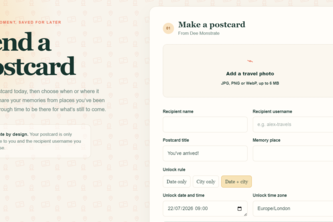
Wish You Were is a self-reported social media travel app for all generations, built by one developer (Abigail Bailey) using AI tools like Codex and GPT-5.6. It allows users to send digital postcards that unlock either at a specific date/time or when the recipient reaches a certain location. The app includes features such as a postcard builder, quest builder, memory box, and memory map.
What changed
The project was submitted as part of an OpenAI 2026 hackathon. It is described as a personal experiment to explore how AI could be used to realize a meaningful idea without losing authenticity. The author states that the app was built quickly with minimal coding experience.
Single most important open question — the commercial due-diligence read
Is there any evidence of user adoption, revenue, or traction beyond the author’s own account? There is no indication of customers, usage metrics, monetization, or product-market fit beyond self-reported claims.
What The Product Actually Is
The description states that Wish You Were is a social media travel app for all generations. It enables users to send digital postcards which unlock either at a given date/time or when the recipient reaches a specific destination. Features include:
- Postcard builder: Users can choose date, location (or both), write messages, format text, and select stamp options.
- Quest builder: Allows senders to create gamified challenges for recipients during travel.
- Memory box: A place to view sent/received postcards, with real-time unlock updates.
- Memory map: Displays a live OpenStreetMap of locations where users have sent or received postcards.
The app is built using Next.js, React, TypeScript, Tailwind CSS, Supabase, and Vercel. AI tools (Codex and GPT-5.6) were used for scaffolding, refactoring, database design, error diagnosis, and interface improvements.
Note
The author describes the product as a personal experiment and not yet fully realized in terms of user engagement or monetization.
Positioning & Claim Evolution
The description states that Wish You Were is “a social media travel app for all generations” and aims to turn distance into meaningful shared memories. It positions itself around:
- Intergenerational connection through travel experiences.
- Gamification via quest features.
- Digital postcards as a way to preserve memories across time and space.
The author also mentions the inspiration behind the idea — exploring places with loved ones, sharing stories, and capturing moments together even when physically apart. This suggests an emotional positioning focused on nostalgia, family bonds, and travel storytelling.
Inference The app may be positioned as a tool for emotional connection rather than pure utility or entertainment. However, this is not backed by any evidence of user behavior or feedback.
Target Customer & ICP
The description states that the app targets “all generations” and aims to help users share travel experiences with family members who live far away. The core use case involves:
- Sending digital postcards between family members.
- Creating quests for travelers to complete during trips.
- Preserving memories in a shared digital space.
There is no evidence of segmentation beyond generational appeal or familial relationships. No specific personas, user types, or demographic breakdowns are mentioned.
Not evidenced No clear ICP defined; no indication of who the primary users are beyond “family” or “travelers.”
Business Model & Pricing Evidence
The description does not contain any information about pricing models, monetization strategies, or business models. The author only describes the features and technical implementation.
Not evidenced No evidence of revenue streams, pricing plans, subscriptions, or commercial viability.
Technical & Delivery Signals
The app is built with modern web technologies including:
- Framework: Next.js, React
- Language: TypeScript
- Styling: Tailwind CSS
- Backend: Supabase (PostgreSQL, authentication, image storage, scheduled jobs)
- Map integration: Leaflet and OpenStreetMap
- AI tools used: Codex, GPT-5.6
The author notes that the app was built with minimal coding experience using AI assistance for scaffolding, refactoring, and debugging.
Inference The technical stack suggests a scalable, modern SaaS-like architecture. However, there is no evidence of production deployment or performance data.
Traction & Maturity Signals
The project was submitted to the OpenAI 2026 hackathon. The author describes it as a personal experiment and a prototype built in a short timeframe. There is no mention of:
- Users
- Customer acquisition
- Revenue
- Product-market fit
- Iteration history or feedback loops
- Deployment status (e.g., live domain, public access)
Not evidenced No traction or maturity indicators beyond the initial build.
Competitive Context
The description does not reference any competitors. It is unclear whether similar products exist in the market for digital postcards, location-based sharing, or intergenerational travel storytelling.
Not evidenced No competitive landscape analysis provided.
Open Questions & Risks
- Single-founder model: Only one team member (Abigail Bailey) is listed.
- No revenue or traction evidence: The app has not been deployed for public use or monetized.
- Unverified claims: All descriptions are self-reported and unverified.
- AI dependency: Heavy reliance on AI tools raises questions about scalability, control, and long-term maintainability.
- Privacy concerns: While privacy features are mentioned, no details are given on how they are implemented or tested.
Inference The lack of independent validation makes it difficult to assess the viability or sustainability of this concept.
Questions the description leaves open
- What is your plan for user acquisition and retention?
- Have you conducted any user testing or gathered feedback from potential users?
- How do you intend to monetize the platform?
- Are there plans to expand beyond the current feature set (e.g., quests, memory maps)?
- What are the key privacy and security measures in place for location-based unlocking?
- Is there a roadmap for scaling beyond the current prototype?
- How do you plan to differentiate from existing social media or travel apps?
Overall Assessment
This is a self-reported, unverified project built as part of a hackathon. There is no evidence of revenue, customers, traction, or commercial viability.
Assessment Not ready for investment or partnership consideration at this stage. The idea shows potential in emotional storytelling and intergenerational connection but lacks any demonstration of product-market fit or business execution. Further validation through user testing, early adoption, or pilot programs would be required before assessing its readiness for funding or strategic interest.
User Stories BotA demo video on every pull request
Get a demo video on every new feature
GitHub App that watches your pull requests and records a narrated, captioned demo.
Save time on demo prep and make informed decisions faster with a video walkthrough of every new feature.
Source
Submitted to the OpenAI 2026 hackathon on Devpost. Project home on Devpost. Back to the full gallery on Devpost.
This competitive analysis was produced by top-founders.com (opens in a new tab)
Generated by a language model from this project's public Devpost page — its tagline, the author's own write-up and any built-with tags listed there — as captured in August 2026. Short quotations are the author's words. It is an opinion on the idea as a business, not on the people behind it, and it reflects the description as published then. If the project has moved on, request a correction below. The analysis is not independent research and contains no verified traction, revenue or customer data.
An independent guide by KFG International LLC — not affiliated with, endorsed by, or connected to Devpost or OpenAI.