

Archive position — measured, not model output
1 like on Devpost
505 of the 7,850 archived projects have more likes, and 1,758 share exactly 1 — so this project's #957 place in the like-ranked listing is a tie-break inside that group, not a ranking.
Projects (log scale)
Likes on Devpost. ▲ marks this project's group.
Show the figures
| Likes | Projects | Share of archive |
|---|---|---|
| 0 | 5,587 | 71.2% |
| 1 | 1,758 | 22.4% |
| 2 | 284 | 3.6% |
| 3–4 | 132 | 1.7% |
| 5–9 | 75 | 1.0% |
| 10+ | 14 | 0.2% |
 User Stories BotA demo video on every pull request
Get a demo video on every new feature
GitHub App that watches your pull requests and records a narrated, captioned demo.
Save time on demo prep and make informed decisions faster with a video walkthrough of every new feature.
Executive Summary
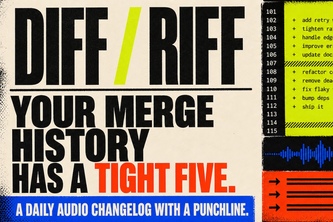
What the company appears to be: Diff Riff is a self-reported tool that generates daily audio changelogs in the form of stand-up comedy routines based on GitHub activity. It is built by a single developer (Ammon Brown) and uses AI tools like GPT-5.6, ElevenLabs, and Cloudflare infrastructure.
What changed: The project was submitted to the OpenAI 2026 hackathon as a proof-of-concept. It is described as a prototype with real integration boundaries, migrations, tests, and deployment paths, but no commercial traction or revenue is evidenced.
Single most important open question: Is there any evidence of user adoption, revenue, or pricing plans beyond the author's self-reported claims?
Analysis basis: This report is based entirely on the self-reported project description provided by the author. No external verification, archived data, or third-party sources are available. All statements reflect the author’s own account and should be treated as unverified claims.
What The Product Actually Is
The description states that Diff Riff:
- Analyzes GitHub history of Pull Requests and Commits.
- Creates color commentary in the form of an audio stand-up routine.
- Sends these routines to a Slack channel chosen by the user.
- Makes them available and shareable on diffriff.com.
It also includes:
- Sources and links to repositories for deeper exploration.
- Uses Cloudflare Workers, Hono, GitHub App + OAuth, Slack OAuth + Block Kit, ElevenLabs TTS, and GPT-5.6 for generation.
Inference: The product is described as a daily audio summary tool that aims to make standups more engaging through humor. It is not a general-purpose changelog generator but specifically targets GitHub activity with comedic delivery.
Positioning & Claim Evolution
The author states:
- The goal is to make standups something people actually pay attention to.
- Comedy is used as a delivery mechanism, not the product itself.
- The tool aims to increase engagement and visibility of work within teams.
Claim: The tool positions itself as a way to improve team communication by making changelogs entertaining.
Inference: This is a novel positioning in B2B SaaS — combining developer productivity with entertainment, though no evidence of traction or adoption exists.
Target Customer & ICP
The description states:
- The tool targets developers and teams using GitHub.
- It sends updates to Slack channels.
- Users can choose which channel to receive the audio changelog.
Claim: The target customer is a developer or team that uses GitHub and Slack.
Inference: There is no evidence of specific personas, segmentation, or targeting beyond this general description.
Business Model & Pricing Evidence
The author states:
- They plan to add pricing at some point.
- Potential models include per repo or per number of Riffs generated.
- AI costs are noted as a factor requiring monetization.
Claim: The business model is expected to involve subscription or usage-based pricing.
Inference: No pricing plans, revenue streams, or monetization strategy have been implemented or evidenced.
Technical & Delivery Signals
The author reports:
- Built with Cloudflare Workers, Hono, Turso/LibSQL, GitHub App + OAuth, Slack OAuth, ElevenLabs TTS.
- Uses GPT-5.6 for structured analysis and writing.
- Includes migrations, tests, staging/production environments, and one-command deploy path.
- Delivers via Slack, web interface, and potentially other platforms (Teams, email, API).
Claim: The technical stack is production-ready with real integration boundaries.
Inference: This is a prototype with infrastructure built for deployment, but no evidence of live usage or scalability.
Traction & Maturity Signals
The description states:
- It was built in a hackathon.
- Includes migrations, tests, and full build/deploy paths.
- Has a one-command deploy process.
- The author is proud of the name and integration design.
Claim: The product has been developed with production-like standards.
Inference: No evidence of users, customers, or adoption beyond the author’s own development.
Competitive Context
The description does not mention any competitors or market positioning relative to others in the space.
Claim: No competitive analysis or market context is provided by the author.
Inference: The project appears to be a standalone idea without reference to existing tools or markets.
Open Questions & Risks
- The product is described as a hackathon submission with no commercial traction.
- Pricing and monetization plans are speculative.
- No evidence of user feedback, retention, or usage metrics.
- Reliance on AI tools like GPT-5.6 and ElevenLabs may pose cost or availability risks.
- The comedic tone may not resonate with all teams or cultures.
Inference: The lack of any revenue, customers, or adoption data raises questions about viability as a commercial product.
Questions the description leaves open
- What is the current status of user feedback or early adopters?
- Has there been any attempt to monetize the tool beyond the stated intention?
- Are there plans for team or enterprise features, and how would they be priced?
- How does the tool handle edge cases in GitHub activity (e.g., large commits, private repos)?
- What are the long-term plans for AI cost management and scalability?
Overall Assessment
The author describes Diff Riff as a prototype built during a hackathon with some production-ready features but no evidence of traction or monetization.
Assessment: Not evidenced.
Confidence level: Low — this is a self-reported, unverified concept with no data on revenue, customers, or adoption. It may be an interesting idea, but there is no commercial due-diligence basis to support investment or partnership at this stage.
User Stories BotA demo video on every pull request
Get a demo video on every new feature
GitHub App that watches your pull requests and records a narrated, captioned demo.
Save time on demo prep and make informed decisions faster with a video walkthrough of every new feature.
Source
Submitted to the OpenAI 2026 hackathon on Devpost. Project home on Devpost. Back to the full gallery on Devpost.
This competitive analysis was produced by top-founders.com (opens in a new tab)
Generated by a language model from this project's public Devpost page — its tagline, the author's own write-up and any built-with tags listed there — as captured in August 2026. Short quotations are the author's words. It is an opinion on the idea as a business, not on the people behind it, and it reflects the description as published then. If the project has moved on, request a correction below. The analysis is not independent research and contains no verified traction, revenue or customer data.
An independent guide by KFG International LLC — not affiliated with, endorsed by, or connected to Devpost or OpenAI.