

Archive position — measured, not model output
0 likes on Devpost
2,263 of the 7,850 archived projects have more likes, and 5,587 share exactly 0 — so this project's #2,920 place in the like-ranked listing is a tie-break inside that group, not a ranking.
Projects (log scale)
Likes on Devpost. ▲ marks this project's group.
Show the figures
| Likes | Projects | Share of archive |
|---|---|---|
| 0 | 5,587 | 71.2% |
| 1 | 1,758 | 22.4% |
| 2 | 284 | 3.6% |
| 3–4 | 132 | 1.7% |
| 5–9 | 75 | 1.0% |
| 10+ | 14 | 0.2% |
 User Stories BotA demo video on every pull request
Get a demo video on every new feature
GitHub App that watches your pull requests and records a narrated, captioned demo.
Save time on demo prep and make informed decisions faster with a video walkthrough of every new feature.
Executive Summary
What the company appears to be
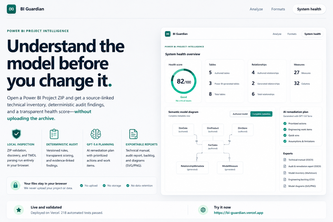
BI Guardian is a self-reported AI-powered quality gate for Power BI projects. The author states it enables teams to audit Power BI semantic models without uploading sensitive data to public AI services, using local parsing and deterministic scoring with optional GPT-5.6 remediation planning.
What changed
The project was submitted as part of the OpenAI 2026 hackathon. It is described as a functional prototype built in a short timeframe, with no evidence of prior traction or commercial deployment beyond its own development.
Single most important open question
Is there any evidence that BI Guardian has been used by teams outside of its own development, or whether it has been adopted for real-world Power BI auditing?
What The Product Actually Is
The description states that BI Guardian is an AI quality gate for Power BI projects. It accepts a ZIP file containing PBIP/TMDL project data and performs local inspection in the browser.
- It parses and validates the archive.
- Separates user-authored objects from Power BI-generated metadata.
- Creates an inventory of tables, columns, measures, and relationships.
- Runs deterministic rulesets against supported metadata.
- Produces a health score with transparent deductions.
- Generates findings with classification, severity, prevalence, and scope.
- Exports audit reports, remediation plans, diagrams, and engineering backlog artifacts.
AI planning is optional and explicit. When requested, GPT-5.6 receives only sanitized aggregate context and representative finding summaries — raw DAX or project files are not sent to the model.
The system is built with Next.js, React, TypeScript, and deployed on Vercel. The OpenAI API key remains server-side.
Inference BI Guardian appears to be a browser-based tool for auditing Power BI models, with a focus on privacy and deterministic scoring before AI involvement.
Positioning & Claim Evolution
The author states that BI Guardian addresses the problem of teams inheriting poorly documented or risky Power BI semantic models. It was built around the question: Can AI help teams improve a Power BI project without receiving the project itself or becoming the source of truth?
Key claims:
- The tool operates locally in the browser.
- It avoids sending sensitive data to public AI services.
- It separates user-authored from generated metadata.
- It uses deterministic scoring and only applies AI for remediation planning.
- It does not rewrite models but helps teams understand, review, and improve them.
Inference The positioning is that of a privacy-preserving, deterministic audit tool with optional AI assistance — not an automated model editor or full-fledged AI assistant.
Target Customer & ICP
The description states that BI Guardian targets Power BI teams who inherit semantic models that are difficult to understand, inconsistently documented, and risky to change. These users likely work in enterprise environments where sensitive data cannot be uploaded to public AI services.
Inference The primary customer is internal Power BI developers or analysts working in organizations with strict data governance policies. The ICP is likely large enterprises or teams managing complex semantic models.
Business Model & Pricing Evidence
Not evidenced.
The description does not mention any pricing, licensing, or monetization strategy. It only describes the tool’s functionality and architecture.
Technical & Delivery Signals
- Built with Next.js, React, TypeScript.
- Uses local browser parsing for inspection.
- Separates three layers: local inspection, deterministic audit, GPT-5.6 remediation planning.
- OpenAI API key is server-side and not exposed to the browser.
- Codex was used during development.
- 218 automated tests pass before deployment.
- Deployed on Vercel.
Inference The architecture is designed with a strong emphasis on privacy, deterministic behavior, and modularity. The use of automated testing suggests attention to quality and maintainability.
Traction & Maturity Signals
Not evidenced.
There is no mention of customers, revenue, usage metrics, or adoption beyond its own development. The project was submitted as a hackathon entry, with no indication of prior commercial traction.
Competitive Context
Not evidenced.
The description does not reference competitors or existing tools in the Power BI auditing or AI-assisted data modeling space.
Open Questions & Risks
- No evidence of real-world usage: The tool is described as a hackathon project with no known adoption.
- Unproven AI integration: While GPT-5.6 is used for remediation planning, there’s no evidence that this has been tested or validated in practice.
- Limited scope: It only supports PBIP/TMDL files and does not yet cover broader Power BI metadata or CI/CD integrations.
- Self-reported maturity: The project is described as a prototype with no commercial deployment or user feedback.
Inference The tool may be too early-stage to assess its real-world utility or scalability. It lacks any evidence of market validation or product-market fit.
Questions the description leaves open
- Has BI Guardian been used by teams outside of the development team?
- What is the current level of support for different PBIP/TMDL features and Power BI versions?
- Are there plans to integrate with CI/CD pipelines or version control systems like GitHub?
- How does the deterministic scoring system handle edge cases or ambiguous model structures?
- What are the specific use cases where teams have found the AI remediation planning most useful?
- Is there any feedback from Power BI users on the accuracy of findings or usefulness of reports?
Overall Assessment
Not evidenced.
There is no evidence of funding, revenue, or commercial traction to assess viability for investment or partnership. The project is described as a hackathon submission with no indication of a business model or market readiness.
Confidence level Low — based on self-reported description only, with no external validation or usage data.
User Stories BotA demo video on every pull request
Get a demo video on every new feature
GitHub App that watches your pull requests and records a narrated, captioned demo.
Save time on demo prep and make informed decisions faster with a video walkthrough of every new feature.
Source
Submitted to the OpenAI 2026 hackathon on Devpost. Project home on Devpost. Back to the full gallery on Devpost.
This competitive analysis was produced by top-founders.com (opens in a new tab)
Generated by a language model from this project's public Devpost page — its tagline, the author's own write-up and any built-with tags listed there — as captured in August 2026. Short quotations are the author's words. It is an opinion on the idea as a business, not on the people behind it, and it reflects the description as published then. If the project has moved on, request a correction below. The analysis is not independent research and contains no verified traction, revenue or customer data.
An independent guide by KFG International LLC — not affiliated with, endorsed by, or connected to Devpost or OpenAI.