

Archive position — measured, not model output
3 likes on Devpost
128 of the 7,850 archived projects have more likes, and 93 share exactly 3 — so this project's #151 place in the like-ranked listing is a tie-break inside that group, not a ranking.
Projects (log scale)
Likes on Devpost. ▲ marks this project's group.
Show the figures
| Likes | Projects | Share of archive |
|---|---|---|
| 0 | 5,587 | 71.2% |
| 1 | 1,758 | 22.4% |
| 2 | 284 | 3.6% |
| 3–4 | 132 | 1.7% |
| 5–9 | 75 | 1.0% |
| 10+ | 14 | 0.2% |
 User Stories BotA demo video on every pull request
Get a demo video on every new feature
GitHub App that watches your pull requests and records a narrated, captioned demo.
Save time on demo prep and make informed decisions faster with a video walkthrough of every new feature.
Executive Summary
What the company appears to be
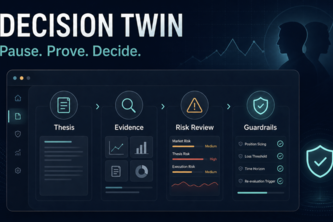
Decision_Twin is a local-first AI decision workspace for investors, designed to help them turn impulsive trade ideas into evidence-backed, risk-aware theses before money is at risk. It is not a stock picker or auto-trading tool.
What changed
The project was submitted as part of the OpenAI 2026 hackathon. It represents an early-stage prototype built by a team of three (yue bei, Raj Roy, angelacui24601 Cui), using a lightweight local web app architecture with Python and static frontend technologies.
Single most important open question
Is there evidence that users will adopt this tool in practice, or does it remain a proof-of-concept without commercial traction?
What The Product Actually Is
The description states that Decision_Twin is a local-first research and pre-trade review workspace for US and Hong Kong equities. It allows users to record their thesis, position size, evidence, catalyst, downside scenario, and invalidation conditions.
It pulls public market data from no-key sources (e.g., Finnhub, SEC Edgar) and displays source and timestamp. The system evaluates these inputs using deterministic code for stress scenarios, data freshness checks, and risk rules, returning a research status such as Blocked, Needs Evidence, Conditionally Passed, or Invalidated.
GPT-5.6 is optional and acts as a reasoning assistant to help separate facts from assumptions, point out gaps in evidence, and suggest research questions — but never overrides risk rules, sends orders, or provides financial advice.
The app stores all data locally as JSON files, ensuring privacy by default. It uses a Python standard-library server with a static HTML/CSS/JS interface, built without any brokerage connection or account access.
Evidence
- The product is described as a local-first web app.
- Data comes from no-key sources like Finnhub and SEC Edgar.
- It evaluates inputs via deterministic logic.
- GPT-5.6 is optional and acts only as an assistant.
- No trading or brokerage integration is included.
- Local storage of data in JSON format.
Inference The product is a lightweight, self-contained tool for pre-trade decision-making, not a full-fledged investment platform.
Positioning & Claim Evolution
The description states that most poor trading decisions begin with an untested story — a rumor, narrative, or loss recovery urge — rather than lack of information. Decision_Twin aims to slow down the decision process before money is at risk.
It positions itself not as a stock picker or auto-trader, but as a tool to help investors turn “I think this will go up” into a structured claim with evidence and downside scenarios.
The product does not pretend uncertainty has disappeared; instead, it blocks trades when core elements are missing. It also works without an API key for GPT, meaning the core safety workflow is independent of AI.
Evidence
- The product is positioned to slow down impulsive decisions.
- It focuses on pre-trade review and evidence-based thesis building.
- It does not provide financial advice or auto-trading capabilities.
- Core functionality works without GPT API access.
Inference The positioning reflects a focus on discipline over prediction, with an emphasis on reducing risk through structured thinking.
Target Customer & ICP
The description states that Decision_Twin is intended for investors, specifically those who trade US and Hong Kong equities. It targets users looking to improve their decision-making process by turning impulsive ideas into evidence-backed theses before executing trades.
It does not appear to target retail investors broadly, but rather those with some experience in investing and a need for structured pre-trade workflows.
Evidence
- The tool is built for US and Hong Kong equity traders.
- It helps users build risk-aware theses.
- No mention of general public or beginner users.
Inference The ICP likely includes experienced investors who want to reduce emotional bias in their trading decisions, but not necessarily novice users.
Business Model & Pricing Evidence
There is no evidence provided about a business model or pricing structure. The description does not indicate whether the tool will be offered for free, sold as a SaaS product, or monetized through other means.
Evidence
- No mention of pricing.
- No indication of monetization strategy.
- No revenue streams described.
Inference The business model remains unknown and unproven. The project is currently a hackathon submission with no commercial traction.
Technical & Delivery Signals
Decision_Twin was built as a lightweight local web app, using:
- Python standard-library server
- Static HTML, CSS, JavaScript interface
- No-key data sources (Finnhub, SEC Edgar)
- Deterministic code for research admission and stress calculations
- Optional GPT-5.6 integration
The system stores all user data locally as JSON files, ensuring privacy by default. It includes automated tests and a reproducible setup.
Evidence
- Built with Next.js, React, Tailwind, TypeScript, Spring Boot, Python.
- Uses no-key market data sources.
- Local storage of research records and settings.
- Deterministic logic for risk evaluation.
- Optional GPT integration.
- Reproducible local project with tests.
Inference The technical stack suggests a minimal viable product (MVP) focused on privacy and reproducibility. The architecture avoids cloud dependencies or complex integrations.
Traction & Maturity Signals
There is no evidence of traction, customers, or adoption beyond the hackathon submission. No revenue, user base, or usage metrics are mentioned.
The project is described as a prototype built for a hackathon, with no indication that it has moved beyond this stage.
Evidence
- Submitted to OpenAI 2026 hackathon.
- No mention of users, customers, or adoption.
- No revenue data or growth indicators.
Inference The product is in early development and lacks any commercial traction or user validation.
Competitive Context
There is no evidence provided about competitors, their offerings, or market positioning. The description does not reference existing tools for pre-trade decision-making or investor research.
Evidence
- No mention of competitors.
- No comparison to other platforms or tools in the space.
Inference The competitive landscape is unknown and unassessed based on the provided information.
Open Questions & Risks
Several key risks and open questions are present:
- No commercial traction: The product exists only as a hackathon submission with no evidence of adoption or revenue.
- Limited scope: It supports only US and Hong Kong equities, limiting its market reach.
- AI dependency risk: While GPT-5.6 is optional, its inclusion raises questions about how the tool will scale without it.
- Local-first design may limit scalability: Storing data locally could hinder broader adoption or collaboration features.
- No monetization strategy: No indication of how the product will generate revenue.
Evidence
- No users, customers, or revenue.
- Only US and Hong Kong equity support.
- Optional AI integration.
- Local storage only.
- No business model described.
Inference The tool is a prototype with no clear path to commercial viability or scalability.
Questions the description leaves open
- What is the intended user acquisition strategy beyond the hackathon?
- How do you plan to monetize this product, if at all?
- Are there any plans to expand beyond US and Hong Kong equities?
- What are the key assumptions underlying the risk evaluation logic?
- How will you handle data quality issues from no-key sources?
- Has there been any user feedback or testing outside of the hackathon?
- What is the long-term vision for AI integration, especially if GPT-5.6 becomes unavailable?
Overall Assessment
Not evidenced: There is no evidence of revenue, customers, or commercial traction to support an investment or partnership decision.
The project is a hackathon prototype, built by a small team with limited scope and no demonstrated path to monetization or user adoption. While the concept shows promise in addressing a real problem (impulsive trading), there is no indication that it has progressed beyond the idea stage.
Confidence level: Low — based entirely on self-reported, unverified information.
Assessment Not ready for investment or partnership consideration at this time. The project requires further development, user testing, and commercial validation before any strategic move can be justified.
User Stories BotA demo video on every pull request
Get a demo video on every new feature
GitHub App that watches your pull requests and records a narrated, captioned demo.
Save time on demo prep and make informed decisions faster with a video walkthrough of every new feature.
Source
Submitted to the OpenAI 2026 hackathon on Devpost. Project home on Devpost. Back to the full gallery on Devpost.
This competitive analysis was produced by top-founders.com (opens in a new tab)
Generated by a language model from this project's public Devpost page — its tagline, the author's own write-up and any built-with tags listed there — as captured in August 2026. Short quotations are the author's words. It is an opinion on the idea as a business, not on the people behind it, and it reflects the description as published then. If the project has moved on, request a correction below. The analysis is not independent research and contains no verified traction, revenue or customer data.
An independent guide by KFG International LLC — not affiliated with, endorsed by, or connected to Devpost or OpenAI.