

Archive position — measured, not model output
1 like on Devpost
505 of the 7,850 archived projects have more likes, and 1,758 share exactly 1 — so this project's #938 place in the like-ranked listing is a tie-break inside that group, not a ranking.
Projects (log scale)
Likes on Devpost. ▲ marks this project's group.
Show the figures
| Likes | Projects | Share of archive |
|---|---|---|
| 0 | 5,587 | 71.2% |
| 1 | 1,758 | 22.4% |
| 2 | 284 | 3.6% |
| 3–4 | 132 | 1.7% |
| 5–9 | 75 | 1.0% |
| 10+ | 14 | 0.2% |
 User Stories BotA demo video on every pull request
Get a demo video on every new feature
GitHub App that watches your pull requests and records a narrated, captioned demo.
Save time on demo prep and make informed decisions faster with a video walkthrough of every new feature.
Executive Summary
What the company appears to be
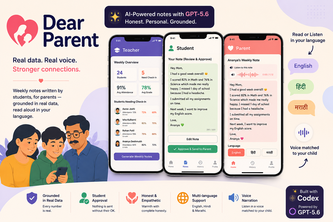
Dear Parent is a self-reported mobile app built for teachers, students, and parents in multilingual educational environments. The app allows teachers to upload student data (grades, attendance, assignments) via CSV, which then triggers AI-generated weekly notes written in the student's voice. Students review and approve these notes before they are sent home. Parents can read or listen to the note in English, Hindi, or Marathi, with numbers preserved exactly.
What changed
The project is a self-reported hackathon submission (Devpost entry) for the OpenAI 2026 hackathon. It was built using GPT-5.6 and React Native, with no evidence of prior traction, revenue, or customer adoption.
Single most important open question
Is there any evidence that this product has been used in real classrooms or by actual schools? The description states it is a hackathon project, but the authors claim it addresses a real educational communication gap — yet no real-world usage or feedback is provided.
What The Product Actually Is
The description states:
- Dear Parent is a three-role mobile app for teachers, students, and parents.
- Teachers upload CSV data (grades, attendance, assignments) to generate notes.
- Students review and approve the AI-generated note before it reaches parents.
- Parents can read or listen to the note in English, Hindi, or Marathi.
- The system uses GPT-5.6 for note generation and translation.
- It includes fallback mechanisms using a hand-written offline composer if API calls fail.
Inference The app is built as a mobile application using React Native, Expo, and TypeScript, with integration of OpenAI’s GPT-5.6 and text-to-speech (TTS) capabilities for multilingual support.
Positioning & Claim Evolution
The description states:
- The app aims to close the gap between report card scores and real student stories.
- It seeks to improve communication by letting students explain their own week in their own voice.
- It addresses access issues for parents who are more comfortable in Hindi or Marathi than English.
Inference The positioning is centered on empathy, transparency, and accessibility in educational communication — not just a dashboard but a narrative tool that empowers students to share their experiences.
Target Customer & ICP
The description states:
- Teachers upload data.
- Students review and approve notes.
- Parents read or listen to the note.
Inference The primary ICP appears to be multilingual schools or educational institutions where parents speak Hindi or Marathi, and where teachers want to communicate more meaningfully with students and families.
Business Model & Pricing Evidence
Not evidenced.
Explanation
There is no mention of pricing, monetization, or business model in the description. The project is described as a hackathon submission with no indication of commercial intent or revenue streams.
Technical & Delivery Signals
The description states:
- Built using React Native, Expo, TypeScript, and GPT-5.6.
- Uses Codex for development.
- Includes fallback to offline composer if API fails.
- Supports CSV import and multilingual TTS (English, Hindi, Marathi).
- Handles file picker issues on Android and voice gender matching.
Inference The technical stack is standard for a mobile app with AI integration. The app includes robust fallbacks, suggesting attention to reliability in real-world use cases.
Traction & Maturity Signals
Not evidenced.
Explanation
There is no evidence of users, customers, or adoption beyond the hackathon submission. No data on usage, retention, or feedback from teachers, students, or parents is provided.
Competitive Context
Not evidenced.
Explanation
The description does not mention competitors or similar products in the education or communication space. No market positioning or competitive differentiation is stated.
Open Questions & Risks
- Unverified claims: The app is described as solving a real problem, but there’s no evidence of real-world usage or impact.
- No commercial traction: It's a hackathon project with no revenue, customers, or business model.
- AI dependency: Heavy reliance on GPT-5.6 and API keys raises concerns about scalability and control without backend infrastructure.
- Limited scope: The app is described as focused on one specific use case (weekly notes) with no indication of future expansion.
Questions the description leaves open
- Has this app been tested in any real classrooms or schools?
- What is the plan for handling data privacy and compliance (e.g., FERPA, GDPR)?
- How does the team intend to scale beyond a single developer?
- Are there plans to move away from client-side API keys to a backend solution?
- Has the student approval step been validated with actual students or parents?
Overall Assessment
Not evidenced.
Explanation
There is no evidence of revenue, customers, or traction to support an investment or partnership decision. The project is described as a hackathon submission and lacks any commercial maturity indicators. The team size is listed as one (Tanmay Patil), and there is no indication of funding, partnerships, or product-market fit beyond the authors' own claims.
User Stories BotA demo video on every pull request
Get a demo video on every new feature
GitHub App that watches your pull requests and records a narrated, captioned demo.
Save time on demo prep and make informed decisions faster with a video walkthrough of every new feature.
Source
Submitted to the OpenAI 2026 hackathon on Devpost. Project home on Devpost. Back to the full gallery on Devpost.
This competitive analysis was produced by top-founders.com (opens in a new tab)
Generated by a language model from this project's public Devpost page — its tagline, the author's own write-up and any built-with tags listed there — as captured in August 2026. Short quotations are the author's words. It is an opinion on the idea as a business, not on the people behind it, and it reflects the description as published then. If the project has moved on, request a correction below. The analysis is not independent research and contains no verified traction, revenue or customer data.
An independent guide by KFG International LLC — not affiliated with, endorsed by, or connected to Devpost or OpenAI.