

Archive position — measured, not model output
1 like on Devpost
505 of the 7,850 archived projects have more likes, and 1,758 share exactly 1 — so this project's #933 place in the like-ranked listing is a tie-break inside that group, not a ranking.
Projects (log scale)
Likes on Devpost. ▲ marks this project's group.
Show the figures
| Likes | Projects | Share of archive |
|---|---|---|
| 0 | 5,587 | 71.2% |
| 1 | 1,758 | 22.4% |
| 2 | 284 | 3.6% |
| 3–4 | 132 | 1.7% |
| 5–9 | 75 | 1.0% |
| 10+ | 14 | 0.2% |
 User Stories BotA demo video on every pull request
Get a demo video on every new feature
GitHub App that watches your pull requests and records a narrated, captioned demo.
Save time on demo prep and make informed decisions faster with a video walkthrough of every new feature.
Executive Summary
What the company appears to be
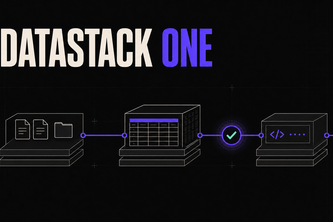
DataStack One is a self-reported local-first conversational data engineering workspace built as a hackathon prototype. The description states it allows users to interact with data through natural language, using tools like DuckDB and GPT-5.6, while maintaining strict security boundaries around credentials and execution state.
What changed
The project was submitted as part of the OpenAI 2026 hackathon. It is described as a two-day prototype with no prior commercial traction or revenue evidence.
Single most important open question
Is there any evidence that DataStack One has moved beyond the prototype stage, or that it has begun to attract users or customers who might validate its utility in real-world data engineering workflows?
What The Product Actually Is
The description states that DataStack One is a local-first conversational data engineering workspace. It allows users to:
- Upload files
- Start sessions from existing project folders
- Connect Postgres databases
- Profile and query data
- Build transformations
- Run quality checks
- Publish approved results as JSON or CSV endpoints
Each session has independent history, files, working directory, DuckDB warehouse, approvals, and execution state. Sessions can run simultaneously without interference.
All write operations require explicit human approval. Database credentials remain on the backend and are not exposed to prompts, chat history, or model-generated tool arguments.
Inference The product appears to be a developer tool designed for local data engineering tasks, using an agent-based interface with conversational interaction and strong isolation between sessions.
Positioning & Claim Evolution
The description states that DataStack One was inspired by coding agents such as Codex, but tailored specifically for data engineering workflows. It positions itself as a way to simplify fragmented data engineering work across terminals, SQL editors, dashboards, configuration files, and deployment tools.
It claims to enable engineers to describe outcomes in plain English while maintaining full control over actions.
Inference The positioning reflects an intent to make data engineering more accessible via conversational interfaces, but there is no evidence of prior market validation or adoption.
Target Customer & ICP
The description does not explicitly name target customers. However, it implies that the primary users are data engineers who work with local projects and need tools for querying, transforming, and publishing data.
It also suggests a focus on developers working in local-first environments, where they want to maintain control over their workflows and avoid exposure of sensitive information like database credentials.
Inference The ICP likely includes small teams or individual developers using local development setups for data engineering tasks. No evidence of broader customer segments or enterprise adoption is provided.
Business Model & Pricing Evidence
There is no mention of pricing, monetization strategy, or business model in the description.
The product is described as a hackathon prototype, not a commercial offering.
Inference No evidence exists regarding how DataStack One would generate revenue or whether it intends to be sold or offered as a service.
Technical & Delivery Signals
The project was built using:
- Frontend: React, TypeScript, Vite, Tailwind CSS
- Backend: Fastify, DuckDB, OpenCode SDK
- AI/ML tools: GPT-5.6, Codex
- Data formats: Parquet, CSV, JSON
- Infrastructure: Server-Sent Events (SSE), PostgreSQL
Key technical features include:
- Isolated sessions with independent history and execution state
- Secure handling of database credentials
- Support for multiple background sessions
- Inline approvals for all write operations
- Automated test coverage exceeding 1,000 tests
Inference The architecture shows a focus on security, isolation, and developer experience. However, the prototype nature suggests limited production readiness.
Traction & Maturity Signals
The description explicitly states that DataStack One is a two-day hackathon prototype. It was submitted to the OpenAI 2026 hackathon.
There is no evidence of:
- Revenue
- Customers
- User adoption
- Product-market fit
- Any form of traction beyond internal development and testing
Inference The product has not yet demonstrated any commercial viability or real-world usage.
Competitive Context
The description mentions inspiration from coding agents such as Codex, suggesting a competitive landscape that includes AI-powered developer tools.
However, no specific competitors are named. There is also no evidence of how DataStack One differentiates itself in the market beyond its local-first approach and conversational interface.
Inference The competitive context is unclear due to lack of market positioning or differentiation data.
Open Questions & Risks
- Prototype-only status: No evidence of product maturity or commercial viability.
- No revenue or customer data: The project lacks any demonstration of traction or monetization potential.
- Limited scope: The tool appears focused on local development and may not scale to enterprise needs.
- Unverified claims: All statements are self-reported; no independent verification exists.
- Unclear path to market: No evidence of go-to-market strategy, distribution channels, or user acquisition plans.
Inference The risk of misalignment between stated goals and actual product development is high. Without further evidence, the project remains unproven in terms of utility or commercial potential.
Questions the description leaves open
- What specific data engineering workflows does DataStack One aim to solve that current tools do not address?
- How does the team plan to transition from a hackathon prototype to a production-ready product?
- Are there any early adopters or pilot users who have tested the tool in real-world scenarios?
- What is the long-term vision for monetization, if any?
- How will the tool evolve beyond local-first capabilities to support distributed or cloud-based data engineering?
- What are the key assumptions underlying the product’s design and architecture?
Overall Assessment
Not evidenced.
There is no evidence of revenue, customers, traction, or a clear path to commercialization. The project is described as a hackathon prototype with no indication of progress toward becoming a viable product or business.
Inference Based on the self-reported description alone, there is insufficient basis for an investment or partnership decision. Any future evaluation would require evidence of product-market fit, user feedback, and development milestones beyond the prototype stage.
User Stories BotA demo video on every pull request
Get a demo video on every new feature
GitHub App that watches your pull requests and records a narrated, captioned demo.
Save time on demo prep and make informed decisions faster with a video walkthrough of every new feature.
Source
Submitted to the OpenAI 2026 hackathon on Devpost. Project home on Devpost. Back to the full gallery on Devpost.
This competitive analysis was produced by top-founders.com (opens in a new tab)
Generated by a language model from this project's public Devpost page — its tagline, the author's own write-up and any built-with tags listed there — as captured in August 2026. Short quotations are the author's words. It is an opinion on the idea as a business, not on the people behind it, and it reflects the description as published then. If the project has moved on, request a correction below. The analysis is not independent research and contains no verified traction, revenue or customer data.
An independent guide by KFG International LLC — not affiliated with, endorsed by, or connected to Devpost or OpenAI.