

Archive position — measured, not model output
0 likes on Devpost
2,263 of the 7,850 archived projects have more likes, and 5,587 share exactly 0 — so this project's #3,634 place in the like-ranked listing is a tie-break inside that group, not a ranking.
Projects (log scale)
Likes on Devpost. ▲ marks this project's group.
Show the figures
| Likes | Projects | Share of archive |
|---|---|---|
| 0 | 5,587 | 71.2% |
| 1 | 1,758 | 22.4% |
| 2 | 284 | 3.6% |
| 3–4 | 132 | 1.7% |
| 5–9 | 75 | 1.0% |
| 10+ | 14 | 0.2% |
 User Stories BotA demo video on every pull request
Get a demo video on every new feature
GitHub App that watches your pull requests and records a narrated, captioned demo.
Save time on demo prep and make informed decisions faster with a video walkthrough of every new feature.
Executive Summary
What the company appears to be
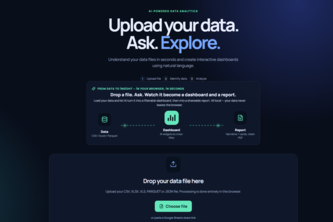
Data Lens is a self-reported in-browser analytics studio that uses AI to enable users to ask questions about data files and receive filtered dashboards, reports, and SQL workspaces — all running 100% inside the browser.
What changed
The project description indicates an evolution from traditional analytics tools where users must configure and learn query languages before gaining insights. Instead, Data Lens claims to allow a goal-driven AI agent to interpret natural language and drive the entire application through a typed capability registry, aiming for a “no-server” experience with local data processing.
Single most important open question
Is there evidence of actual user adoption or product-market fit beyond the author’s self-reported technical demonstration?
Note: This analysis is based entirely on the self-reported project description provided by the caller. No external verification, traction data, revenue figures, or customer information are available. All claims are treated as stated by the author and not independently confirmed.
What The Product Actually Is
The description states that Data Lens is an in-browser analytics studio powered by AI. It allows users to upload files (e.g., spreadsheets), ask questions in plain language, and receive outputs including dashboards, reports, SQL workspaces, and AI-authored insights — all without leaving the browser.
It uses:
- DuckDB-WASM for local data processing
- GPT-5.6 as an AI agent for reasoning, SQL generation, chart creation, and report drafting
- React + Vite + TypeScript for UI
- IndexedDB for local storage
The product is described as a "living analytics workspace" with:
- A central widget system (charts, gauges, tables, filters)
- Cross-file filtering capabilities
- AI Insight widgets that generate HTML templates and bind to live filters
- A report studio with block editing
- SQL Lab reimagined for multi-table queries
Inference: The product is built as a single-user tool focused on privacy and local execution. It is not described as supporting collaboration or enterprise features.
Positioning & Claim Evolution
The author positions Data Lens as an alternative to traditional analytics tools that require users to become data engineers before gaining insights. The key claim is:
“Open a file, say what you want, and watch it happen.”
This reflects a shift from configuration-heavy tools toward goal-driven AI interaction.
Key claims include:
- AI-native design where GPT-5.6 drives both architecture and runtime behavior
- Full privacy: data never leaves the browser (DuckDB-WASM + IndexedDB)
- Vision-in-the-loop capability, allowing models to interpret screenshots of UI elements
Claim vs Fact: These are self-reported claims about functionality and user experience. No evidence of actual usage or feedback is provided.
Target Customer & ICP
The description does not explicitly name target customers or define an Ideal Customer Profile (ICP). However, the positioning implies:
- Individuals or small teams who want to analyze data quickly without technical setup
- Users concerned about privacy and local data control
- People seeking a no-server analytics solution
Inference: The product appears aimed at personal or small-scale use cases rather than enterprise or large organizations. No mention of B2B, pricing tiers, or institutional adoption.
Business Model & Pricing Evidence
There is no evidence in the description of any business model or pricing structure. The project is described as a hackathon submission and does not reference monetization strategies, subscriptions, freemium models, or sales channels.
Not evidenced: No indication of how the product would be sold or whether it intends to generate revenue.
Technical & Delivery Signals
The technical stack includes:
- DuckDB-WASM for analytical database
- GPT-5.6 for AI reasoning and runtime tasks
- React + Vite + TypeScript for frontend
- IndexedDB for local storage
- Codex for development automation
Key delivery signals:
- 87 passing tests in a green build process
- Use of typed capabilities registry to guide agent behavior
- Support for multiple AI providers (OpenAI, Google AI Studio, Vertex AI, Ollama)
- Mobile responsiveness and size constraints handled via CDN loading
Inference: The team appears technically capable and has implemented a disciplined engineering loop. However, no production deployment or scalability data is shared.
Traction & Maturity Signals
There is no evidence of traction, revenue, customers, or user engagement beyond the author’s own account. The project is described as a hackathon submission (Devpost entry for OpenAI 2026 hackathon), and no metrics such as active users, downloads, or usage frequency are mentioned.
Not evidenced: No signs of product-market fit, customer feedback, or real-world adoption.
Competitive Context
The description does not provide a competitive analysis. However, based on the features described (in-browser analytics, AI-driven insights, no-server architecture), potential competitors might include:
- Traditional BI tools like Tableau, Power BI
- No-code platforms like Looker Studio, Metabase (with local options)
- Developer-focused tools like Jupyter Notebooks or Superset
Inference: The product attempts to differentiate itself via privacy-first design and AI-native interaction. But no comparison with existing solutions is made.
Open Questions & Risks
- No traction or user feedback: The project is presented as a hackathon submission with no evidence of real-world usage.
- Unproven scalability: While it runs locally, the performance implications for large datasets are unclear.
- AI dependency risk: Heavy reliance on GPT-5.6 may pose risks if access becomes limited or expensive.
- Limited functionality scope: No mention of collaboration, sharing, or advanced reporting features.
- Single-person team: The project is attributed to one individual (Savaş Hasçelik), raising questions about long-term maintenance and growth.
Not evidenced: No data on competitive positioning, market size, or scalability concerns beyond the author’s own claims.
Questions the description leaves open
- What specific use cases have you tested with real users?
- How do you plan to scale beyond a single-user, local-first model?
- Are there any known limitations in handling large datasets or complex data relationships?
- What is the roadmap for monetization and go-to-market strategy?
- How do you handle edge cases where AI-generated SQL or visualizations fail?
- Have you considered how this would integrate with existing enterprise tools or workflows?
Overall Assessment
There is no evidence of commercial traction, revenue, or customer adoption beyond the author’s self-reported account. The project is described as a hackathon submission and lacks any indication of product-market fit or scalability.
Confidence Level: Low
Assessment: Not ready for investment or partnership consideration without further evidence of user engagement, market validation, or business model development.
User Stories BotA demo video on every pull request
Get a demo video on every new feature
GitHub App that watches your pull requests and records a narrated, captioned demo.
Save time on demo prep and make informed decisions faster with a video walkthrough of every new feature.
Source
Submitted to the OpenAI 2026 hackathon on Devpost. Project home on Devpost. Back to the full gallery on Devpost.
This competitive analysis was produced by top-founders.com (opens in a new tab)
Generated by a language model from this project's public Devpost page — its tagline, the author's own write-up and any built-with tags listed there — as captured in August 2026. Short quotations are the author's words. It is an opinion on the idea as a business, not on the people behind it, and it reflects the description as published then. If the project has moved on, request a correction below. The analysis is not independent research and contains no verified traction, revenue or customer data.
An independent guide by KFG International LLC — not affiliated with, endorsed by, or connected to Devpost or OpenAI.