

Archive position — measured, not model output
0 likes on Devpost
2,263 of the 7,850 archived projects have more likes, and 5,587 share exactly 0 — so this project's #3,624 place in the like-ranked listing is a tie-break inside that group, not a ranking.
Projects (log scale)
Likes on Devpost. ▲ marks this project's group.
Show the figures
| Likes | Projects | Share of archive |
|---|---|---|
| 0 | 5,587 | 71.2% |
| 1 | 1,758 | 22.4% |
| 2 | 284 | 3.6% |
| 3–4 | 132 | 1.7% |
| 5–9 | 75 | 1.0% |
| 10+ | 14 | 0.2% |
 User Stories BotA demo video on every pull request
Get a demo video on every new feature
GitHub App that watches your pull requests and records a narrated, captioned demo.
Save time on demo prep and make informed decisions faster with a video walkthrough of every new feature.
Executive Summary
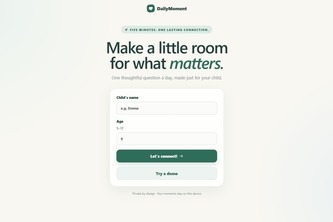
The company appears to be a single-person project, DailyMoment, submitted to the OpenAI 2026 hackathon. The author describes it as a tool that turns a busy parent's commute or bedtime into real connection with their kid through one 5-minute daily question — no grading, no tracking, just conversation. It is built using Next.js, React, TypeScript, Node.js, and OpenAI APIs (specifically GPT-5.6). The product was developed in a single day by someone with zero coding experience.
What changed: The author reports that the app evolved from an initial version with API key errors, repetitive prompts, laggy buttons, and demo data mixing into a polished version after iterative fixes using Codex (presumably AI assistance) and user testing. It was submitted to a hackathon, not yet deployed in production.
The single most important open question: Is there any evidence of actual parent users or real-world adoption beyond the hackathon submission? The description states no revenue, customers, or traction data are available.
What The Product Actually Is
The description states that DailyMoment is a tool designed for busy parents to engage in conversation with their children during short daily moments — such as commute or bedtime — through a 5-minute daily question. It emphasizes no grading, no tracking, and only conversation.
It was built using:
- Frontend: React, Next.js, TypeScript, CSS
- Backend: Node.js
- AI tools: OpenAI (specifically GPT-5.6), Codex
- Hosting: Vercel
- Data storage: localStorage
The product is described as a single-day hackathon project with no prior development history.
Positioning & Claim Evolution
The author states that the idea emerged during a hackathon and was intentionally designed to be unique in a crowded space, focusing on connection rather than tracking or dashboards. The positioning appears to be:
- A tool for parents seeking meaningful interaction with children.
- Emphasis on simplicity, no pressure, and conversational flow.
There is no evidence of prior positioning claims or evolution beyond the hackathon submission.
Target Customer & ICP
The description states that DailyMoment is built for busy parents, specifically targeting moments like commute or bedtime to foster conversation with their kids. It does not specify any细分市场 (e.g., age of children, parental demographics, or family income), nor does it describe a defined ideal customer profile beyond the general category of "busy parent."
Business Model & Pricing Evidence
Not evidenced.
The description does not mention any pricing model, monetization strategy, or business model. It is unclear whether this is intended to be a freemium product, paid subscription, or ad-supported.
Technical & Delivery Signals
- Built with: React, Next.js, TypeScript, Node.js, CSS, localStorage, OpenAI GPT-5.6, Codex.
- Hosted on Vercel.
- The author reports fixing several technical issues:
- API key errors (resolved by regenerating and correctly loading the key).
- Repetitive prompts (fixed using Codex to enforce variety).
- Button responsiveness (immediate loading states and disabling buttons on first click).
- Demo data mixing with real data (resolved via incognito testing).
The project was completed in a single day, with no prior development history.
Traction & Maturity Signals
Not evidenced.
There is no evidence of:
- Revenue
- Customers
- User adoption
- Product usage metrics
- Post-hackathon deployment or growth
The product is described as a hackathon submission and not yet in production.
Competitive Context
Not evidenced.
The description does not mention any competitors, market analysis, or competitive positioning beyond the claim that it is “a genuinely unique idea in a crowded hackathon.”
Open Questions & Risks
- No traction or revenue: The project is a hackathon submission with no evidence of real-world adoption.
- Single-person development: Only one team member (Iftikhar Ahmed) is mentioned, raising questions about scalability and long-term maintenance.
- Unverified claims: All descriptions are self-reported and unverified; there is no third-party validation.
- Limited product scope: The app is described as a 5-minute daily question tool — unclear if this is sufficient to build a sustainable product or business.
- Dependency on AI tools: Heavy reliance on Codex and GPT-5.6 may be a risk if those services change or become unavailable.
Questions the description leaves open
- What is the actual user feedback from parents who tried this tool beyond the hackathon?
- How do you plan to scale beyond a single developer and a hackathon prototype?
- Is there any intention to monetize or build a sustainable business model around this idea?
- What are your plans for product iteration post-hackathon?
- Are there any specific user personas or target segments you're considering?
Overall Assessment
Not evidenced.
There is no evidence of revenue, customers, traction, or a clear path to monetization. The project is described as a hackathon submission with no indication of commercial viability or long-term strategy. It is unclear whether this represents a viable investment or partnership opportunity at this stage.
User Stories BotA demo video on every pull request
Get a demo video on every new feature
GitHub App that watches your pull requests and records a narrated, captioned demo.
Save time on demo prep and make informed decisions faster with a video walkthrough of every new feature.
Source
Submitted to the OpenAI 2026 hackathon on Devpost. Project home on Devpost. Back to the full gallery on Devpost.
This competitive analysis was produced by top-founders.com (opens in a new tab)
Generated by a language model from this project's public Devpost page — its tagline, the author's own write-up and any built-with tags listed there — as captured in August 2026. Short quotations are the author's words. It is an opinion on the idea as a business, not on the people behind it, and it reflects the description as published then. If the project has moved on, request a correction below. The analysis is not independent research and contains no verified traction, revenue or customer data.
An independent guide by KFG International LLC — not affiliated with, endorsed by, or connected to Devpost or OpenAI.