

Archive position — measured, not model output
0 likes on Devpost
2,263 of the 7,850 archived projects have more likes, and 5,587 share exactly 0 — so this project's #5,671 place in the like-ranked listing is a tie-break inside that group, not a ranking.
Projects (log scale)
Likes on Devpost. ▲ marks this project's group.
Show the figures
| Likes | Projects | Share of archive |
|---|---|---|
| 0 | 5,587 | 71.2% |
| 1 | 1,758 | 22.4% |
| 2 | 284 | 3.6% |
| 3–4 | 132 | 1.7% |
| 5–9 | 75 | 1.0% |
| 10+ | 14 | 0.2% |
 User Stories BotA demo video on every pull request
Get a demo video on every new feature
GitHub App that watches your pull requests and records a narrated, captioned demo.
Save time on demo prep and make informed decisions faster with a video walkthrough of every new feature.
Executive Summary
What the company appears to be
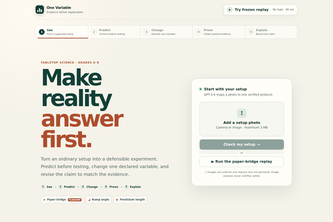
One Variable is a self-reported educational tool designed to support scientific reasoning in students by structuring a closed-loop workflow: prediction → variable change → evidence collection → claim revision. It uses AI (GPT-5.6) for contextual classification and structured guidance, while deterministic code enforces safety, protocol control, and evidence validation.
What changed
The project is described as a prototype built for the OpenAI 2026 hackathon. It does not appear to have moved beyond a development or demonstration stage, nor has it shown any traction, revenue, or customer adoption.
Single most important open question
Is there evidence of real-world use or impact beyond the author’s own development and synthetic testing?
What The Product Actually Is
The description states that One Variable is a strict TypeScript React PWA with an Express server, using GPT-5.6 via OpenAI Responses API for contextual tasks such as:
- Mapping setup images to one of three allowlisted protocols;
- Reviewing learner claims against structured paired measurements;
- Providing bounded guidance and asking discriminating questions.
The system supports exactly three low-risk tabletop science protocols:
- Paper bridge shape
- Ramp angle
- Pendulum length
It enforces a five-step workflow:
- See — Upload setup photo; GPT maps to protocol or fails closed.
- Predict — Write directional prediction and reason (locks before evidence).
- Change — Declare one independent variable and attest to controls.
- Prove — Record baseline and changed-condition photos/measures in same units.
- Explain — Write a claim; GPT reviews against paired measurements and returns challenge + uncertainty.
The final output is a student work record preserving all steps, including locked prediction, declared controls, evidence, original claim, challenge, bounded revision, and uncertainty.
Deterministic code owns authority over:
- Hazard blocking and protocol allowlisting;
- Prediction locking;
- Single variable declaration and required controls;
- Evidence completeness and comparability;
- Bounded-claim enforcement;
- Rubric and report completeness;
- Frozen replay and audit events.
No API keys are exposed to the browser; all requests pass through strict Zod schemas, and model responses are validated with bounded retries.
Positioning & Claim Evolution
The description states that One Variable is not another answer tutor, worksheet generator, fixed simulation, or autonomous grader. Instead, it positions itself as a system that:
- Reverses the typical AI-driven science learning sequence;
- Makes scientific reasoning visible through physical reality and learner declarations;
- Preserves the learner’s reasoning process without hiding model chain-of-thought.
It claims to support “claim-evidence-reasoning” in a 15-minute activity using ordinary materials, not lab equipment. It does not claim improved grades or proven learning outcomes, but rather that it creates an opportunity for students to practice:
- Prediction;
- Variable control;
- Evidence comparison;
- Bounded claims;
- Uncertainty.
The author emphasizes that the learner produces evidence and writes the final claim, while AI interprets context and questions overreach. The system is described as pedagogically focused, not performance-driven.
Target Customer & ICP
The description states that One Variable is designed for a focused 15-minute science activity using ordinary materials, not specialist lab equipment. It does not name specific customers or target segments beyond general educational use.
It is implied to be aimed at:
- Students learning scientific reasoning;
- Educators looking to scaffold inquiry-based learning;
- Teachers seeking tools that preserve student thinking without AI-generated answers.
No explicit ICP (Ideal Customer Profile) is defined, nor are there any stated customer personas, usage patterns, or adoption metrics.
Business Model & Pricing Evidence
Not evidenced. The description does not contain any information about:
- Revenue streams;
- Pricing models;
- Monetization strategy;
- Customers or buyers;
- Sales process or go-to-market approach.
The project is described as a hackathon submission, and no commercial or business model details are provided.
Technical & Delivery Signals
The system is built as a TypeScript React PWA with:
- Express.js backend;
- GPT-5.6 via OpenAI Responses API for contextual tasks;
- Deterministic code handling safety, protocol control, and evidence validation;
- Strict Zod schemas for input/output validation;
- Browser-side state machine using reducer pattern;
- Frozen replay functionality without login or network calls.
Key technical features include:
- Image classification via GPT-5.6;
- Structured output review of learner claims;
- Locked prediction and variable control enforcement;
- Evidence completeness checks in comparable units;
- Bounded claim revision and uncertainty display;
- Offline PWA support for frozen replay;
- Synthetic testing with 59 unit tests, 24 browser checks, and 12 development evaluations.
The system is described as having:
- No API keys exposed to the browser;
- Strict schema validation;
- Deterministic code ownership of safety and transitions;
- Zero retries in production evaluation;
- Estimated token cost of $0.07 for a full evaluation.
Traction & Maturity Signals
Not evidenced. The description does not contain any information about:
- Customers or users;
- Revenue or monetization;
- Product adoption or usage metrics;
- Market traction or growth;
- Real-world classroom deployment or feedback.
The project is described as a development prototype for a hackathon, with no indication of real-world use beyond synthetic testing and author’s own evaluation.
Competitive Context
Not evidenced. The description does not mention:
- Competitors in the educational AI or science learning space;
- Market positioning relative to existing tools;
- Differentiation from similar products.
The author notes that One Variable is not another answer tutor, worksheet generator, fixed simulation, or autonomous grader, but does not compare it to any specific alternatives.
Open Questions & Risks
- No real-world use or adoption — The project is described as a hackathon prototype with no evidence of classroom deployment or user feedback.
- Unverified claims — The system’s impact on learning outcomes is not demonstrated, and it does not claim to improve grades or performance.
- Limited scope — Only three protocols are supported; expansion would require new safety and evaluation reviews.
- Dependency on GPT-5.6 — While deterministic code owns safety, the model is used for key tasks like claim review and classification.
- No commercialization plan — No pricing, monetization or business model is described.
- Synthetic testing only — All evaluation is described as synthetic development checks, not classroom studies.
Questions the description leaves open
- What real-world feedback has been gathered from teachers or students using this tool?
- Are there any plans to expand beyond the three supported protocols?
- How does the team intend to scale beyond a hackathon prototype?
- Has the system undergone any form of privacy or accessibility review in a classroom setting?
- What is the long-term vision for monetization or commercial use?
- What are the risks associated with relying on GPT-5.6 for claim review and classification?
Overall Assessment
Not evidenced. The description does not contain any information about:
- Funding status;
- Investors or partners;
- Commercial traction or revenue;
- Strategic partnerships.
The project is described as a hackathon submission, with no indication of investment interest, commercial viability, or partnership potential. It remains in an early development stage without evidence of product-market fit or scalability.
User Stories BotA demo video on every pull request
Get a demo video on every new feature
GitHub App that watches your pull requests and records a narrated, captioned demo.
Save time on demo prep and make informed decisions faster with a video walkthrough of every new feature.
Source
Submitted to the OpenAI 2026 hackathon on Devpost. Project home on Devpost. Back to the full gallery on Devpost.
This competitive analysis was produced by top-founders.com (opens in a new tab)
Generated by a language model from this project's public Devpost page — its tagline, the author's own write-up and any built-with tags listed there — as captured in August 2026. Short quotations are the author's words. It is an opinion on the idea as a business, not on the people behind it, and it reflects the description as published then. If the project has moved on, request a correction below. The analysis is not independent research and contains no verified traction, revenue or customer data.
An independent guide by KFG International LLC — not affiliated with, endorsed by, or connected to Devpost or OpenAI.