

Archive position — measured, not model output
0 likes on Devpost
2,263 of the 7,850 archived projects have more likes, and 5,587 share exactly 0 — so this project's #7,486 place in the like-ranked listing is a tie-break inside that group, not a ranking.
Projects (log scale)
Likes on Devpost. ▲ marks this project's group.
Show the figures
| Likes | Projects | Share of archive |
|---|---|---|
| 0 | 5,587 | 71.2% |
| 1 | 1,758 | 22.4% |
| 2 | 284 | 3.6% |
| 3–4 | 132 | 1.7% |
| 5–9 | 75 | 1.0% |
| 10+ | 14 | 0.2% |
 User Stories BotA demo video on every pull request
Get a demo video on every new feature
GitHub App that watches your pull requests and records a narrated, captioned demo.
Save time on demo prep and make informed decisions faster with a video walkthrough of every new feature.
Executive Summary
What the company appears to be
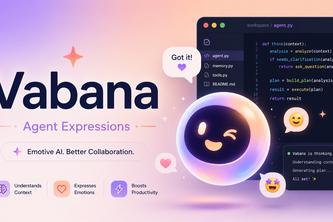
Vabana - Agent Expressions is a self-reported macOS application that provides visual feedback for AI coding agents. It aims to improve developer experience by showing agent activity through floating overlays, cards, and pulses rather than terminal output.
What changed
The project evolved from an experimental "emotion overlay" into a native embodiment and coordination layer for AI coding agents, according to the author. It now supports native hooks from Codex and Claude Code, and includes MCP tools for intentional agent expression.
Single most important open question
Is there any evidence of traction, revenue or customer adoption beyond the single developer's own account?
What The Product Actually Is
The description states that Vabana is a local macOS application built with SwiftUI and AppKit. It provides:
- A floating visual presence for AI coding agents
- Two display styles: Pulse (emoji-based) and Card (persistent, compact view)
- Native lifecycle event conversion from Codex and Claude Code into readable activity cues
- MCP tools enabling expressive agent communication (emojis, GIFs, prompts, code, etc.)
- A local task inspector showing recent sessions and verification evidence
The system architecture includes:
- TypeScript monorepo with an MCP server, shared protocol, coordination runtime, adapters for Codex/Claude Code, and a bounded local projection cache
- Native hook payloads normalized into provider-neutral events
- Token-authenticated WebSocket communication between runtime and macOS renderer
Evidence
- The author describes Vabana as a "local macOS application"
- It uses SwiftUI and AppKit for UI elements
- It integrates with Codex and Claude Code via native hooks
- It has an MCP-based tool system for agent expression
- It includes a task inspector and local projection cache
Inference The product is described as a developer tool focused on improving AI agent transparency, but no evidence of actual deployment or usage exists.
Positioning & Claim Evolution
The author states that Vabana grew from research into whether explaining an AI assistant’s actions could improve trust during complex tasks. The name derives from the Nepali word for feelings or emotions, reflecting its goal of giving AI agents understandable visual body language.
It evolved from:
- An experimental emotion overlay
- Into a native embodiment and coordination layer for coding agents
The author claims Vabana:
- Shows agent activity through ambient digital body language
- Converts noisy event streams into meaningful feedback
- Supports expressive MCP surfaces ranging from emojis to interactive prompts
- Enforces repository-defined definitions of done through supported native stop hooks
Evidence
- The project was initially described as a research effort on AI trust and transparency
- It evolved into a tool for visualizing agent behavior
- It supports multiple expression modes (Pulse, Card, MCP tools)
Inference The positioning appears to be that Vabana is a developer experience tool aimed at improving clarity and trust in AI coding agents. However, no evidence of market positioning or competitive differentiation beyond the author's own claims.
Target Customer & ICP
The description indicates that Vabana targets developers working with AI coding agents, particularly those using Codex and Claude Code on macOS.
It is designed for users who:
- Work with AI coding agents
- Want to understand what these agents are doing in real time
- Prefer visual feedback over terminal output
- Are interested in agent transparency and trust
Evidence
- The product works specifically with Codex and Claude Code
- It runs on macOS
- It focuses on improving developer experience for AI-assisted coding workflows
Inference The ICP is likely early-stage developers or teams using AI coding agents, but there is no evidence of actual customers or user segments beyond the single developer's own use case.
Business Model & Pricing Evidence
There is no evidence in the description of any business model or pricing structure. The author does not mention monetization strategies, subscription plans, licensing models, or revenue streams.
Evidence
- No mention of pricing
- No indication of commercial intent or customer acquisition
- No reference to sales, partnerships, or enterprise features
Inference The project appears to be a personal or research initiative without any commercial business model evident in the description.
Technical & Delivery Signals
The author reports that Vabana:
- Is built as a local macOS application using SwiftUI and AppKit
- Uses TypeScript monorepo architecture with shared protocol, MCP server, coordination runtime, adapters for Codex/Claude Code, and projection cache
- Implements deterministic presentation policy to reduce noise from agent events
- Separates native harness activity from agent-authored expression
- Employs sanitization, fixtures, contract tests, and bounded schemas to maintain consistency between Swift renderer and TypeScript runtime
Evidence
- Built with specific technologies: SwiftUI, AppKit, TypeScript, Node.js, Swift, macOS, etc.
- Uses MCP protocol for agent interaction
- Implements event normalization and state management
- Includes local task inspector and verification mechanisms
Inference The technical implementation suggests a sophisticated developer tool, but no evidence of production deployment or scalability beyond the author’s own environment.
Traction & Maturity Signals
There is no evidence of traction, revenue, customers, or adoption. The project is described as:
- A third-semester research project
- An early-alpha macOS application
- Released as version 0.1.1
- Developed through AI-assisted iterations using Codex and GPT
The author notes that the next steps include improving installation, packaging, onboarding, and testing across real development environments.
Evidence
- Version 0.1.1 release
- Early-stage alpha status
- No mention of users, customers, or revenue
- No data on usage metrics or adoption rates
Inference The project is in a very early stage with no demonstrated traction or commercial viability.
Competitive Context
There is no evidence provided about competitive landscape or existing alternatives. The author does not reference other tools or platforms that might address similar problems.
Evidence
- No mention of competitors
- No comparison to existing AI agent visualization tools
- No discussion of market gaps or differentiation
Inference Without any mention of competition, it is unclear whether Vabana addresses a known market need or if it is an isolated idea.
Open Questions & Risks
Key risks and open questions based on the self-reported description:
- Single Developer Project: The team size is listed as 1, suggesting limited resources for scaling or support.
- No Traction or Revenue: No evidence of customers, users, or monetization strategy.
- Early Stage Alpha: Described as early-alpha and not yet widely tested in real environments.
- Limited Platform Support: Currently only supports macOS and specific agents (Codex/Claude Code).
- Unproven Market Need: No indication that there is a significant demand for this type of tool beyond the author’s personal use case.
- No Commercial Strategy: No mention of business model, pricing, or go-to-market plans.
Evidence
- Team size = 1
- Version 0.1.1 release
- No mention of users or revenue
- Only supports macOS and two agents
Inference This is a highly speculative project with no commercial validation or market proof.
Questions the description leaves open
- What specific problem are you solving, and how do you know it matters to developers?
- Have you tested Vabana with other developers beyond yourself? If so, what feedback did you get?
- Are there any plans for expanding support beyond macOS and Codex/Claude Code?
- How do you plan to monetize this tool, if at all?
- What are the key assumptions underlying your product design choices?
- Do you have any data on how much time or effort developers spend trying to understand agent behavior without Vabana?
- Are there any known technical limitations that prevent broader adoption?
Overall Assessment
Not evidenced
The description provides no information about:
- Revenue
- Customers
- Market traction
- Financial performance
- Strategic partnerships
- Product-market fit
This is a self-reported, unverified project described by one individual as a research or experimental tool. There is no evidence of commercial viability, user adoption, or business model.
Confidence Level Very Low
Risk Rating
High (due to lack of traction, revenue, and market validation)
Recommendation
No basis for investment or partnership consideration at this time.
User Stories BotA demo video on every pull request
Get a demo video on every new feature
GitHub App that watches your pull requests and records a narrated, captioned demo.
Save time on demo prep and make informed decisions faster with a video walkthrough of every new feature.
Source
Submitted to the OpenAI 2026 hackathon on Devpost. Project home on Devpost. Back to the full gallery on Devpost.
This competitive analysis was produced by top-founders.com (opens in a new tab)
Generated by a language model from this project's public Devpost page — its tagline, the author's own write-up and any built-with tags listed there — as captured in August 2026. Short quotations are the author's words. It is an opinion on the idea as a business, not on the people behind it, and it reflects the description as published then. If the project has moved on, request a correction below. The analysis is not independent research and contains no verified traction, revenue or customer data.
An independent guide by KFG International LLC — not affiliated with, endorsed by, or connected to Devpost or OpenAI.