

Archive position — measured, not model output
0 likes on Devpost
2,263 of the 7,850 archived projects have more likes, and 5,587 share exactly 0 — so this project's #3,588 place in the like-ranked listing is a tie-break inside that group, not a ranking.
Projects (log scale)
Likes on Devpost. ▲ marks this project's group.
Show the figures
| Likes | Projects | Share of archive |
|---|---|---|
| 0 | 5,587 | 71.2% |
| 1 | 1,758 | 22.4% |
| 2 | 284 | 3.6% |
| 3–4 | 132 | 1.7% |
| 5–9 | 75 | 1.0% |
| 10+ | 14 | 0.2% |
 User Stories BotA demo video on every pull request
Get a demo video on every new feature
GitHub App that watches your pull requests and records a narrated, captioned demo.
Save time on demo prep and make informed decisions faster with a video walkthrough of every new feature.
Executive Summary
What the company appears to be
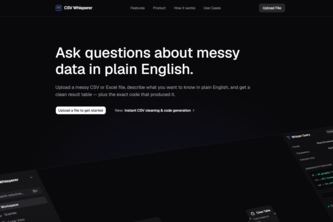
CSV Whisperer is a self-reported tool that allows users to upload messy CSV or Excel files and ask questions about them in plain English. It uses GPT-5.6 to generate real pandas code tailored to each query, executes it safely within an isolated sandbox, and returns both the result and the code used — with automatic error correction and retry logic.
What changed
The project description indicates a self-developed solution built entirely in Codex, using a single developer (Ali Hamza), with no evidence of prior traction or revenue. It was submitted to the OpenAI 2026 hackathon as part of a hackathon submission.
Single most important open question
Is there any evidence that CSV Whisperer has been used beyond the author’s own development environment, or whether it has achieved any adoption or commercial viability?
What The Product Actually Is
The description states that CSV Whisperer is a tool that:
- Accepts uploaded messy CSV or Excel files.
- Allows users to ask questions in plain English.
- Generates real pandas code using GPT-5.6.
- Executes the generated code inside an isolated sandbox.
- Returns both the result and the code used, with self-correction on errors.
- Supports downloading results as clean CSVs.
- Enables conversational refinement of analysis.
It also includes a frontend built with Next.js, featuring chat, result table, and live code viewer panels. The backend was developed in Codex, using a step-by-step approach for building components like schema parsing, sandboxing, and execution logic.
Inference The tool appears to be a proof-of-concept or early-stage prototype, not yet a commercial product with users or revenue.
Positioning & Claim Evolution
The author claims that CSV Whisperer:
- Closes the gap between messy data and quick answers.
- Eliminates reliance on spreadsheet formulas or analysts.
- Provides full transparency by showing the actual code used to derive results.
- Offers no black-box behavior — every answer comes with its own executable script.
It positions itself as a solution for teams dealing with unstructured or poorly formatted data, aiming to democratize access to data analysis through conversational interfaces and automated code generation.
Inference This is a self-reported positioning claim. No evidence exists that this product has been tested in real-world environments or adopted by users beyond the developer’s own use case.
Target Customer & ICP
The description implies that CSV Whisperer targets:
- Teams working with messy data (e.g., analysts, business users).
- Users who want to avoid complex spreadsheet tools or manual scripting.
- Anyone needing quick answers from CSV files without prior knowledge of pandas.
It does not specify any细分 customer segments or personas beyond general "teams" and "users."
Inference The target customer is inferred from the problem statement but lacks specificity in terms of industry, size, or decision-making roles. No evidence supports a defined ICP or customer segmentation.
Business Model & Pricing Evidence
There is no mention of pricing, monetization strategy, or business model in the description.
Not evidenced
Technical & Delivery Signals
The system uses:
- GPT-5.6 for code generation.
- Pandas as the core data analysis engine.
- Sandboxing techniques to isolate and secure execution of generated code.
- A modular architecture allowing easy swapping of LLMs (e.g., free-tier to GPT-5.6).
- Static AST checks combined with subprocess isolation for safety.
- React/Next.js frontend with three-panel UI (chat, result table, live code viewer).
The backend was built in Codex using a continuous session approach, and the team tested sandboxing against real threats like os.system and infinite loops.
Inference These technical choices suggest a focus on security and modularity, which are important for an LLM-based tool that executes user-generated code. However, no evidence of production deployment or scalability beyond prototype-level development.
Traction & Maturity Signals
There is no evidence of:
- Revenue
- Customers
- User adoption
- Product usage metrics
- Any form of traction or market validation
The project was submitted to a hackathon and built by one person (Ali Hamza) in a single continuous session within Codex.
Inference This is a prototype, not a mature product with real-world usage. No signs of growth, retention, or monetization are evident.
Competitive Context
No mention of competitors or competitive landscape is provided in the description.
Not evidenced
Open Questions & Risks
- Single Developer: The entire project was built by one individual (Ali Hamza), raising concerns about scalability and long-term maintenance.
- Unverified Claims: All claims are self-reported; there is no independent verification of performance, accuracy, or usability.
- No Revenue or Customers: No evidence of any monetization, customer base, or commercial traction.
- Hackathon Origin: The project originated from a hackathon, suggesting it may be experimental rather than production-ready.
- High Technical Risk: Execution of arbitrary code via LLMs introduces significant security and correctness risks, which are mitigated only through sandboxing — but no evidence of how well those safeguards have been tested in practice.
Inference This is a high-risk, unproven concept with no demonstrated viability or commercial potential at this stage.
Questions the description leaves open
- Has CSV Whisperer been used beyond the development environment? If so, by whom and how?
- What specific use cases have you identified for this tool in real-world settings?
- How do you plan to scale the system beyond a single developer’s capacity?
- Are there any known limitations or edge cases where the tool fails to produce correct results?
- Have you considered integrating with existing platforms (e.g., Google Sheets, Excel, BI tools)?
- What is your roadmap for monetization and product development post-hackathon?
Overall Assessment
Not evidenced
The project description provides no evidence of traction, revenue, or customer adoption. It appears to be a hackathon prototype built by one person, with no indication of commercial viability or market readiness.
Given the lack of any measurable outcomes or business metrics, and the speculative nature of its claims, there is insufficient basis for an investment or partnership decision at this time.
Confidence Level Low
Evidence Base
Self-reported only; no external validation or data on performance, users, or revenue.
User Stories BotA demo video on every pull request
Get a demo video on every new feature
GitHub App that watches your pull requests and records a narrated, captioned demo.
Save time on demo prep and make informed decisions faster with a video walkthrough of every new feature.
Source
Submitted to the OpenAI 2026 hackathon on Devpost. Project home on Devpost. Back to the full gallery on Devpost.
This competitive analysis was produced by top-founders.com (opens in a new tab)
Generated by a language model from this project's public Devpost page — its tagline, the author's own write-up and any built-with tags listed there — as captured in August 2026. Short quotations are the author's words. It is an opinion on the idea as a business, not on the people behind it, and it reflects the description as published then. If the project has moved on, request a correction below. The analysis is not independent research and contains no verified traction, revenue or customer data.
An independent guide by KFG International LLC — not affiliated with, endorsed by, or connected to Devpost or OpenAI.