

Archive position — measured, not model output
0 likes on Devpost
2,263 of the 7,850 archived projects have more likes, and 5,587 share exactly 0 — so this project's #3,567 place in the like-ranked listing is a tie-break inside that group, not a ranking.
Projects (log scale)
Likes on Devpost. ▲ marks this project's group.
Show the figures
| Likes | Projects | Share of archive |
|---|---|---|
| 0 | 5,587 | 71.2% |
| 1 | 1,758 | 22.4% |
| 2 | 284 | 3.6% |
| 3–4 | 132 | 1.7% |
| 5–9 | 75 | 1.0% |
| 10+ | 14 | 0.2% |
 User Stories BotA demo video on every pull request
Get a demo video on every new feature
GitHub App that watches your pull requests and records a narrated, captioned demo.
Save time on demo prep and make informed decisions faster with a video walkthrough of every new feature.
Executive Summary
What the company appears to be
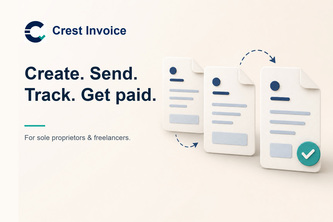
Crest Invoice is a self-reported tool for sole proprietors and freelancers to create, send, and track invoices with minimal friction. The authors describe it as a browser-based solution built using AI tools like Codex and GPT-5.6, without traditional software engineering expertise.
What changed
The project evolved from a Telegram bot prototype used by one therapist (Alina) to a web-based product intended for broader use among freelancers and sole proprietors. It was submitted to the OpenAI 2026 hackathon.
Single most important open question
Is there evidence of real-world usage or traction beyond the initial prototype, and does the product solve a problem that extends beyond the authors' own experience?
Note: This analysis is based entirely on the self-reported description provided by the authors. No independent verification, revenue data, customer list, or traction metrics are available.
What The Product Actually Is
The description states that Crest Invoice helps sole proprietors and freelancers create, send, and track invoices in a "delightfully easy way". It allows users to:
- Create an invoice
- Add payment methods (e.g., IBAN or Stripe link)
- Send clients one live link
- Clients report payment with an “I’ve paid” button
- User gets notified, verifies payment, and closes the invoice
It also generates PDFs, tracks when invoices are viewed, and sends reminders.
The authors note that it deliberately avoids features typical of full invoicing tools such as accounting integrations or complex bookkeeping functions. Instead, it focuses on coordinating payments without touching actual money or banks.
Evidence: Self-reported by authors.
Inference: The product is a lightweight web interface with backend logic in Python and SQLite, deployed via Docker and Nginx.
Positioning & Claim Evolution
The authors state that Crest Invoice was inspired by a personal problem faced by Alina, a therapist who needed to manage payments manually. The solution began as a Telegram bot for her own use and later expanded into a general-purpose tool for freelancers.
They claim the product solves a coordination issue rather than a complex financial one — emphasizing simplicity over feature richness.
The positioning has evolved from:
- A niche tool for one person (Alina)
- To a scalable solution for solo practitioners
- With potential to grow into a paid Pro version with advanced features
Evidence: Self-reported by authors.
Inference: The evolution reflects an attempt to move from a personal hack to a productized service, though no evidence of market validation or user feedback beyond early interviews.
Target Customer & ICP
The description states that Crest Invoice targets:
- Sole proprietors
- Freelancers
It is explicitly positioned for users who want payment coordination without the complexity of traditional invoicing tools.
Evidence: Self-reported by authors.
Inference: The target customer profile appears to be individuals with limited technical knowledge or time, who prefer minimal setup and straightforward workflows.
Business Model & Pricing Evidence
The tagline says: “free of charge.” The authors state that the core product is free, but they are considering adding a paid Pro version in the future that could include:
- Automatic payment confirmation via providers like Stripe
- API, CLI, MCP access
- Extended reminder options (SMS, iMessage, WhatsApp)
There is no indication of current pricing or monetization strategy beyond the free offering.
Evidence: Self-reported by authors.
Inference: The business model appears to be freemium with a potential paid tier. However, there’s no evidence of revenue streams or user conversion rates.
Technical & Delivery Signals
The authors report:
- Built using HTML5, CSS3, JavaScript, Python, SQLite
- Deployed via Docker and Nginx
- Uses Codex and GPT-5.6 for development
- Backend handles live links, payment states, notifications, and reminders
- PDF generation handled by ReportLab
- Browser-based interface with responsive design
They also mention:
- Use of Playwright for browser automation
- SMTP for email delivery
- REST API integration
- Integration with PDF libraries (PyPDF, ReportLab)
Evidence: Self-reported by authors.
Inference: The technical stack suggests a lightweight, server-side application built around simplicity and ease-of-use. AI tools are used extensively in development.
Traction & Maturity Signals
The authors report:
- Over three months, Alina processed 112 invoices through the prototype
- All were paid on time
- Manual chasing disappeared from her practice
They also note that they have interviewed other therapists who shared similar problems with payment follow-up.
However, there is no evidence of:
- Real-world usage beyond the initial prototype
- Customer acquisition or retention metrics
- Revenue data or user base growth
- Product adoption beyond the authors’ own circle
Evidence: Self-reported by authors.
Inference: Traction is limited to one user’s experience and early interviews. No external validation or measurable impact.
Competitive Context
The description does not provide any information about competitors or market positioning relative to existing invoicing tools.
It implies that Crest Invoice avoids complexity found in full-featured platforms, focusing instead on a minimal payment coordination workflow.
Evidence: Not evidenced.
Inference: The product likely competes with simpler alternatives like Google Sheets or basic email-based invoicing, but lacks competitive analysis or differentiation from known players.
Open Questions & Risks
Key risks and open questions include:
- No independent verification of claims: All data is self-reported and unverified.
- Lack of traction beyond prototype stage: No evidence of real-world usage or customer base.
- Dependency on AI tools for development: This may limit scalability or reproducibility if those tools change or become unavailable.
- Limited team size (2 people): May constrain execution speed, product depth, and long-term sustainability.
- No pricing or monetization strategy yet: Unclear how the free model will evolve into a sustainable business.
- Unproven market demand beyond initial interviews: No evidence of broad applicability or user validation.
Evidence: Self-reported by authors.
Inference: These are inherent risks in early-stage, self-built products without external validation or revenue data.
Questions the description leaves open
- What specific feedback have you received from users outside your immediate circle?
- How do you plan to validate that the problem extends beyond your own experience?
- What is your roadmap for transitioning from a free product to a paid model?
- Have you considered how to scale beyond two founders and day jobs?
- Are there any legal or compliance considerations around handling payment confirmations without direct bank integration?
- How do you intend to handle currency support, if at all?
- What are the key assumptions behind your belief that users will adopt this over existing tools?
Overall Assessment
There is no evidence of revenue, customers, or traction beyond a prototype used by one individual. The product is described as a personal solution that has been generalized for others, but lacks validation in the market.
The authors are not software engineers and rely heavily on AI tools for development — which raises questions about scalability, maintainability, and long-term control over the product.
While the idea of solving a real coordination problem with minimal friction is appealing, there is no demonstrated commercial viability or path to growth at this stage.
Assessment: Not ready for investment or partnership. Requires further validation of demand, user adoption, and product-market fit before any serious consideration.
Note: This assessment is based solely on the self-reported description provided by the authors. No external data, revenue figures, or customer feedback beyond what was written are available.
User Stories BotA demo video on every pull request
Get a demo video on every new feature
GitHub App that watches your pull requests and records a narrated, captioned demo.
Save time on demo prep and make informed decisions faster with a video walkthrough of every new feature.
Source
Submitted to the OpenAI 2026 hackathon on Devpost. Project home on Devpost. Back to the full gallery on Devpost.
This competitive analysis was produced by top-founders.com (opens in a new tab)
Generated by a language model from this project's public Devpost page — its tagline, the author's own write-up and any built-with tags listed there — as captured in August 2026. Short quotations are the author's words. It is an opinion on the idea as a business, not on the people behind it, and it reflects the description as published then. If the project has moved on, request a correction below. The analysis is not independent research and contains no verified traction, revenue or customer data.
An independent guide by KFG International LLC — not affiliated with, endorsed by, or connected to Devpost or OpenAI.