

Archive position — measured, not model output
1 like on Devpost
505 of the 7,850 archived projects have more likes, and 1,758 share exactly 1 — so this project's #897 place in the like-ranked listing is a tie-break inside that group, not a ranking.
Projects (log scale)
Likes on Devpost. ▲ marks this project's group.
Show the figures
| Likes | Projects | Share of archive |
|---|---|---|
| 0 | 5,587 | 71.2% |
| 1 | 1,758 | 22.4% |
| 2 | 284 | 3.6% |
| 3–4 | 132 | 1.7% |
| 5–9 | 75 | 1.0% |
| 10+ | 14 | 0.2% |
 User Stories BotA demo video on every pull request
Get a demo video on every new feature
GitHub App that watches your pull requests and records a narrated, captioned demo.
Save time on demo prep and make informed decisions faster with a video walkthrough of every new feature.
Executive Summary
What the company appears to be
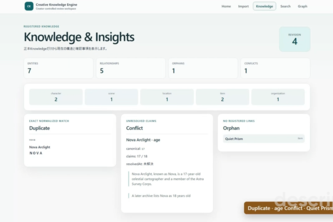
Creative Knowledge Engine (CKE) is a self-reported tool for organizing creative content into structured knowledge. It imports documents and extracts entities (characters, scenes, locations, items, organizations), relationships between them, and presents candidates for human review before committing to canonical knowledge.
What changed
The project was submitted as part of the OpenAI 2026 hackathon. No prior version or evolution is described; this is a single self-reported development effort.
Single most important open question
Is there any evidence of traction, revenue, or adoption beyond the author’s own description?
Note: This analysis is based solely on the self-reported project description provided by the author. It contains no verified data about customers, revenue, usage, or market validation. All claims are stated by the author and not independently confirmed.
What The Product Actually Is
The description states that CKE imports creative documents and organizes their contents into five entity types:
- Character
- Scene
- Location
- Item
- Organization
Relationships between entities are stored separately. Each document produces candidate entities and relationships, which are reviewed by a creator before being accepted or rejected.
Key features include:
- Candidate review workflow
- Duplicate detection and conflict resolution
- Orphaned entity identification
- Search by name, alias, and tag
- Read-only Knowledge Graph view
- Export as versioned JSON
It also includes:
- Deterministic identity matching rules
- Source-level grounding of AI output
- Structured Outputs API integration (via GPT-5.6)
- Server-side handling of API keys
- WAF rate limiting for Live AI endpoint
- Automated test suite covering domain logic, security, and deployment
Inference: The product is described as a structured knowledge management tool tailored to creative workflows, with an emphasis on human control over AI-generated content.
Positioning & Claim Evolution
The author states that CKE was built around the principle:
"AI proposes. Creators decide."
This positions the tool as a human-in-the-loop system for managing AI-generated knowledge in creative projects.
It claims to:
- Preserve ambiguity instead of hiding it
- Avoid silent rewriting of history
- Support conflict resolution with source evidence
- Prevent fabricated relationships
The positioning implies a niche within creative workflows where trust and control over AI outputs are paramount — particularly relevant for writers, game designers, or worldbuilders working with large, multi-source documents.
Claim vs Fact: The author claims this is a solution to problems in creative knowledge management. No evidence of prior adoption or market validation is provided.
Target Customer & ICP
The description does not explicitly name target customers but implies usage by:
- Writers
- Game designers
- Worldbuilders
- Content creators working with complex, multi-document projects
It suggests these users work with scattered documents and need structured knowledge that can be reviewed and reused.
Inference: The ideal customer profile (ICP) likely includes individuals or teams who create long-form narrative content and require reliable, conflict-aware knowledge systems to manage continuity and collaboration.
Business Model & Pricing Evidence
No business model or pricing information is provided in the description.
Not evidenced
Technical & Delivery Signals
The system uses:
- React, TypeScript, Vite, Zod, and Vercel
- Server-side GPT-5.6 API calls via Vercel Functions
- Structured Outputs for AI responses
- Exact source reference validation
- Deterministic matching logic
- WAF rate limiting
- Automated test suite
It includes:
- A deterministic offline demo (no API key required)
- Production-verified deployment
- Restricted secret handling
- Versioned JSON export capability
Inference: The technical stack and architecture suggest a modern, secure, and scalable approach to knowledge management. However, no evidence of production usage or scalability beyond the demo is given.
Traction & Maturity Signals
The description states that this was built for a hackathon (OpenAI 2026). No evidence of:
- Revenue
- Customers
- Users
- Product-market fit
- Market traction
- Adoption metrics
Not evidenced
Competitive Context
No mention of competitors or competitive landscape is made in the description.
Not evidenced
Open Questions & Risks
- No traction or validation: The project exists only as a hackathon submission with no evidence of real-world usage.
- Single founder team: Only one member listed (Yu Sakamoto).
- Unproven market demand: No indication that the described problem has been validated in practice.
- Limited scope: Focus is on creative document management; unclear how it integrates into broader workflows or platforms.
- Self-reported maturity: All claims are from the author, with no third-party verification.
Inference: Without external validation or evidence of product-market fit, there is a high risk that this remains an experimental prototype rather than a viable commercial offering.
Questions the description leaves open
- What specific creative workflows does CKE address? How do you know these are real pain points?
- Have you tested the tool with actual users or teams in creative industries?
- Is there any plan to monetize this beyond personal use or hackathon submissions?
- What is your roadmap for expanding beyond the current scope (e.g., collaboration, integration)?
- How do you intend to scale beyond a single developer’s effort?
Overall Assessment
The description indicates that CKE is a single-developer hackathon project with no evidence of traction, revenue, or customer validation.
Assessment: Not ready for investment or partnership at this stage. It shows potential in addressing a niche creative workflow challenge but lacks commercial viability indicators. Further due diligence would require proof of concept, early adopters, or product-market fit.
User Stories BotA demo video on every pull request
Get a demo video on every new feature
GitHub App that watches your pull requests and records a narrated, captioned demo.
Save time on demo prep and make informed decisions faster with a video walkthrough of every new feature.
Source
Submitted to the OpenAI 2026 hackathon on Devpost. Project home on Devpost. Back to the full gallery on Devpost.
This competitive analysis was produced by top-founders.com (opens in a new tab)
Generated by a language model from this project's public Devpost page — its tagline, the author's own write-up and any built-with tags listed there — as captured in August 2026. Short quotations are the author's words. It is an opinion on the idea as a business, not on the people behind it, and it reflects the description as published then. If the project has moved on, request a correction below. The analysis is not independent research and contains no verified traction, revenue or customer data.
An independent guide by KFG International LLC — not affiliated with, endorsed by, or connected to Devpost or OpenAI.