

Archive position — measured, not model output
0 likes on Devpost
2,263 of the 7,850 archived projects have more likes, and 5,587 share exactly 0 — so this project's #3,535 place in the like-ranked listing is a tie-break inside that group, not a ranking.
Projects (log scale)
Likes on Devpost. ▲ marks this project's group.
Show the figures
| Likes | Projects | Share of archive |
|---|---|---|
| 0 | 5,587 | 71.2% |
| 1 | 1,758 | 22.4% |
| 2 | 284 | 3.6% |
| 3–4 | 132 | 1.7% |
| 5–9 | 75 | 1.0% |
| 10+ | 14 | 0.2% |
 User Stories BotA demo video on every pull request
Get a demo video on every new feature
GitHub App that watches your pull requests and records a narrated, captioned demo.
Save time on demo prep and make informed decisions faster with a video walkthrough of every new feature.
Executive Summary
Project: Cosm-optiC
Author's Claim: A scene-to-render studio with editable lighting and AI-agentic workflows, built using AI tools like ChatGPT and Codex, supporting 2D to 3D rendering from direct lighting to Pixar-level quality.
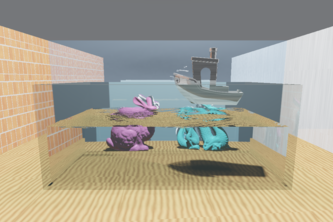
What Changed: The author reports a progression from a 2D ray tracer to a 3D rendering engine, integrating agentic workflows via AI tools (ChatGPT, Codex), with an emphasis on material systems, fluid simulation, and motion authoring.
Single Most Important Open Question: Is there any evidence of actual product-market fit or usage beyond the author’s own development?
This is a self-reported, unverified account of a personal project built over 14 months. No revenue, customers, traction, or commercial adoption are evidenced. The description contains no claims about monetization, partnerships, or user base.
What The Product Actually Is
The description states that Cosm-optiC is a rendering engine and scene-to-render studio. It supports:
- Scene creation with STL objects
- Fluid simulation (via VF3D data source)
- Material state configuration for objects in scenes
- Rendering integrators from direct lighting to Pixar-level quality
- Animation rendering capabilities
It is described as being built using AI tools like ChatGPT and Codex, and includes a CLI-based workflow. The author also mentions building a "FabriC" set of core libraries and a worker node system for distributed computing.
Inference: The product appears to be a personal development project focused on rendering and simulation, not yet commercialized or validated in any marketplace context.
Positioning & Claim Evolution
The author positions Cosm-optiC as:
- An editable scene-to-render studio
- Capable of fast direct lighting to Disney-v2 quality
- Designed to function in parallel with AI agentic workflows
It is described as a tool for creating dynamic scenes and simulations, integrating fluid dynamics and complex material systems.
Inference: The positioning evolved from a personal learning project (ray tracing) into a more advanced rendering system with AI integration. However, the author does not claim any market presence or product adoption beyond their own use.
Target Customer & ICP
Not evidenced.
The description does not identify any specific customer segments or personas. It is unclear whether this tool is intended for developers, animators, or end-users. The author describes working alone and building a system for personal use, with no mention of external users or target markets.
Business Model & Pricing Evidence
Not evidenced.
There is no indication of pricing, monetization strategy, or business model in the description. No revenue streams, subscriptions, or commercial partnerships are mentioned.
Technical & Delivery Signals
The author reports:
- Development using AI tools (ChatGPT, Codex)
- Use of C and Python
- CLI-based tooling
- Ray tracing (2D → 3D)
- Fluid simulation (VF3D data source)
- Material system and scene editor
- Worker node system for distributed computing
- Compiler development for validation
Inference: The technical stack is personal, with a focus on AI-assisted development. No evidence of delivery to users or production systems.
Traction & Maturity Signals
Not evidenced.
There is no mention of:
- Customers
- Revenue
- Usage metrics
- Product releases beyond the author’s own work
- Market feedback or adoption
The project is described as a personal effort over 14 months, without any indication of traction or commercial viability.
Competitive Context
Not evidenced.
No competitors are named or described. The author does not reference existing tools in the rendering or simulation space, nor does he compare his work to others.
Open Questions & Risks
- No commercial evidence: No revenue, customers, or adoption.
- Self-reported only: All claims are unverified and based on personal narrative.
- Personal project: The entire effort appears to be a solo endeavor with no external validation.
- Unclear market fit: No indication of target users or demand.
- No product-market alignment: The author does not describe any feedback loop from users or customers.
Questions the description leaves open
- What specific problem are you solving for users, and how do you know they have that problem?
- Have you tested your tool with external users or collaborators?
- Are there any early adopters or pilot programs?
- How do you plan to monetize this tool?
- What is the timeline for moving from a personal project to a productized offering?
Overall Assessment
Not evidenced.
There is no evidence of commercial traction, revenue, or market validation. The description is entirely self-reported and lacks any data on product-market fit, user adoption, or business model viability. This appears to be a solo developer’s personal project with no indication of commercial potential or partnership opportunity at this time.
User Stories BotA demo video on every pull request
Get a demo video on every new feature
GitHub App that watches your pull requests and records a narrated, captioned demo.
Save time on demo prep and make informed decisions faster with a video walkthrough of every new feature.
Source
Submitted to the OpenAI 2026 hackathon on Devpost. Project home on Devpost. Back to the full gallery on Devpost.
This competitive analysis was produced by top-founders.com (opens in a new tab)
Generated by a language model from this project's public Devpost page — its tagline, the author's own write-up and any built-with tags listed there — as captured in August 2026. Short quotations are the author's words. It is an opinion on the idea as a business, not on the people behind it, and it reflects the description as published then. If the project has moved on, request a correction below. The analysis is not independent research and contains no verified traction, revenue or customer data.
An independent guide by KFG International LLC — not affiliated with, endorsed by, or connected to Devpost or OpenAI.