

Archive position — measured, not model output
0 likes on Devpost
2,263 of the 7,850 archived projects have more likes, and 5,587 share exactly 0 — so this project's #3,472 place in the like-ranked listing is a tie-break inside that group, not a ranking.
Projects (log scale)
Likes on Devpost. ▲ marks this project's group.
Show the figures
| Likes | Projects | Share of archive |
|---|---|---|
| 0 | 5,587 | 71.2% |
| 1 | 1,758 | 22.4% |
| 2 | 284 | 3.6% |
| 3–4 | 132 | 1.7% |
| 5–9 | 75 | 1.0% |
| 10+ | 14 | 0.2% |
 User Stories BotA demo video on every pull request
Get a demo video on every new feature
GitHub App that watches your pull requests and records a narrated, captioned demo.
Save time on demo prep and make informed decisions faster with a video walkthrough of every new feature.
Executive Summary
What the company appears to be
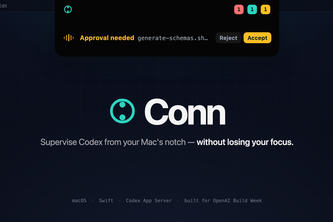
Conn is a macOS notch companion for Codex, described as a native app that turns the area around the macOS notch into a supervision surface for Codex agents. It allows users to monitor running threads, approve or deny permissions, and interact with tasks without leaving their workflow.
What changed
The author pivoted from an ambitious GIS plugin for Codex to a lightweight macOS app that uses Codex's App Server to supervise autonomous agent tasks, leveraging GPT 5.6 Sol for implementation.
Single most important open question
Is there any evidence of actual usage or adoption beyond the author’s own development and dogfooding?
What The Product Actually Is
The description states that Conn is a native macOS notch app designed to supervise Codex agents. It connects as a client to the Codex-managed App Server daemon, allowing Codex to own the threads and work while Conn watches and lets users act quickly when needed.
- The app uses the macOS notch area as an interface for monitoring agent tasks.
- It shows status pins (teal = running, amber = waiting for permission, red = failed, grey = idle).
- When something meaningful happens, a small shelf slides out to show what the thread is doing.
- Approve and deny options appear in the notch when Codex asks for permission.
- Expanded view provides a compact chat workspace to switch threads, read transcripts, answer questions, steer running turns, send follow-ups, stop turns, or start new chats.
- If full attention is needed, "Open in Codex" hands control back to the main application.
Evidence Self-reported by author. No third-party verification or traction data provided.
Positioning & Claim Evolution
The author describes Conn as a "macOS notch companion for Codex", inspired by the iPhone Dynamic Island but adapted for desktop use. The positioning is rooted in solving friction experienced while building a plugin for Codex — specifically, the problem of missing notifications when tabbing away during long-running tasks.
- The app was conceived as a way to offload tasks to autonomous agents and receive ambient updates.
- It positions itself as a tool that enables users to "go browse Reddit or play a game" while still maintaining oversight over Codex workflows.
- The name "Conn" comes from the naval term describing control of a ship, metaphorically applying to controlling agents.
Evidence Self-reported. No external positioning claims or market research cited.
Target Customer & ICP
The description suggests that Conn targets users who work with Codex and want to supervise autonomous agent tasks without being constantly present in the app.
- The primary user is likely someone working with Codex plugins or agents, especially those involving long-running processes.
- Users may include developers, analysts, or power users of AI tools who value ambient awareness and minimal interruption during task execution.
Evidence Self-reported. No explicit customer segmentation or persona data provided.
Business Model & Pricing Evidence
There is no evidence of a business model or pricing structure in the description.
- The project is described as an open-source release.
- No mention of monetization, subscriptions, licensing, or revenue streams.
Evidence Not evidenced.
Technical & Delivery Signals
The author built Conn using:
- SwiftUI
- Swift concurrency
- Codex CLI
- Codex App Server
- JSON-RPC
- Unix sockets
- WebSocket
- AppKit
The app was developed over a weekend, with significant use of GPT 5.6 Sol for implementation and design decisions.
- The author used ChatGPT voice chat to explore ideas.
- A handover document was written for Codex.
- GPT 5.6 Sol was used to implement the app through and through, including UI development.
- The author dogfooded the app during development.
Evidence Self-reported. No external validation or technical audits provided.
Traction & Maturity Signals
There is no evidence of traction, adoption, or user engagement beyond the author’s own development and testing.
- The project was submitted to a hackathon.
- It is described as an open-source release.
- No metrics, customer feedback, or usage data are mentioned.
Evidence Not evidenced.
Competitive Context
The description does not provide any information about competitors or market context.
- No mention of similar tools or platforms in the space.
- No indication of how Conn compares to existing agent supervision or ambient notification systems.
Evidence Not evidenced.
Open Questions & Risks
Several risks and open questions are present based on the self-reported description:
- No traction or adoption evidence: The project is described as a weekend hackathon effort, with no signs of real-world usage.
- Single-person team: Only one developer (Archit Pai) is involved, raising concerns about scalability and long-term maintenance.
- Unverified claims: All descriptions are self-reported; there is no third-party validation or independent evidence.
- Open-source nature: While open source can be a positive signal, it also implies no commercial focus or monetization strategy at this stage.
- Dependency on GPT 5.6 Sol: Heavy reliance on AI for development raises questions about reproducibility and future viability if access to such tools changes.
Evidence Self-reported. No external data or market signals provided.
Questions the description leaves open
- What is the actual usage rate of Conn among developers or analysts?
- Are there any plans to monetize or commercialize the product beyond open-source?
- How does Conn integrate with other agent frameworks, not just Codex?
- Has the author considered potential scalability issues with the current architecture?
- What are the long-term maintenance plans for the project given the single-person team?
Inference These questions arise from the lack of traction and commercialization evidence in the description.
Overall Assessment
There is no evidence of a viable business model, revenue, or traction. The project is described as a weekend hackathon effort, with no indication of real-world adoption or monetization plans.
- It appears to be an experimental tool built for personal use and dogfooding.
- No clear path to market traction or commercial viability is evident from the description.
- The single-person team and open-source nature suggest limited immediate potential for investment or partnership.
Assessment Not evidenced. This project lacks the commercial signals required for due-diligence consideration at this stage.
User Stories BotA demo video on every pull request
Get a demo video on every new feature
GitHub App that watches your pull requests and records a narrated, captioned demo.
Save time on demo prep and make informed decisions faster with a video walkthrough of every new feature.
Source
Submitted to the OpenAI 2026 hackathon on Devpost. Project home on Devpost. Back to the full gallery on Devpost.
This competitive analysis was produced by top-founders.com (opens in a new tab)
Generated by a language model from this project's public Devpost page — its tagline, the author's own write-up and any built-with tags listed there — as captured in August 2026. Short quotations are the author's words. It is an opinion on the idea as a business, not on the people behind it, and it reflects the description as published then. If the project has moved on, request a correction below. The analysis is not independent research and contains no verified traction, revenue or customer data.
An independent guide by KFG International LLC — not affiliated with, endorsed by, or connected to Devpost or OpenAI.