

Archive position — measured, not model output
2 likes on Devpost
221 of the 7,850 archived projects have more likes, and 284 share exactly 2 — so this project's #290 place in the like-ranked listing is a tie-break inside that group, not a ranking.
Projects (log scale)
Likes on Devpost. ▲ marks this project's group.
Show the figures
| Likes | Projects | Share of archive |
|---|---|---|
| 0 | 5,587 | 71.2% |
| 1 | 1,758 | 22.4% |
| 2 | 284 | 3.6% |
| 3–4 | 132 | 1.7% |
| 5–9 | 75 | 1.0% |
| 10+ | 14 | 0.2% |
 User Stories BotA demo video on every pull request
Get a demo video on every new feature
GitHub App that watches your pull requests and records a narrated, captioned demo.
Save time on demo prep and make informed decisions faster with a video walkthrough of every new feature.
Executive Summary
What the company appears to be
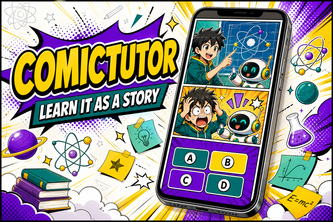
ComicTutor is a self-reported mobile learning application that uses AI to transform difficult topics or uploaded files into personalized illustrated comic lessons and dynamic quizzes. The app is built with Flutter and Dart for the frontend, and Python/FastAPI for backend processing.
What changed
The project description indicates a shift from personal experimentation with image generation (using GPT Image 2) to a structured educational tool that integrates source material, story creation, visual teaching moments, and assessment. It evolved into a complete learning loop involving source input, comic generation, quiz building, and feedback mechanisms.
Single most important open question
Is there evidence of actual user adoption or testing beyond the authors' own demonstrations? The description states no revenue, customers, or traction data are available — all claims are self-reported.
What The Product Actually Is
The description states that ComicTutor is a mobile learning app that turns difficult topics, pasted text, or supported files into illustrated vertical comic lessons. It includes:
- Four to six mobile-friendly comic pages with recurring characters, dialogue, captions, diagrams, cutaways, and visual explanations.
- A five-question Twist Quiz built from the lesson's actual content.
- Challenge Mode with Rapid Recall, Story Check, and Final Clue rounds.
- Local demo lessons bundled for immediate access without credentials or generation time.
The app is described as not simply an image generator with a quiz attached — instead, the source facts, story, visual teaching moments, quiz, feedback, and Challenge Mode all belong to the same grounded lesson plan.
Evidence Self-reported by authors. No independent verification of functionality or user experience.
Positioning & Claim Evolution
The description states that ComicTutor was inspired by the author's experimentation with GPT Image 2 to create illustrated comic stories for friends who enjoyed them. This led to a broader question: what if difficult lessons could feel as engaging and memorable as those stories?
The app is positioned as transforming complex ideas into memorable, interactive learning experiences using AI-powered storytelling and visual teaching.
It evolved from a personal experiment into a structured educational tool that integrates source material, story creation, visual explanations, and assessment — aiming to make learning more engaging and effective than traditional methods.
Evidence Self-reported evolution narrative. No external validation or market positioning data provided.
Target Customer & ICP
The description does not explicitly state the target customer segment or ideal customer profile (ICP). However, it implies a focus on learners who struggle with dense or abstract content and want more engaging ways to understand difficult topics.
The app supports various input types including text, PDFs, and images, suggesting a broad educational audience. It also mentions future features like educator-reviewed collections and classroom collaboration, which may indicate an eventual target of educators or institutions.
Evidence Inferred from product description. No explicit customer data or segmentation provided.
Business Model & Pricing Evidence
The description does not provide any information about pricing models, monetization strategies, or business model details. There is no mention of subscriptions, freemium tiers, enterprise licensing, or other commercial structures.
Evidence Not evidenced.
Technical & Delivery Signals
The app is built with:
- Frontend: Flutter and Dart
- Backend: Python, FastAPI, Pydantic, SQLite
- AI Tools: Codex with GPT-5.6, GPT-Image-2, OpenAI Responses API, OpenAI Image API
- Infrastructure: Docker, GitHub Actions, Uvicorn, Riverpod, GoRouter, Dio, SymPy, PyPDF, JSON Schema, HTTPX
The pipeline includes:
- Source validation and fact extraction
- Story planning with character guide
- Concurrent comic page generation via Codex CLI
- Quiz and Challenge Mode creation from lesson content
- Local demo lessons bundled for immediate access
It supports text-based PDFs, captioned images, and pasted text as inputs.
Evidence Self-reported technical architecture and workflow. No independent verification of delivery or performance metrics.
Traction & Maturity Signals
The description does not contain any data on user traction, adoption rates, revenue, or customer base. It mentions:
- Four original demo lessons bundled locally
- A video demo link (https://youtu.be/wthHR-sVCI4)
- Source code available at GitHub (https://github.com/said-yousuf/ComicTutor)
No evidence of live users, usage statistics, or product-market fit is provided.
Evidence Not evidenced.
Competitive Context
The description does not mention competitors or the competitive landscape. It does not reference similar tools in the educational AI space, nor does it describe how ComicTutor differentiates from existing solutions.
Evidence Not evidenced.
Open Questions & Risks
Several risks and open questions are present based on the self-reported information:
- No traction or revenue data: The app appears to be a prototype or early-stage product with no evidence of real-world usage.
- Unverified claims: All features, functionality, and outcomes are self-reported without external validation.
- Limited commercial clarity: No pricing model, monetization strategy, or business plan is described.
- Dependency on AI tools: Heavy reliance on Codex, GPT-5.6, and OpenAI APIs may pose scalability or cost risks if these services change or become unavailable.
- Lack of user feedback or testing: The project has not been tested with real learners beyond the authors' own experiments.
Evidence Inferred from lack of evidence and self-reported nature of description.
Questions the description leaves open
- What specific educational outcomes have you observed in your testing?
- Have you conducted any user studies or pilot programs with actual students or educators?
- How do you plan to scale the comic generation process beyond local development?
- What is your roadmap for monetization and long-term sustainability?
- Are there any partnerships or institutional collaborations planned?
- How do you ensure consistency in educational content across generated lessons?
- What are the technical limitations of current AI tools that impact scalability?
Evidence Inferences based on lack of information in the description.
Overall Assessment
The description indicates a self-reported prototype or early-stage product with no verified traction, revenue, or customer data. It is built around an idea that aligns with emerging trends in AI-powered education but lacks evidence of real-world application or commercial viability.
Given the lack of independent verification and absence of any measurable impact, this project should be considered a concept or proof-of-concept rather than a developed business.
Assessment Not ready for investment or partnership. Requires further validation through user testing, market feedback, and demonstration of traction before any serious consideration.
User Stories BotA demo video on every pull request
Get a demo video on every new feature
GitHub App that watches your pull requests and records a narrated, captioned demo.
Save time on demo prep and make informed decisions faster with a video walkthrough of every new feature.
Source
Submitted to the OpenAI 2026 hackathon on Devpost. Project home on Devpost. Back to the full gallery on Devpost.
This competitive analysis was produced by top-founders.com (opens in a new tab)
Generated by a language model from this project's public Devpost page — its tagline, the author's own write-up and any built-with tags listed there — as captured in August 2026. Short quotations are the author's words. It is an opinion on the idea as a business, not on the people behind it, and it reflects the description as published then. If the project has moved on, request a correction below. The analysis is not independent research and contains no verified traction, revenue or customer data.
An independent guide by KFG International LLC — not affiliated with, endorsed by, or connected to Devpost or OpenAI.