

Archive position — measured, not model output
0 likes on Devpost
2,263 of the 7,850 archived projects have more likes, and 5,587 share exactly 0 — so this project's #4,216 place in the like-ranked listing is a tie-break inside that group, not a ranking.
Projects (log scale)
Likes on Devpost. ▲ marks this project's group.
Show the figures
| Likes | Projects | Share of archive |
|---|---|---|
| 0 | 5,587 | 71.2% |
| 1 | 1,758 | 22.4% |
| 2 | 284 | 3.6% |
| 3–4 | 132 | 1.7% |
| 5–9 | 75 | 1.0% |
| 10+ | 14 | 0.2% |
 User Stories BotA demo video on every pull request
Get a demo video on every new feature
GitHub App that watches your pull requests and records a narrated, captioned demo.
Save time on demo prep and make informed decisions faster with a video walkthrough of every new feature.
Executive Summary
Company: FoundPair
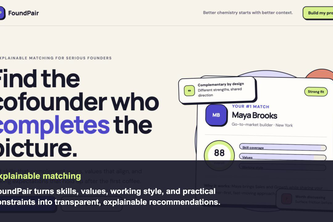
Self-reported purpose: A tool to help founders find complementary cofounders by matching profiles based on skills, values, goals, work style, and logistics.
Key claim: The product helps founders make better first-conversation decisions rather than pretending to choose a life-changing partner for them.
What changed: This is a hackathon MVP built with React, TypeScript, and AI tools (Codex, GPT-5.6), designed as a local-first experience without authentication or backend services.
Single most important open question: Does the described matching logic actually produce useful or reliable recommendations for cofounder pairing — or is it merely a demonstration of concept?
What The Product Actually Is
The description states that FoundPair is a static React 19 and TypeScript 6 application, built with Vite, using local browser storage. It is a local-first product that does not require an account or API key.
It allows users to input their own profile data (skills, needs, values, goals, working style, availability, logistics) and then evaluates candidates based on five transparent dimensions: skill complementarity, values, goals, work style, and logistics.
The system includes:
- Eligibility filters for hard constraints
- A deterministic weighted model that computes scores across the five dimensions
- Stable ranking for candidates scoring 50 or higher
- Grounded templates that turn profile evidence into strengths, friction points, and conversation prompts
It also generates a thoughtful introduction based on this data.
Not evidenced: Whether any actual matching has occurred beyond the fictional cohort used in the demo. No real-world data or user feedback is provided.
Positioning & Claim Evolution
The description states that FoundPair was inspired by the idea that “the most consequential early-stage hire is not really a hire: it is the person you choose to build the company with.”
It positions itself as:
- A decision-support tool, not an AI black box
- A transparent system where match explanations are grounded in profile evidence
- A privacy-first product, storing all data locally and avoiding remote endpoints in its MVP
The authors emphasize that they rejected an AI-only approach because it would be difficult to reproduce, test, or challenge.
They also state that the next milestone is a consent-based beta with verified profiles, mutual interest, and structured feedback mechanisms.
Inference: The positioning reflects a shift from speculative AI-driven matching toward a more human-in-the-loop, explainable system. However, this evolution is not yet demonstrated in the MVP.
Target Customer & ICP
The description states that FoundPair is aimed at founders looking for complementary cofounders, particularly those who are early-stage and may be relying on warm introductions or unstructured methods like résumé keywords.
It targets:
- Early-stage founders
- People seeking to build companies with others
- Individuals who want to validate compatibility before investing time in a conversation
Not evidenced: Specific customer segments, personas, or market size. No evidence of target market validation or user interviews.
Business Model & Pricing Evidence
The description does not contain any information about pricing, monetization, or business model.
It mentions that the next step is a consent-based beta, implying some form of opt-in data sharing or access control, but no details are given on how this might translate into revenue.
Not evidenced: Any commercial structure, pricing tiers, or monetization strategy beyond the idea of a future beta with feedback loops.
Technical & Delivery Signals
The product is built using:
- React 19
- TypeScript 6
- Vite
- Codex and GPT-5.6 (used for scoping, architecture, testing, and documentation)
- Local browser storage (no backend or API calls in the demo)
It uses:
- Pure domain modules
- Deterministic scoring logic
- Unit tests and interaction tests
- Versioned and defensive local storage handling
The authors claim that GPT-5.6 was used only at build time, not in production.
Inference: The technical stack supports a lightweight, client-side experience with strong emphasis on privacy and testability. However, no evidence of scalability or performance under load is provided.
Traction & Maturity Signals
The description states that this is a hackathon MVP, built for judges to evaluate the full journey without needing an account or API key.
It includes:
- A no-sign-up live demo
- Dated product documents and incremental commits
- Automated tests
- A documented engineering process assisted by Codex
There is no mention of:
- Real users or usage metrics
- Customer feedback or retention
- Product iterations beyond the hackathon version
Not evidenced: Any traction, user base, or adoption data.
Competitive Context
The description does not reference any competitors directly. It implies that current methods for cofounder matching include:
- Warm introductions
- Broad communities
- Résumé keywords
- Unexplained match percentages
It positions FoundPair as an alternative to these approaches by emphasizing transparency and evidence-based recommendations.
Not evidenced: Market analysis, competitive landscape, or differentiation from existing tools in the cofounder-matching space.
Open Questions & Risks
Key risks include:
- Unproven matching logic: The system is described as deterministic but not validated with real-world data.
- Limited scope of MVP: The demo uses a fictional cohort and lacks authentication, chat, or live marketplace features.
- Privacy vs. utility trade-off: While privacy is emphasized, the lack of real profiles and feedback may limit its usefulness in practice.
- AI dependency without clarity: Although GPT-5.6 was used only at build time, there’s no indication how much AI will be involved in future versions or whether it will remain transparent.
Inference: The product is still largely conceptual and untested in real-world scenarios.
Questions the description leaves open
- How did you validate the scoring criteria used for each of the five dimensions (skill complementarity, values, goals, work style, logistics)?
- What assumptions are baked into the model that could lead to incorrect matches?
- Can you walk us through how you would test or audit the matching algorithm in a real-world setting?
- How do you plan to handle edge cases like incomplete profiles or conflicting data?
- What kind of feedback mechanism will be used in the beta version to improve match quality over time?
- Are there any plans to integrate external data sources (e.g., LinkedIn, GitHub) into the matching process?
- How do you intend to scale beyond the local-first MVP without compromising privacy?
Overall Assessment
Not evidenced: No financials, revenue, or traction data are available. The project is described as a hackathon MVP with no commercial activity.
The description suggests a conceptual strength in transparency and privacy, but lacks evidence of:
- Real-world validation
- Scalable architecture
- Clear monetization path
This is a pre-product concept, not a product ready for investment or partnership. The authors have demonstrated an understanding of the problem space and some technical capability, but no real-world performance or user behavior has been shown.
Confidence level: Low — based entirely on self-reported claims with no external verification or data.
User Stories BotA demo video on every pull request
Get a demo video on every new feature
GitHub App that watches your pull requests and records a narrated, captioned demo.
Save time on demo prep and make informed decisions faster with a video walkthrough of every new feature.
Source
Submitted to the OpenAI 2026 hackathon on Devpost. Project home on Devpost. Back to the full gallery on Devpost.
This competitive analysis was produced by top-founders.com (opens in a new tab)
Generated by a language model from this project's public Devpost page — its tagline, the author's own write-up and any built-with tags listed there — as captured in August 2026. Short quotations are the author's words. It is an opinion on the idea as a business, not on the people behind it, and it reflects the description as published then. If the project has moved on, request a correction below. The analysis is not independent research and contains no verified traction, revenue or customer data.
An independent guide by KFG International LLC — not affiliated with, endorsed by, or connected to Devpost or OpenAI.