

Archive position — measured, not model output
0 likes on Devpost
2,263 of the 7,850 archived projects have more likes, and 5,587 share exactly 0 — so this project's #3,415 place in the like-ranked listing is a tie-break inside that group, not a ranking.
Projects (log scale)
Likes on Devpost. ▲ marks this project's group.
Show the figures
| Likes | Projects | Share of archive |
|---|---|---|
| 0 | 5,587 | 71.2% |
| 1 | 1,758 | 22.4% |
| 2 | 284 | 3.6% |
| 3–4 | 132 | 1.7% |
| 5–9 | 75 | 1.0% |
| 10+ | 14 | 0.2% |
 User Stories BotA demo video on every pull request
Get a demo video on every new feature
GitHub App that watches your pull requests and records a narrated, captioned demo.
Save time on demo prep and make informed decisions faster with a video walkthrough of every new feature.
Executive Summary
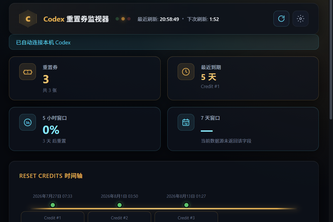
The description states that codex-reset-watcher is a Windows desktop app for visualizing Codex reset credit expiration timelines and rate limits, with smart usage recommendations. The author describes it as lightweight and built using Tauri, React, TypeScript, and Vite. It was submitted to the OpenAI 2026 hackathon.
What changed: This appears to be a self-contained tool developed for a hackathon, likely intended to help developers manage API usage limits in a specific context (Codex). The project has no evidence of prior traction or commercial deployment beyond its submission.
Single most important open question: Is there any evidence of actual user adoption or demand for this tool outside of the hackathon context?
Note: This analysis is based solely on the self-reported, unverified description provided by the caller. No external verification or historical data are available. All claims are attributed to the author’s own write-up.
What The Product Actually Is
The description states that codex-reset-watcher is a Windows desktop app designed to visualize:
- Codex reset credit expiration timelines
- 5-hour and 7-day rate limit windows
- Provide smart usage recommendations
It is described as lightweight, built using Tauri, React, TypeScript, and Vite, with support for localization.
The author does not provide a detailed product walkthrough or functional specification beyond its purpose. There is no evidence of UI mockups, screenshots, or feature lists in the description.
Positioning & Claim Evolution
The description states that codex-reset-watcher is a lightweight Windows desktop app for visualizing Codex reset credit expiration timelines and rate limit windows, with smart usage recommendations.
It positions itself as a tool for developers managing API usage limits, particularly in the context of OpenAI’s Codex service. The author does not describe any evolution or prior versions of this product — it appears to be a one-off submission to a hackathon.
No claims about market fit, prior versions, or competitive differentiation are made by the author.
Target Customer & ICP
The description states that codex-reset-watcher is for users managing Codex reset credit expiration timelines and rate limits, particularly in the context of OpenAI’s Codex service. It is a Windows desktop app.
It is not clear whether this targets individual developers or enterprise users, nor if it has a defined ICP beyond those who use Codex APIs.
The author does not define a specific customer persona or segment. No evidence of target user research or segmentation is provided.
Business Model & Pricing Evidence
The description states that codex-reset-watcher is a Windows desktop app with no mention of pricing, monetization, or business model.
There is no indication of whether it will be free, paid, or offered as part of a larger suite. No evidence of a revenue stream or pricing structure is provided.
Not evidenced.
Technical & Delivery Signals
The description states that codex-reset-watcher was built using:
- Tauri
- React
- TypeScript
- Vite
- CSS
- Localization support
It is a Windows desktop app, and the author declares it as lightweight.
These technical choices suggest a modern, cross-platform approach to building desktop apps. However, no evidence of delivery timeline, versioning, or deployment strategy is provided.
Traction & Maturity Signals
The description states that codex-reset-watcher was submitted to the OpenAI 2026 hackathon on Devpost.
There is no evidence of:
- User adoption
- Revenue
- Customers
- Product usage metrics
- Post-hackathon development or deployment
Not evidenced.
Competitive Context
The description does not mention any competitors or similar tools. It is unclear whether there are existing solutions for visualizing Codex reset credit expiration timelines or rate limits.
Not evidenced.
Open Questions & Risks
- The tool is described as a hackathon submission, with no evidence of further development or commercialization.
- No evidence of user feedback, adoption, or market demand.
- The author does not describe any strategy for product-market fit or scalability.
- The app is limited to Windows desktop, which may limit its reach.
- No indication of how it integrates with Codex APIs or whether it’s an official or third-party tool.
These are inferred risks based on the lack of evidence around traction, commercial viability, and product maturity.
Questions the description leaves open
- What inspired the creation of this tool? Was there a specific pain point you were trying to solve?
- How did you identify your target users or use cases for this tool?
- Are you planning to continue development beyond the hackathon?
- Do you have any early feedback from developers using Codex APIs?
- What is your plan for monetization or distribution of this tool?
- Is this tool intended to be a standalone utility or part of a larger product suite?
Overall Assessment
The description states that codex-reset-watcher is a Windows desktop app submitted to the OpenAI 2026 hackathon.
There is no evidence of:
- Product-market fit
- Traction or user adoption
- Revenue or monetization strategy
- Commercial viability or scalability
Not evidenced. The tool appears to be a prototype or proof-of-concept, with no indication of commercial intent or development beyond the hackathon submission.
User Stories BotA demo video on every pull request
Get a demo video on every new feature
GitHub App that watches your pull requests and records a narrated, captioned demo.
Save time on demo prep and make informed decisions faster with a video walkthrough of every new feature.
Source
Submitted to the OpenAI 2026 hackathon on Devpost. Project home on Devpost. Back to the full gallery on Devpost.
This competitive analysis was produced by top-founders.com (opens in a new tab)
Generated by a language model from this project's public Devpost page — its tagline and any built-with tags listed there, since the author published no write-up — as captured in August 2026. Short quotations are the author's words. It is an opinion on the idea as a business, not on the people behind it, and it reflects the description as published then. If the project has moved on, request a correction below. The analysis is not independent research and contains no verified traction, revenue or customer data.
An independent guide by KFG International LLC — not affiliated with, endorsed by, or connected to Devpost or OpenAI.