

Archive position — measured, not model output
1 like on Devpost
505 of the 7,850 archived projects have more likes, and 1,758 share exactly 1 — so this project's #836 place in the like-ranked listing is a tie-break inside that group, not a ranking.
Projects (log scale)
Likes on Devpost. ▲ marks this project's group.
Show the figures
| Likes | Projects | Share of archive |
|---|---|---|
| 0 | 5,587 | 71.2% |
| 1 | 1,758 | 22.4% |
| 2 | 284 | 3.6% |
| 3–4 | 132 | 1.7% |
| 5–9 | 75 | 1.0% |
| 10+ | 14 | 0.2% |
 User Stories BotA demo video on every pull request
Get a demo video on every new feature
GitHub App that watches your pull requests and records a narrated, captioned demo.
Save time on demo prep and make informed decisions faster with a video walkthrough of every new feature.
Executive Summary
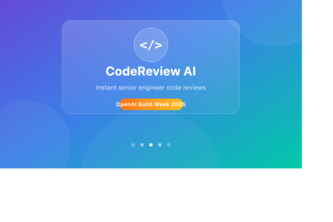
The description states that CodeReview AI is a web app that takes code snippets and returns structured senior engineer-style reviews powered by OpenAI's Codex. The author claims it identifies bugs, performance issues, security vulnerabilities, and provides actionable fixes. It was built as a hackathon submission for the OpenAI 2026 hackathon.
The project appears to be an early-stage prototype with no evidence of revenue, customers or traction. The author is a single individual (Ommer Younus) who built it in a hackathon context. The core functionality relies on prompt engineering and Codex API integration.
Most important open question
Is there any evidence that this tool has been used beyond the hackathon context, or whether it has moved beyond prototype status?
What The Product Actually Is
The description states that CodeReview AI is a web app that takes code snippets and returns structured senior engineer-style reviews powered by OpenAI's Codex. It identifies:
- 🐛 Bugs — logic errors, off-by-one mistakes, null pointer risks
- ⚡ Performance issues — inefficient algorithms, unnecessary allocations
- 🔒 Security vulnerabilities — injection risks, unsafe defaults
- ✅ Actionable fixes — not just what's wrong, but how to fix it
The author describes the technical implementation as:
- Frontend — React app with a clean code editor interface
- Backend — Node.js API endpoint calling OpenAI Codex with carefully engineered prompts
- Deployment — Hosted on Vercel for instant global availability
Positioning & Claim Evolution
The description states that CodeReview AI was inspired by the problem of developers shipping bugs that senior engineers could catch, but who are expensive, busy and not always available. The author's claim is that it gives every developer access to instant, high-quality code review at any time.
The positioning appears to be:
- A tool for developers (from students to startup founders) seeking immediate feedback on code quality
- Leveraging AI to democratize access to senior-level code review
- Focused on catching bugs, security issues and performance problems before production
Target Customer & ICP
The description states that the target customer is "every developer — from students to startup founders" who wants access to instant, high-quality code review.
The author's own write-up indicates this is a tool for developers seeking to improve their code quality and catch issues early in development. The positioning suggests it targets individual developers rather than organizations or teams.
Business Model & Pricing Evidence
Not evidenced. The description does not contain any information about pricing, monetization strategy, or business model.
Technical & Delivery Signals
The description states that the tool was built with:
- Frontend: React app with a clean code editor interface
- Backend: Node.js API endpoint calling OpenAI Codex with carefully engineered prompts
- Deployment: Hosted on Vercel for instant global availability
The author notes that prompt engineering was key to getting structured, consistent reviews. Early versions were too verbose or missed critical bugs. The tool uses a structured output format (explicit categories) rather than free-form responses.
Traction & Maturity Signals
Not evidenced. There is no evidence of revenue, customers, usage metrics, or product maturity beyond the hackathon prototype.
The description states this was built as a hackathon submission for the OpenAI 2026 hackathon. The author mentions using a real bug from their own debugging experience to demonstrate functionality.
Competitive Context
Not evidenced. The description does not contain any information about competitors, market positioning relative to existing tools, or competitive landscape.
Open Questions & Risks
- Prototype-only status: Built as a hackathon submission with no evidence of further development or traction
- Single-person team: Only one individual (Ommer Younus) involved in creation
- Dependency on external API: Relies entirely on OpenAI Codex, which may change pricing or availability
- Limited validation: No evidence of real-world usage beyond the author's own debugging experience
- Unproven commercial viability: No revenue, customers or business model described
Questions the description leaves open
- Has this tool been used beyond the hackathon context?
- What is the current status of development beyond the prototype phase?
- Are there any plans to monetize or scale this product?
- How does the tool handle edge cases or complex code scenarios not covered in the demo?
- What are the technical limitations or accuracy issues with Codex that might affect real-world use?
Overall Assessment
Not evidenced. The description contains no information about funding, valuation, or investment status. The project appears to be an early-stage prototype with no evidence of commercial traction or viability beyond the hackathon context.
The author states this was built for a hackathon and there is no evidence of any revenue, customers, or business model. The tool relies on external API dependencies and has not demonstrated real-world adoption or usage beyond the author's own experience.
User Stories BotA demo video on every pull request
Get a demo video on every new feature
GitHub App that watches your pull requests and records a narrated, captioned demo.
Save time on demo prep and make informed decisions faster with a video walkthrough of every new feature.
Source
Submitted to the OpenAI 2026 hackathon on Devpost. Project home on Devpost. Back to the full gallery on Devpost.
This competitive analysis was produced by top-founders.com (opens in a new tab)
Generated by a language model from this project's public Devpost page — its tagline, the author's own write-up and any built-with tags listed there — as captured in August 2026. Short quotations are the author's words. It is an opinion on the idea as a business, not on the people behind it, and it reflects the description as published then. If the project has moved on, request a correction below. The analysis is not independent research and contains no verified traction, revenue or customer data.
An independent guide by KFG International LLC — not affiliated with, endorsed by, or connected to Devpost or OpenAI.