

Archive position — measured, not model output
0 likes on Devpost
2,263 of the 7,850 archived projects have more likes, and 5,587 share exactly 0 — so this project's #3,348 place in the like-ranked listing is a tie-break inside that group, not a ranking.
Projects (log scale)
Likes on Devpost. ▲ marks this project's group.
Show the figures
| Likes | Projects | Share of archive |
|---|---|---|
| 0 | 5,587 | 71.2% |
| 1 | 1,758 | 22.4% |
| 2 | 284 | 3.6% |
| 3–4 | 132 | 1.7% |
| 5–9 | 75 | 1.0% |
| 10+ | 14 | 0.2% |
 User Stories BotA demo video on every pull request
Get a demo video on every new feature
GitHub App that watches your pull requests and records a narrated, captioned demo.
Save time on demo prep and make informed decisions faster with a video walkthrough of every new feature.
Executive Summary
Codemask, as described by its author, is a browser extension that enables websites to interact with a user’s local Codex instance via a typed window.codex provider. It allows sites to request specific permissions and execute tasks within the user's own Codex environment without exposing sensitive data or requiring API keys.
The project is presented as a solution to the friction of integrating AI agents into web apps — particularly around authentication, access control, and privacy concerns. The author frames it as a "wallet for agent access" that enables secure, permissioned interaction between web applications and local AI workspaces.
What changed: The description indicates this was built for the OpenAI 2026 hackathon, suggesting an early-stage prototype or proof-of-concept. It does not describe any prior version or evolution from earlier iterations.
Single most important open question: Is there a real market need for such a tool, and if so, how does Codemask differentiate itself from existing agent platforms or local AI tools?
What The Product Actually Is
The description states that Codemask is a browser extension (Manifest V3) with a local native bridge, a TypeScript SDK, and a public API. It provides a window.codex provider for web apps to request access to a user’s local Codex instance.
It works by:
- Enabling websites to ask for specific permissions.
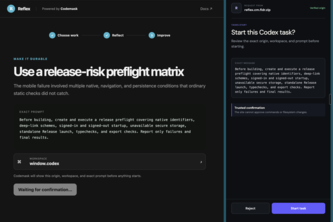
- Showing the origin, workspace, and exact prompt before execution.
- Communicating with a signed-in Codex locally via a native host.
- Blocking unauthorized methods and filtering events.
- Supporting one-time grants and scoped access.
The author also mentions building Reflex, a demo app that analyzes Codex history for insights, and create-window-codex, which appears to be a tool or library used in development.
Inference: The product seems designed to allow developers to integrate AI agent capabilities into web apps without needing to manage authentication or data exposure themselves. It is not a standalone AI platform but rather an integration layer between web apps and local AI environments.
Positioning & Claim Evolution
The author positions Codemask as:
- A way for websites to "turn any site into a Codex app".
- A platform-like experience where the site owns UX, while Codex handles the agent work.
- A privacy-first approach that avoids sending private data or API keys to third-party servers.
Key claims include:
- “Codex can do real work, but web apps can’t safely build on the Codex already running on your computer.”
- “It works like a wallet for agent access.”
- “The privacy model is real, not just UI copy.”
There is no indication of prior positioning or evolution in the description. This appears to be a new concept introduced in this project.
Inference: The author sees Codemask as solving a gap in how developers currently connect web apps to local AI tools — particularly around security and UX friction.
Target Customer & ICP
The description does not name specific customers or personas. However, it implies:
- Developers building web applications that want to integrate with local AI agents.
- Users who run Codex locally, likely power users or developers working in AI/agent environments.
- Websites or platforms looking to offer agent-powered features without managing backend infrastructure.
The author refers to “sites” and “web apps” as the primary interface for end-users, suggesting a B2B developer audience focused on integrating AI into their products.
Inference: The ICP likely includes developers building AI-enhanced web tools or platforms who are already using or interested in local Codex environments.
Business Model & Pricing Evidence
There is no mention of pricing, monetization strategy, or business model in the description. The author does not state whether Codemask will be offered as a freemium, paid service, or open-source tool.
Not evidenced: No evidence of revenue streams, customer acquisition costs, or pricing tiers.
Technical & Delivery Signals
The project is built using:
- Manifest V3 extension
- Native messaging bridge
- TypeScript SDK
- React, Vite, Node.js, TanStack, Cloudflare Pages
- Chrome native messaging, Base UI
It supports:
- Origin-scoped access
- One-time grants
- Event filtering
- Safe error handling
- Confirmation flows for long-running tasks
The author notes challenges in:
- Handling Chrome execution contexts
- Managing native host lifecycles
- Ensuring origin isolation and safe errors
They also mention a guided macOS setup flow and an npx installer to simplify installation.
Inference: The technical architecture is focused on secure, local-first integration with minimal server-side components. It’s built for developers who are comfortable with web technologies and want to build agent-enabled apps.
Traction & Maturity Signals
The description does not provide any evidence of traction or adoption:
- No customers, users, or usage metrics
- No revenue or funding data
- No mention of product launches or user feedback
It is described as a hackathon submission, indicating an early-stage prototype.
Not evidenced: No signs of market validation, product-market fit, or real-world usage.
Competitive Context
The description does not reference competitors or similar tools. It only mentions Codex and Reflex as part of the project ecosystem.
Inference: The author appears to be positioning Codemask in a space where local AI agents are being integrated into web apps — possibly overlapping with tools like OpenAI’s agent framework, LangChain, or other agent platforms that support local execution.
Open Questions & Risks
- No traction or market validation — this is a hackathon project.
- Limited scope and maturity — only one developer involved, no clear roadmap beyond “make setup nearly invisible.”
- Privacy model may be hard to implement at scale — the description implies strong privacy controls but doesn’t explain how they would scale or be enforced in production.
- No business model — unclear how Codemask intends to monetize or sustain itself.
- Technical complexity — reliance on native messaging and browser APIs could limit adoption across platforms.
Questions the description leaves open
- What specific use cases are you targeting for developers? Are there any early adopters?
- How do you plan to expand beyond macOS and Chrome?
- What is your long-term vision for the product — is it a standalone tool, or part of a larger platform strategy?
- How do you intend to onboard developers and explain the value proposition?
- Do you have any plans for monetization or revenue generation?
- What are the biggest technical challenges still unresolved?
Overall Assessment
Not evidenced: No data on valuation, funding rounds, or investor interest.
The project is described as a hackathon submission, suggesting it is in an early prototype phase with no demonstrated traction or commercial viability.
Confidence level: Low. The description provides little evidence of product-market fit, customer demand, or business sustainability.
This appears to be a conceptual proof-of-concept that may evolve into something more substantial, but currently lacks the signals needed for investment or partnership consideration.
User Stories BotA demo video on every pull request
Get a demo video on every new feature
GitHub App that watches your pull requests and records a narrated, captioned demo.
Save time on demo prep and make informed decisions faster with a video walkthrough of every new feature.
Source
Submitted to the OpenAI 2026 hackathon on Devpost. Project home on Devpost. Back to the full gallery on Devpost.
This competitive analysis was produced by top-founders.com (opens in a new tab)
Generated by a language model from this project's public Devpost page — its tagline, the author's own write-up and any built-with tags listed there — as captured in August 2026. Short quotations are the author's words. It is an opinion on the idea as a business, not on the people behind it, and it reflects the description as published then. If the project has moved on, request a correction below. The analysis is not independent research and contains no verified traction, revenue or customer data.
An independent guide by KFG International LLC — not affiliated with, endorsed by, or connected to Devpost or OpenAI.