

Archive position — measured, not model output
0 likes on Devpost
2,263 of the 7,850 archived projects have more likes, and 5,587 share exactly 0 — so this project's #3,339 place in the like-ranked listing is a tie-break inside that group, not a ranking.
Projects (log scale)
Likes on Devpost. ▲ marks this project's group.
Show the figures
| Likes | Projects | Share of archive |
|---|---|---|
| 0 | 5,587 | 71.2% |
| 1 | 1,758 | 22.4% |
| 2 | 284 | 3.6% |
| 3–4 | 132 | 1.7% |
| 5–9 | 75 | 1.0% |
| 10+ | 14 | 0.2% |
 User Stories BotA demo video on every pull request
Get a demo video on every new feature
GitHub App that watches your pull requests and records a narrated, captioned demo.
Save time on demo prep and make informed decisions faster with a video walkthrough of every new feature.
Executive Summary
What the company appears to be
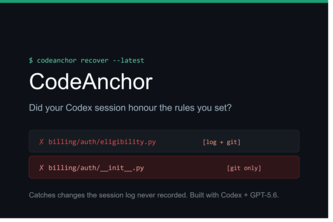
CodeAnchor is a tool that verifies whether a resumed Codex session honoured its original constraints. It operates as a stop hook that runs automatically when a Codex session ends, and can also be invoked manually or integrated into CI/CD pipelines. The tool uses git as an independent source of truth to detect violations — including those not recorded in the agent's own log.
What changed
The project description indicates a shift from attempting to verify constraints via the agent’s own log (which is encrypted and unreliable) to using git as the ground truth. This reframing was driven by the discovery that Codex encrypts its compaction summaries, making log-based verification impossible on real data.
Single most important open question
Is there a viable market for this tool beyond the specific use case described (i.e., regulated codebases with frozen modules)? The description does not indicate any commercial traction or customer feedback, nor does it describe how CodeAnchor would scale beyond its current hackathon prototype.
Note: This analysis is based solely on the self-reported project description provided by the author. No external verification, revenue data, customer names, or adoption metrics are available.
What The Product Actually Is
The description states that CodeAnchor:
- Verifies whether a resumed Codex session still honored its constraints.
- Installs as a Codex Stop hook and runs automatically at session end.
- Can also be run on demand from the CLI or wired into CI as a merge gate.
- Parses the Codex session rollout, extracts task constraints (from AGENTS.md, prompt, or CODEOWNERS), detects where compaction occurred, and checks against git for violations.
- Tags violations by evidence source: log + git, log-only, or git-only.
Inference: The tool is built to detect rule violations that occur during long Codex sessions due to memory compaction. It is not a general-purpose agent monitoring system but rather a specialized verification layer for Codex-based workflows.
Positioning & Claim Evolution
The author states:
- The inspiration came from observing that Codex can compress its memory and silently violate rules without recording the violation in its own log.
- This failure mode was documented by OpenAI itself, indicating a known issue.
- The tool is designed to answer: “Can I trust that the rules I set were honored?”
- It reframes verification from relying on the agent’s own account to using git as an independent source of truth.
Inference: The positioning evolved from a general-purpose agent integrity checker to a specialized solution for regulated environments where compliance is critical. The core insight — that Codex encrypts its summaries — led to this shift in approach.
Target Customer & ICP
The description states:
- The tool addresses “regulated codebases” where touching frozen modules is not just an inconvenience but a compliance event.
- It targets users who rely on Codex for long tasks and need assurance that constraints are honored.
- The tool is built to be integrated into CI/CD pipelines, suggesting enterprise or development teams with formal workflows.
Inference: The initial ICP appears to be developers or DevOps engineers working in regulated industries (e.g., finance, healthcare) who use Codex for code generation and require compliance assurance. However, no explicit customer list or segment data is provided.
Business Model & Pricing Evidence
Not evidenced.
The description does not mention:
- Any pricing model
- Revenue streams
- Monetization strategy
- Subscription tiers or usage-based models
Inference: There is no evidence of a business model beyond the hackathon prototype. The tool appears to be open-source or experimental in nature, with no indication of commercial intent.
Technical & Delivery Signals
The description states:
- Built using GPT-5.6 for code generation and reasoning.
- Uses git as an independent source of truth.
- Parses Codex session rollouts and detects compaction points.
- Implements a stop hook that integrates into Codex sessions.
- The tool is agent-agnostic in design, with Codex being the first supported agent.
- 85 passing tests, including validation against real Codex sessions.
Inference: The technical architecture shows strong engineering effort for a prototype. It leverages AI for both development and runtime logic, and uses git as a robust verification mechanism. However, no production deployment or scalability data is provided.
Traction & Maturity Signals
Not evidenced.
The description does not include:
- Any revenue figures
- Customer adoption or usage metrics
- Product maturity indicators (e.g., versioning, release history)
- User feedback or testimonials
- Market traction beyond the hackathon submission
Inference: The tool is at a prototype stage, likely built for a single hackathon. No evidence of real-world deployment or user engagement.
Competitive Context
Not evidenced.
The description does not mention:
- Competitors in the agent integrity or compliance space
- Existing tools addressing similar issues
- Market size or competitive positioning
Inference: The tool appears to address a niche problem within Codex-based workflows. Its uniqueness lies in its use of git as an independent verification source, but no competitive landscape is described.
Open Questions & Risks
- No commercial traction or revenue evidence: The tool is presented as a hackathon submission with no indication of adoption or monetization.
- Limited scope: It only supports Codex and is built for specific use cases (e.g., regulated environments).
- Dependency on AI model availability: Reliance on GPT-5.6 for both development and runtime logic introduces potential instability or access barriers.
- Unproven scalability: The tool is described as a prototype, with no evidence of production readiness or performance at scale.
- No clear path to market: No mention of how the tool would be distributed or sold beyond GitHub App/Action integration.
Questions the description leaves open
- What specific compliance requirements are you targeting? Are there any known use cases outside regulated environments?
- How do you plan to monetize this tool, if at all?
- Have you tested the tool with real enterprise users or in production workflows?
- What is the expected performance impact of running CodeAnchor on every Codex session?
- Is there a roadmap for supporting other agents beyond Codex?
- How does the tool handle false positives or ambiguous violations?
Overall Assessment
Not evidenced.
The description provides no information about:
- Valuation
- Funding rounds
- Founders’ backgrounds
- Strategic partners or integrations
- Potential for acquisition or partnership
Inference: The project is a hackathon prototype with limited commercial viability or traction. It may be of interest as an early-stage idea or proof-of-concept, but lacks the evidence to support a formal investment or partnership decision at this time.
User Stories BotA demo video on every pull request
Get a demo video on every new feature
GitHub App that watches your pull requests and records a narrated, captioned demo.
Save time on demo prep and make informed decisions faster with a video walkthrough of every new feature.
Source
Submitted to the OpenAI 2026 hackathon on Devpost. Project home on Devpost. Back to the full gallery on Devpost.
This competitive analysis was produced by top-founders.com (opens in a new tab)
Generated by a language model from this project's public Devpost page — its tagline, the author's own write-up and any built-with tags listed there — as captured in August 2026. Short quotations are the author's words. It is an opinion on the idea as a business, not on the people behind it, and it reflects the description as published then. If the project has moved on, request a correction below. The analysis is not independent research and contains no verified traction, revenue or customer data.
An independent guide by KFG International LLC — not affiliated with, endorsed by, or connected to Devpost or OpenAI.