

Archive position — measured, not model output
0 likes on Devpost
2,263 of the 7,850 archived projects have more likes, and 5,587 share exactly 0 — so this project's #3,340 place in the like-ranked listing is a tie-break inside that group, not a ranking.
Projects (log scale)
Likes on Devpost. ▲ marks this project's group.
Show the figures
| Likes | Projects | Share of archive |
|---|---|---|
| 0 | 5,587 | 71.2% |
| 1 | 1,758 | 22.4% |
| 2 | 284 | 3.6% |
| 3–4 | 132 | 1.7% |
| 5–9 | 75 | 1.0% |
| 10+ | 14 | 0.2% |
 User Stories BotA demo video on every pull request
Get a demo video on every new feature
GitHub App that watches your pull requests and records a narrated, captioned demo.
Save time on demo prep and make informed decisions faster with a video walkthrough of every new feature.
Executive Summary
What the company appears to be
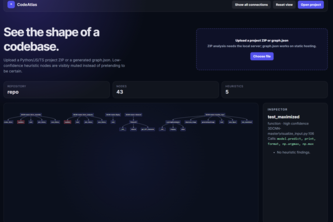
CodeAtlas is a developer tool that turns local codebases into interactive architecture maps using static analysis. The description states it analyzes Python, JavaScript, and TypeScript files without executing code, extracting modules, dependencies, API routes, and highlighting potential bottlenecks.
What changed
The project was submitted as part of the OpenAI 2026 hackathon. It is a self-contained, local-first tool built with Python, JavaScript, and Mermaid.js, using OpenAI Codex for development assistance.
Single most important open question
Is there any evidence of traction, revenue, or customer adoption beyond the author's own submission? The description does not state whether CodeAtlas has been used by others, how many developers are using it, or if it has been integrated into workflows.
What The Product Actually Is
The description states that CodeAtlas:
- Analyzes a local codebase and turns it into an interactive architecture graph.
- Extracts modules, classes, functions, imports, calls, and common HTTP API routes.
- Produces a structured
graph.jsonand a Mermaid-powered visual diagram. - Highlights likely bottlenecks such as nested loops, blocking I/O inside loops, and N+1-style query patterns.
- Uses Python's built-in
astmodule for safe parsing of Python files. - Uses lightweight heuristics for JavaScript/TypeScript files.
- Includes confidence indicators on nodes to reflect uncertainty in analysis.
- Features progressive disclosure in the UI to avoid overwhelming users with large graphs.
Inference The tool is designed to help developers understand unfamiliar codebases quickly, without needing to execute or run untrusted code.
Positioning & Claim Evolution
The description states that CodeAtlas was inspired by the problem of developers losing time trying to understand unfamiliar codebases. It positions itself as:
- A lightweight developer tool.
- A fast and honest architecture map generator.
- A solution for onboarding into new repositories.
- A tool that avoids executing untrusted code.
Inference The product is positioned as a utility for developers working in local environments, emphasizing safety, speed, and clarity over accuracy in edge cases.
Target Customer & ICP
The description states:
- The target users are developers trying to understand unfamiliar codebases.
- It is intended for use on local repositories.
- It is built with a focus on developer experience and tooling.
Inference The primary customer is likely individual developers or small teams working in local development environments. No evidence of enterprise or specific vertical targeting.
Business Model & Pricing Evidence
Not evidenced.
Explanation
There is no mention of pricing, monetization strategy, or business model in the description.
Technical & Delivery Signals
The description states:
- Built with Python (for analysis engine), JavaScript/HTML for frontend.
- Uses Mermaid.js for visualization.
- Leverages OpenAI Codex and GPT-5.6 during development.
- Designed to be local-first and dependency-light.
- Supports Python, JavaScript, and TypeScript.
- Includes confidence fields on nodes.
- Implements progressive disclosure in UI.
Inference The tool is built with a minimal, developer-friendly stack and emphasizes safety and clarity in its output.
Traction & Maturity Signals
Not evidenced.
Explanation
There is no evidence of revenue, customers, usage metrics, or adoption beyond the author's own submission. No mention of integrations, user feedback, or product iteration history.
Competitive Context
Not evidenced.
Explanation
The description does not reference competitors or similar tools in the market. No comparison to existing architecture mapping or static analysis tools is made.
Open Questions & Risks
- No traction or adoption evidence: The tool appears to be a prototype or hackathon submission with no verified users or customers.
- Limited scope: It only supports Python, JavaScript, and TypeScript; does not cover other languages.
- Static analysis limitations: The description acknowledges that static analysis cannot perfectly understand dynamic code, which may limit utility in complex environments.
- Unproven commercial viability: No evidence of monetization strategy or market demand beyond the author’s own use case.
Questions the description leaves open
- What is the actual usage or feedback from developers who have tried this tool?
- Are there any plans to expand support for other programming languages?
- How does CodeAtlas handle edge cases in codebases with dynamic imports, reflection, or generated code?
- Is there a plan to integrate with CI/CD pipelines or version control systems like Git?
- What is the intended monetization model if this were to become a commercial product?
Overall Assessment
Not evidenced.
Explanation
There is no evidence of revenue, customer traction, or market validation to support an investment or partnership decision. The project appears to be a hackathon submission with no demonstrated commercial viability or adoption. Any potential for growth depends on future development and user feedback, which are not provided in the description.
User Stories BotA demo video on every pull request
Get a demo video on every new feature
GitHub App that watches your pull requests and records a narrated, captioned demo.
Save time on demo prep and make informed decisions faster with a video walkthrough of every new feature.
Source
Submitted to the OpenAI 2026 hackathon on Devpost. Project home on Devpost. Back to the full gallery on Devpost.
This competitive analysis was produced by top-founders.com (opens in a new tab)
Generated by a language model from this project's public Devpost page — its tagline, the author's own write-up and any built-with tags listed there — as captured in August 2026. Short quotations are the author's words. It is an opinion on the idea as a business, not on the people behind it, and it reflects the description as published then. If the project has moved on, request a correction below. The analysis is not independent research and contains no verified traction, revenue or customer data.
An independent guide by KFG International LLC — not affiliated with, endorsed by, or connected to Devpost or OpenAI.