

Archive position — measured, not model output
0 likes on Devpost
2,263 of the 7,850 archived projects have more likes, and 5,587 share exactly 0 — so this project's #3,337 place in the like-ranked listing is a tie-break inside that group, not a ranking.
Projects (log scale)
Likes on Devpost. ▲ marks this project's group.
Show the figures
| Likes | Projects | Share of archive |
|---|---|---|
| 0 | 5,587 | 71.2% |
| 1 | 1,758 | 22.4% |
| 2 | 284 | 3.6% |
| 3–4 | 132 | 1.7% |
| 5–9 | 75 | 1.0% |
| 10+ | 14 | 0.2% |
 User Stories BotA demo video on every pull request
Get a demo video on every new feature
GitHub App that watches your pull requests and records a narrated, captioned demo.
Save time on demo prep and make informed decisions faster with a video walkthrough of every new feature.
Executive Summary
What the company appears to be
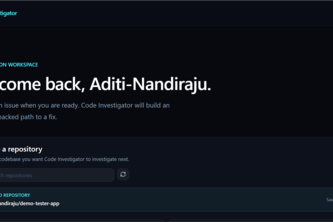
Code Investigator is a developer tool that analyzes GitHub issues and generates evidence-backed investigations using LLMs. The author states it retrieves repository structure from GitHub, builds filtered context, uses an LLM to analyze the issue, identifies relevant files, extracts supporting evidence directly from the repo, and produces an implementation plan.
What changed
The project is described as a self-contained tool built by one developer (Aditi Nandiraju) using Next.js, React, TypeScript, Prisma, PostgreSQL, and multiple LLM providers including GPT-5.6, Anthropic, and Ollama. It was submitted to the OpenAI 2026 hackathon.
Single most important open question
Is there any evidence of user adoption or commercial traction beyond the author's own development work?
What The Product Actually Is
The description states that Code Investigator:
- Analyzes GitHub issues
- Retrieves repository structure from GitHub
- Builds a filtered repository context
- Uses an LLM to analyze the issue
- Identifies the most relevant files
- Extracts supporting evidence directly from the repository
- Produces an implementation plan explaining where and how the issue can be fixed
The tool is described as producing "evidence-backed" investigations, with every finding tied to actual files and code within the repository. It uses a backend investigation engine that orchestrates this workflow, including authentication with GitHub, fetching repository tree, building filtered context, running the investigation using selected LLMs, validating responses against the repository, and storing results in PostgreSQL.
Evidence
- The author states the tool "analyzes a GitHub issue and generates an evidence-backed investigation"
- It "retrieves the repository structure from GitHub"
- It "builds a filtered repository context"
- It "uses an LLM to analyze the issue"
- It "identifies the most relevant files"
- It "extracts supporting evidence directly from the repository"
- It "produces an implementation plan explaining where and how the issue can be fixed"
- The backend orchestrates authentication, fetching, building context, running investigation, validating responses, and storing results
Inference This is a developer tool that aims to reduce time spent on understanding bug reports by providing structured, code-based analysis.
Positioning & Claim Evolution
The author states:
- Developers spend significant time understanding bug reports before writing code
- Even with modern LLMs, asking "Which files should I change?" often results in hallucinated filenames, incorrect evidence, or suggestions not grounded in the repository
- The goal was to bridge that gap with a tool that takes GitHub issues and produces investigations backed by real source code instead of model assumptions
- The tool aims to eliminate the repetitive process of searching through large codebases and provide reliable answers
Evidence
- "Developers spend a significant amount of time understanding bug reports before writing a single line of code"
- "Even with modern LLMs, asking 'Which files should I change?' often results in hallucinated filenames, incorrect evidence, or suggestions that aren't grounded in the repository"
- "The goal wasn't to replace developers, but to eliminate the repetitive process of searching through large codebases and provide a reliable How GPT-5.6 was used"
Inference The positioning is that Code Investigator addresses inefficiencies in current developer workflows by grounding LLM outputs in actual repository data.
Target Customer & ICP
The description states:
- The tool targets developers who need to understand GitHub issues and fix bugs
- It aims to help developers move from a GitHub issue to an implementation plan faster
- It is described as a practical assistant for developers
Evidence
- "Developers spend a significant amount of time understanding bug reports before writing a single line of code"
- "The goal wasn't to replace developers, but to eliminate the repetitive process of searching through large codebases"
- "My long-term vision is to make Code Investigator a practical assistant that helps developers move from a GitHub issue to an implementation plan faster"
Inference The primary customer is likely individual developers or small teams working on open-source or internal projects who need to quickly understand and resolve issues in repositories.
Business Model & Pricing Evidence
Not evidenced.
Evidence No mention of pricing, monetization strategy, or business model in the description.
Inference There is no evidence of any commercial model or pricing structure beyond the author's own development work.
Technical & Delivery Signals
The project was built using:
- Next.js 16 (App Router)
- React 19
- TypeScript
- Prisma 7
- PostgreSQL (Supabase)
- Auth.js with GitHub OAuth
- OpenAI GPT-5.6, Anthropic, and Ollama (pluggable LLM providers)
The backend is centered around an investigation engine that orchestrates the complete workflow:
- Authenticate with GitHub
- Fetch the repository tree
- Build a filtered repository context
- Run the investigation using the selected LLM
- Validate every response against the repository
- Store the investigation in PostgreSQL for future viewing
Evidence
- Built with Next.js, React, TypeScript, Prisma, PostgreSQL, Auth.js, GitHub OAuth, OpenAI GPT-5.6, Anthropic, Ollama
- Backend engine orchestrates authentication, fetching, building context, running investigation, validating responses, and storing results
- Uses pluggable LLM providers architecture
Inference The tool is a full-stack application integrating GitHub APIs, authentication, database persistence, and multiple LLM providers into a single workflow.
Traction & Maturity Signals
Not evidenced.
Evidence No mention of users, customers, revenue, or adoption metrics in the description.
Inference There is no evidence of traction or maturity beyond the author's own development work.
Competitive Context
Not evidenced.
Evidence No mention of competitors or market positioning in the description.
Inference There is no evidence of competitive landscape or differentiation from existing tools.
Open Questions & Risks
- The tool is described as being built by a single developer (Aditi Nandiraju)
- No evidence of user adoption, revenue, or traction
- The project was submitted to a hackathon, suggesting it may be in early development
- The author notes that LLM hallucination was a major challenge and required redesigning the pipeline
- There is no indication of scalability beyond the single developer's own use case
Evidence
- "Team size: 1"
- "The project went through multiple iterations as GPT-5.6 helped identify implementation issues while I evaluated the suggestions, modified the architecture, and tested the results"
- "This iterative workflow made it possible to move from an initial prototype to a more robust investigation pipeline"
Inference The tool may be in early development stage with limited commercial viability or scalability.
Questions the description leaves open
- What is the current state of the product? Is it ready for beta users?
- How many developers have you tested this with, and what feedback did they give?
- Are there any plans to monetize the tool or build a business around it?
- What are the key technical challenges that remain unresolved?
- How do you plan to scale beyond the single developer who built it?
- Have you considered how to handle large repositories or complex codebases?
- What is your roadmap for future features and improvements?
Overall Assessment
Not evidenced.
Evidence No information about funding, valuation, or investment interest in the description.
Inference There is no evidence of any investment or partnership activity beyond the author's own development work.
User Stories BotA demo video on every pull request
Get a demo video on every new feature
GitHub App that watches your pull requests and records a narrated, captioned demo.
Save time on demo prep and make informed decisions faster with a video walkthrough of every new feature.
Source
Submitted to the OpenAI 2026 hackathon on Devpost. Project home on Devpost. Back to the full gallery on Devpost.
This competitive analysis was produced by top-founders.com (opens in a new tab)
Generated by a language model from this project's public Devpost page — its tagline, the author's own write-up and any built-with tags listed there — as captured in August 2026. Short quotations are the author's words. It is an opinion on the idea as a business, not on the people behind it, and it reflects the description as published then. If the project has moved on, request a correction below. The analysis is not independent research and contains no verified traction, revenue or customer data.
An independent guide by KFG International LLC — not affiliated with, endorsed by, or connected to Devpost or OpenAI.