

Archive position — measured, not model output
1 like on Devpost
505 of the 7,850 archived projects have more likes, and 1,758 share exactly 1 — so this project's #849 place in the like-ranked listing is a tie-break inside that group, not a ranking.
Projects (log scale)
Likes on Devpost. ▲ marks this project's group.
Show the figures
| Likes | Projects | Share of archive |
|---|---|---|
| 0 | 5,587 | 71.2% |
| 1 | 1,758 | 22.4% |
| 2 | 284 | 3.6% |
| 3–4 | 132 | 1.7% |
| 5–9 | 75 | 1.0% |
| 10+ | 14 | 0.2% |
 User Stories BotA demo video on every pull request
Get a demo video on every new feature
GitHub App that watches your pull requests and records a narrated, captioned demo.
Save time on demo prep and make informed decisions faster with a video walkthrough of every new feature.
Executive Summary
What the company appears to be
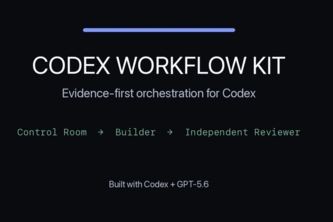
Codex Workflow Kit is a self-reported tool for one developer using Codex inside a repository. The author states it provides durable control over Codex tasks by storing work as files, managing worker identity and evidence, and enforcing closeout gates that reject stale or missing proof.
What changed
The project evolved from a personal workflow to a structured CLI-based system during Build Week. It was built solo with Codex and GPT-5.6, using Git for versioning and repository state tracking.
Single most important open question
Is there any evidence of external adoption or usage beyond the author’s own development?
What The Product Actually Is
The description states that Codex Workflow Kit is a repo-native control and evidence layer for longer and more serious Codex development, designed to manage Codex work inside the repository. It includes:
- Tasks with clear scope and acceptance criteria
- Durable state that survives context compaction
- Optional workers (Builder, Reviewer, Tester, etc.)
- Worker identity and generation checks
- Write ownership and lock coordination
- Separate implementation, review, and test evidence
- Verification tied to Git and worktree state
- Closeout gates that reject missing or stale proof
- Succession packets for continuing work without copying entire conversations
- Installation, upgrade, drift detection, and package hygiene commands
It is described as a CLI tool that enforces workflow rules through code rather than just prompts. It stores task-related information in files so it can reload and verify progress.
Evidence The author describes how the system works, including its components and behavior during development.
Positioning & Claim Evolution
The author claims Codex Workflow Kit is not merely a prompt asking Codex to be careful — instead, it enforces trust checks via code. It aims to make Codex feel like a real engineering partner by providing:
- Durable evidence
- Drift detection
- Safer coordination in local development environments
The project evolved from a personal solution into a structured system during Build Week. The author emphasizes that it is not an operating-system sandbox or cryptographically secure, but rather a workflow-command enforcement layer.
Inference The positioning shifts from a personal hack to a tool for managing complex Codex workflows within repositories.
Target Customer & ICP
The description states the current product targets one developer operating Codex across real repositories. It is designed for serious Codex users who want to:
- Preserve context
- Delegate only when useful
- Review work independently
- Know what “finished” actually means
There is no mention of enterprise customers, teams, or broader market segments.
Evidence The author explicitly says the goal is to help "serious Codex users" and that the product is solo-first.
Business Model & Pricing Evidence
Not evidenced. The description does not contain any information about pricing, monetization, or business model.
Technical & Delivery Signals
The project was built using:
- Tools: git, gpt-5.6, javascript, json, markdown, node.js, npm, openai-codex, shell
- Architecture: CLI-based system with Git integration
- Workflow: Uses a Control Room for planning and task ownership; delegates bounded implementation and review work
- Verification Mechanisms: Command execution logs, exit status, Git commit digests, repository content hashes, managed workflow file digests
The author reports that the tool validates task state, worker receipts, artifact ownership, and closeout requirements. It also includes drift detection and package hygiene commands.
Evidence The write-up describes how it was built and what technical features it implements.
Traction & Maturity Signals
Not evidenced. There is no mention of revenue, customers, or adoption beyond the author’s own use case.
Competitive Context
Not evidenced. No competitors or market positioning are mentioned in the description.
Open Questions & Risks
- No external validation or usage: The tool appears to be used only by the author.
- Solo-first design: May not scale well for team environments or larger organizations.
- Limited scope: Designed specifically for one developer using Codex within a repository.
- Self-reported performance data: Benchmark results are from internal testing and lack independent verification.
Inference The tool may be too niche or experimental to attract broader interest without further development or marketing.
Questions the description leaves open
- Has anyone else used this beyond your own development?
- What specific problems do you see in the current version that would prevent adoption by others?
- How does this tool integrate with existing CI/CD pipelines or IDEs?
- Are there plans to support multi-user collaboration or team workflows?
- What are the main limitations of the current implementation that need fixing before wider release?
Overall Assessment
Not evidenced. No financial data, traction metrics, or strategic alignment details are provided.
User Stories BotA demo video on every pull request
Get a demo video on every new feature
GitHub App that watches your pull requests and records a narrated, captioned demo.
Save time on demo prep and make informed decisions faster with a video walkthrough of every new feature.
Source
Submitted to the OpenAI 2026 hackathon on Devpost. Project home on Devpost. Back to the full gallery on Devpost.
This competitive analysis was produced by top-founders.com (opens in a new tab)
Generated by a language model from this project's public Devpost page — its tagline, the author's own write-up and any built-with tags listed there — as captured in August 2026. Short quotations are the author's words. It is an opinion on the idea as a business, not on the people behind it, and it reflects the description as published then. If the project has moved on, request a correction below. The analysis is not independent research and contains no verified traction, revenue or customer data.
An independent guide by KFG International LLC — not affiliated with, endorsed by, or connected to Devpost or OpenAI.