

Archive position — measured, not model output
0 likes on Devpost
2,263 of the 7,850 archived projects have more likes, and 5,587 share exactly 0 — so this project's #3,305 place in the like-ranked listing is a tie-break inside that group, not a ranking.
Projects (log scale)
Likes on Devpost. ▲ marks this project's group.
Show the figures
| Likes | Projects | Share of archive |
|---|---|---|
| 0 | 5,587 | 71.2% |
| 1 | 1,758 | 22.4% |
| 2 | 284 | 3.6% |
| 3–4 | 132 | 1.7% |
| 5–9 | 75 | 1.0% |
| 10+ | 14 | 0.2% |
 User Stories BotA demo video on every pull request
Get a demo video on every new feature
GitHub App that watches your pull requests and records a narrated, captioned demo.
Save time on demo prep and make informed decisions faster with a video walkthrough of every new feature.
Executive Summary
What the company appears to be
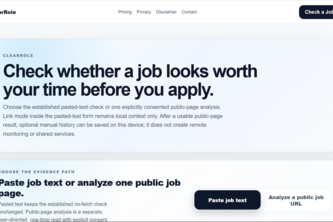
ClearRole is a self-reported job-listing trust and credibility analysis tool designed to help job seekers evaluate whether a job posting deserves their time. It uses AI to analyze job descriptions for signals of fraud, inconsistency, or low quality.
What changed
The project was submitted as part of the OpenAI 2026 hackathon, demonstrating an early-stage prototype focused on pasted text input and basic AI-driven scoring. The author describes a vision for a multi-layered system including a consumer-facing analyzer, a B2B trust engine, and a source intelligence layer.
Single most important open question
Is there evidence of traction or product-market fit beyond the hackathon demo? The description states no revenue, customers, or adoption data exist — only a self-reported prototype with limited functionality.
What The Product Actually Is
The description states that ClearRole is a tool that analyzes job descriptions for trustworthiness. It currently supports pasting text of a job listing into a web interface and returns:
- A 0–100 listing score;
- Risk level (low, medium, high);
- Assessment;
- Evidence-aware confidence level;
- Reasons linked to specific categories;
- Positive, weak, and risk signals;
- Input and source limitations;
- Recommended next action;
- Verification checklist.
It is built with Next.js, React, TypeScript, and uses OpenAI's GPT-5.4–5.6 models via the Responses API. The demo does not store or log pasted content, and only performs one AI request per input.
The product is described as being in an early prototype stage, with a planned Chrome extension to improve user workflow.
Evidence
- The description states ClearRole analyzes job descriptions for signals of fraud, inconsistency, or low quality.
- It returns structured outputs including scores, risk levels, and evidence-based reasoning.
- The demo uses GPT-5.6 Luna and Next.js/React stack.
- It is designed to separate what is observable from what is inferred.
Inference The product appears to be a proof-of-concept for AI-assisted job-listing vetting, not yet a full commercial offering.
Positioning & Claim Evolution
The description states that ClearRole was created to address the trust gap in job listings — particularly where AI-generated or fake listings are common. It positions itself as a decision-support and provenance layer for the job market.
It claims to help both job seekers and platforms by evaluating:
- Listing quality;
- Source credibility;
- Employer identity;
- Freshness;
- Duplicate history;
- Fraud indicators;
- Hiring-intent signals;
- What remains unknown.
The author describes three layers in its long-term vision:
- Ghost Job Detector (consumer-facing);
- ClearRole Trust Engine (B2B use for platforms);
- Source Intelligence Layer (technical foundation for provenance).
Evidence
- The author states that job seekers are often expected to invest time before knowing if a listing is credible.
- It claims to separate observable facts from inferred signals and uncertainty.
- It describes a multi-layered product vision.
Inference The positioning suggests ClearRole aims to become a trust layer for the job market, but only the first layer (consumer-facing) has been demonstrated.
Target Customer & ICP
The description states that ClearRole targets two main audiences:
- Job seekers who want to evaluate whether a listing is worth applying to.
- B2B platforms (job boards, staffing companies, employers) that need tools to identify low-quality or fraudulent listings.
It also mentions that the long-term goal is to build a system that helps career professionals and job platforms understand whether a listing appears credible, current, transparent, and worth acting on.
Evidence
- The product is described as helping job seekers before they invest time.
- It targets platforms needing tools for moderation or quality checks.
- The vision includes employer-facing recommendations to improve listings.
Inference The ICP is likely early-stage job seekers and platform operators, but no customer data or segmentation details are provided.
Business Model & Pricing Evidence
Not evidenced. The description does not state how ClearRole intends to monetize its product or what pricing model it will use.
Evidence
- No mention of revenue streams.
- No pricing information.
- No indication of whether the tool will be free, subscription-based, or B2B SaaS.
Technical & Delivery Signals
The description states that ClearRole is built with:
- Next.js
- React
- TypeScript
- Codex (as engineering partner)
- OpenAI GPT-5.4–5.6 models via the Responses API
It demonstrates a vertical slice where:
- A user pastes a job description.
- The browser sends it to a Next.js
/api/check-textroute. - The server makes one GPT-5.6 request.
- The result is parsed and normalized into a canonical format.
The demo path:
- Performs at most one OpenAI request;
- Does not fetch public URLs;
- Stores no pasted text server-side;
- Does not log the input or raw model output;
- Is limited to localhost and non-production execution.
It also mentions foundational work for:
- Canonical result contracts;
- Evidence categories;
- Scoring policy;
- Confidence controls;
- Source-quality separation;
- Controlled public-source reading;
- Network and private-address protection;
- PostgreSQL-backed authorization and accounting;
- Listing history and observation concepts;
- Change detection;
- Source discovery.
Evidence
- The product is built with modern web stack (Next.js, React, TypeScript).
- It uses OpenAI models via the Responses API.
- A demo path exists that performs one AI request without storing data.
- There are plans for more advanced features like source intelligence and change detection.
Inference The technical architecture suggests a scalable, privacy-conscious approach to AI-based job listing analysis, but only basic functionality is demonstrated.
Traction & Maturity Signals
Not evidenced. The description states that this is a hackathon submission (OpenAI 2026 Build Week), and no traction or adoption data are provided.
Evidence
- It is described as a prototype built for a hackathon.
- No revenue, customers, or usage metrics are mentioned.
- The demo is explicitly limited to localhost and non-production use.
Competitive Context
Not evidenced. The description does not mention any competitors or market positioning relative to existing tools in the job-listing or AI trust space.
Evidence
- No competitor names or market analysis provided.
- No discussion of how ClearRole compares to other tools or platforms.
Open Questions & Risks
- No traction or revenue: The product is a hackathon demo with no evidence of adoption or monetization.
- Limited scope in demo: Only one vertical slice (pasted text) has been demonstrated; the full vision remains unproven.
- Privacy and data handling: While the demo avoids logging, it's unclear how future versions will handle user data or source intelligence.
- AI reliability and bias: The system relies on AI models to detect fraud or inconsistencies — this introduces risk of false positives/negatives.
- Scalability concerns: The current architecture is limited to one request per input; no scaling or batch processing is described.
Evidence
- No revenue, customers, or adoption data.
- Demo is restricted to localhost and non-production use.
- No discussion of how the system will scale or handle large volumes.
Questions the description leaves open
- What are the key assumptions behind the scoring and risk signals?
- How does ClearRole differentiate between a low-quality listing and a legitimate one that simply lacks detail?
- Has there been any user testing or feedback on the accuracy of the AI-generated assessments?
- What is the plan for data privacy, especially around source intelligence and provenance tracking?
- Are there plans to integrate with existing job platforms or APIs?
- How will the B2B Trust Engine be monetized?
- What are the technical limitations of the current model in detecting fraud or impersonation?
- How does ClearRole handle edge cases like internal company job postings or niche roles?
Overall Assessment
Not evidenced.
The description states that this is a hackathon submission, and there is no evidence of traction, revenue, customers, or any commercial activity beyond the prototype.
Evidence
- No financials, customers, or adoption data.
- Product is in early prototype stage.
- No indication of commercial viability or market demand.
Inference This appears to be an idea with potential but lacks validation. It would require further due diligence into the team’s execution ability, product-market fit, and scalability before any investment or partnership consideration.
User Stories BotA demo video on every pull request
Get a demo video on every new feature
GitHub App that watches your pull requests and records a narrated, captioned demo.
Save time on demo prep and make informed decisions faster with a video walkthrough of every new feature.
Source
Submitted to the OpenAI 2026 hackathon on Devpost. Project home on Devpost. Back to the full gallery on Devpost.
This competitive analysis was produced by top-founders.com (opens in a new tab)
Generated by a language model from this project's public Devpost page — its tagline, the author's own write-up and any built-with tags listed there — as captured in August 2026. Short quotations are the author's words. It is an opinion on the idea as a business, not on the people behind it, and it reflects the description as published then. If the project has moved on, request a correction below. The analysis is not independent research and contains no verified traction, revenue or customer data.
An independent guide by KFG International LLC — not affiliated with, endorsed by, or connected to Devpost or OpenAI.