

Archive position — measured, not model output
0 likes on Devpost
2,263 of the 7,850 archived projects have more likes, and 5,587 share exactly 0 — so this project's #3,304 place in the like-ranked listing is a tie-break inside that group, not a ranking.
Projects (log scale)
Likes on Devpost. ▲ marks this project's group.
Show the figures
| Likes | Projects | Share of archive |
|---|---|---|
| 0 | 5,587 | 71.2% |
| 1 | 1,758 | 22.4% |
| 2 | 284 | 3.6% |
| 3–4 | 132 | 1.7% |
| 5–9 | 75 | 1.0% |
| 10+ | 14 | 0.2% |
 User Stories BotA demo video on every pull request
Get a demo video on every new feature
GitHub App that watches your pull requests and records a narrated, captioned demo.
Save time on demo prep and make informed decisions faster with a video walkthrough of every new feature.
Executive Summary
What the company appears to be
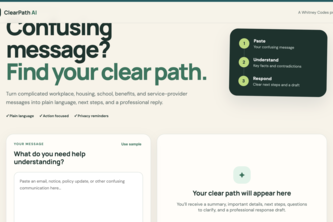
ClearPath AI is a self-reported prototype tool built by a single founder (Whitney-Anne Mayfield-Hill) that transforms confusing administrative messages into plain-language summaries, actionable next steps, and professional response drafts. It was developed as part of an OpenAI 2026 hackathon submission.
What changed
The project is described as a prototype built in a short timeframe (a "Build Week") with no evidence of prior development or commercial traction. It uses AI tools like Codex and GPT-5.6 for development and currently runs locally in the browser without collecting user data.
The single most important open question
Is there any evidence that ClearPath AI has moved beyond a prototype, achieved customer adoption, or generated revenue? The description states no such evidence exists.
Analysis basis
This report is based entirely on the self-reported project description provided by the author. No external verification, archived data, or third-party sources are available. All claims are treated as stated by the author and not independently confirmed.
What The Product Actually Is
The description states that ClearPath AI:
- Transforms complicated administrative messages into five sections:
- Plain-language summary
- Important dates and details
- Actionable next steps
- Questions or contradictions to clarify
- A professional response draft
- Runs locally in the browser (no data collection or storage)
- Is built with HTML, CSS, JavaScript and hosted via GitHub Pages
- Uses Codex and GPT-5.6 for development
- Includes safeguards around privacy and responsible use
- Was designed to avoid providing legal, financial, medical, employment, housing, or benefits advice
Confidence High — this is directly stated by the author.
Positioning & Claim Evolution
The description states that:
- The tool was inspired by personal experiences with unclear administrative communications (payroll, housing, benefits, education).
- It aims to help users move from confusion to clarity and confidence.
- The founder describes it as a practical tool for workers, students, caregivers, tenants, families, and small-business owners.
- It is positioned as a communication support tool, not a source of professional advice.
Inference The positioning implies a focus on accessibility and usability for non-expert users navigating complex systems. However, the claim of being "practical" or "helpful" is self-reported and unverified.
Target Customer & ICP
The description states that ClearPath AI targets:
- Workers
- Students
- Caregivers
- Tenants
- Families
- Small-business owners
It also notes that it addresses communications involving payroll, housing, benefits, education, and services.
Confidence Moderate — the author lists these groups but does not define a specific ICP or segment beyond broad categories.
Business Model & Pricing Evidence
The description states:
- The prototype is a demonstration only.
- It currently runs locally in the browser without collecting user data.
- No pricing, monetization strategy, or business model is described.
- Future versions may include features like secure uploads, multilingual support, and integrations.
Confidence Low — there is no evidence of any revenue model or pricing structure.
Technical & Delivery Signals
The description states:
- Built using HTML, CSS, JavaScript
- Hosted via GitHub Pages
- Uses Codex and GPT-5.6 for development
- Runs locally in the browser (no data collection)
- Includes privacy and responsible-use safeguards
- Designed to be responsive and accessible
- The prototype was deployed within a Build Week deadline
Confidence Moderate — technical details are provided, but no evidence of scalability or production-grade infrastructure.
Traction & Maturity Signals
The description states:
- This is the first public project from Whitney Codes.
- It was built in a short timeframe (Build Week).
- No users, customers, or adoption data are mentioned.
- The prototype does not collect or store user messages.
- No revenue, ARR, headcount, or funding information is provided.
Confidence Very low — no traction or maturity signals are evident.
Competitive Context
The description states:
- The tool is inspired by a "LifeReady"-inspired vision.
- It aims to be part of a larger platform called LifeReady.
- No specific competitors are named or described.
- The author does not reference existing tools in this space.
Confidence Low — no competitive landscape or differentiation is provided.
Open Questions & Risks
The description states:
- The tool is a prototype built in a short timeframe.
- It currently runs locally and does not collect data.
- The founder is a single person (no team).
- No evidence of user feedback, testing, or iteration beyond the prototype stage.
- The vision includes future features that may require significant development and compliance work.
Inference Risks include lack of product-market fit, scalability concerns, and potential legal or ethical issues with handling sensitive communications.
Questions the description leaves open
- What is the actual user feedback or testing done beyond the prototype stage?
- How does the tool handle edge cases or ambiguous messages?
- Are there any plans to collect or store user data, and how will privacy be maintained?
- Is there a plan for monetization or commercial viability beyond the prototype?
- What are the technical limitations of running locally in the browser versus cloud-based processing?
- How does the founder intend to scale beyond a single-person development effort?
Note
These questions are based on the lack of evidence around traction, scalability, and business model.
Overall Assessment
The description states:
- This is a prototype built in a short timeframe.
- No revenue, customers, or funding information is available.
- The tool is not yet commercialized or deployed at scale.
- The founder has no prior track record beyond this project.
Confidence Very low — there is no evidence of commercial readiness, traction, or viability. This is a pre-product-stage idea with no demonstrated market demand or business model.
Conclusion
Not evidenced as a viable investment or partnership opportunity at this time. The project is described as a prototype with no indication of progress beyond that stage.
User Stories BotA demo video on every pull request
Get a demo video on every new feature
GitHub App that watches your pull requests and records a narrated, captioned demo.
Save time on demo prep and make informed decisions faster with a video walkthrough of every new feature.
Source
Submitted to the OpenAI 2026 hackathon on Devpost. Project home on Devpost. Back to the full gallery on Devpost.
This competitive analysis was produced by top-founders.com (opens in a new tab)
Generated by a language model from this project's public Devpost page — its tagline, the author's own write-up and any built-with tags listed there — as captured in August 2026. Short quotations are the author's words. It is an opinion on the idea as a business, not on the people behind it, and it reflects the description as published then. If the project has moved on, request a correction below. The analysis is not independent research and contains no verified traction, revenue or customer data.
An independent guide by KFG International LLC — not affiliated with, endorsed by, or connected to Devpost or OpenAI.