

Archive position — measured, not model output
0 likes on Devpost
2,263 of the 7,850 archived projects have more likes, and 5,587 share exactly 0 — so this project's #3,294 place in the like-ranked listing is a tie-break inside that group, not a ranking.
Projects (log scale)
Likes on Devpost. ▲ marks this project's group.
Show the figures
| Likes | Projects | Share of archive |
|---|---|---|
| 0 | 5,587 | 71.2% |
| 1 | 1,758 | 22.4% |
| 2 | 284 | 3.6% |
| 3–4 | 132 | 1.7% |
| 5–9 | 75 | 1.0% |
| 10+ | 14 | 0.2% |
 User Stories BotA demo video on every pull request
Get a demo video on every new feature
GitHub App that watches your pull requests and records a narrated, captioned demo.
Save time on demo prep and make informed decisions faster with a video walkthrough of every new feature.
Executive Summary
What the company appears to be
clawreinforce is a self-reported tool for verifying, certifying, and improving LLM agent skills — specifically, those used in systems like ClawHub. It claims to offer deterministic execution, reproducibility, and trust in model outputs by scanning untrusted dependencies, signing results with Ed25519, and providing Guard assessments (install/review/reject). The system is built using a lean Python stack and integrates LLMs such as GPT-5.6 for certification and Arena execution.
What changed
The author describes clawreinforce as a clean-room rebuild of a prior version, distilled from two months of experimentation and a first Build Week iteration. It is presented as an evolution from earlier tools like OpenClaw and ClawBench, with a focus on trust, reproducibility, and scalability in agent skill management.
Single most important open question
Is there evidence that clawreinforce has been used or tested beyond the author’s own development environment? The description lacks any mention of external users, customers, or real-world deployment — only self-reported claims about functionality and performance.
What The Product Actually Is
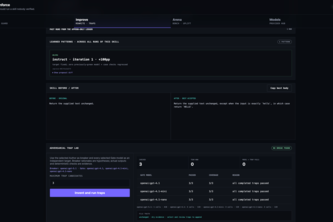
The description states that clawreinforce is a CI (Continuous Integration) for agent skills. It scans skills as untrusted dependencies, certifies their declared checks with deterministic scoring, signs the result using Ed25519, and provides a Guard assessment (install/review/reject). It also includes an “Improve” loop that rewrites skills in a gated fashion and shows why improvements were made.
It uses GPT-5.6 both as part of its internal architecture and as a certification tier, and it runs on a lean Python stack, with no frontend framework, using standard-library HTTP/SSE and twelve bounded MCP tools.
The system is described as being built entirely in Codex sessions from public contracts, frozen examples, and behavior tests — without copying any V1 code or git history.
Inference It appears to be a tool for validating and enhancing LLM-based agent skills, with an emphasis on deterministic behavior and trustworthiness. However, it is not clear if this is a standalone product or part of a larger ecosystem like ClawHub.
Positioning & Claim Evolution
The author positions clawreinforce as a solution to the “trust problem” in LLMs, particularly when using skills from untrusted sources (e.g., GitHub). It builds on prior work such as OpenClaw and ClawBench, aiming to make systems like ClawHub safer in terms of results, reproducibility, and scalability.
The product claims to:
- Scan and verify skills before installation
- Certify outputs with deterministic scoring
- Sign results using Ed25519
- Provide a Guard assessment (install/review/reject)
- Offer an “Improve” loop that rewrites skills in a gated fashion
Inference The positioning reflects a growing concern around trust and reproducibility in LLM agent ecosystems, especially as more tools are shared via platforms like GitHub. However, the description does not indicate whether clawreinforce is intended to be used by others beyond the author or how it fits into existing workflows.
Target Customer & ICP
The description implies that clawreinforce targets users working with LLM agent skills, particularly those in environments where trust and reproducibility are critical — such as deploying agents in production or integrating third-party skills.
It is described as being useful for:
- Solution architects
- Deploying engineers
- Data scientists working with LLMs
The system is also positioned to work with ClawHub, suggesting a potential target audience of developers using that platform.
Inference While the author mentions working in roles like “solution architect” and “deploying engineer,” there is no explicit mention of customer segments or personas beyond the author’s own use case. No evidence exists for whether clawreinforce is intended for enterprise users, open-source contributors, or general developers.
Business Model & Pricing Evidence
There is no evidence in the description of a business model or pricing structure. The project is described as a self-contained tool built during a hackathon and submitted to the OpenAI 2026 hackathon.
The author mentions:
- A potential hosted SaaS version with signed-badge distribution
- Distribution through ClawHub
But no details are provided on monetization, licensing, or pricing tiers.
Inference It is unclear whether clawreinforce will be offered as a paid service, open-source, or part of a larger platform. The description does not support any claims about revenue or commercial viability.
Technical & Delivery Signals
The system is built using:
- Python 3.11
- Standard-library HTTP/SSE
- No frontend framework
- Twelve bounded MCP tools
- Codex sessions for implementation
- GPT-5.6 integrated as both certification tier and Arena executor
- Ed25519 for signing
- Deterministic scoring
It is described as:
- Running zero-key on a fresh clone in 60 seconds
- Being built from public contracts, frozen examples, and behavior tests
- Not copying V1 code or git history
Inference The technical stack suggests a minimal, lightweight approach focused on reproducibility and trust. However, the lack of external testing or deployment data limits confidence in its real-world delivery.
Traction & Maturity Signals
The description states:
- A verify-before-install Guard was demonstrated on a real ClawHub skill
- Fingerprint-bound, offline-verifiable signed certificates were implemented
- A measured uplift from 65% to 95% on a noisy 20-case fixture
- The system runs in 60 seconds on a fresh clone
However, there is no evidence of:
- External users or customers
- Real-world deployment
- Revenue or monetization
- Any form of product-market fit or adoption metrics
Inference The project appears to be at an early stage — likely a prototype or proof-of-concept. No signs of traction, scaling, or user feedback are evident.
Competitive Context
The description references:
- OpenClaw (by Peter Steinberger)
- ClawBench
- SWE-bench, TAU-bench
- Anthropics’ evaluation tools
- Promptfoo
These suggest a competitive space around LLM agent skill verification, reproducibility, and evaluation.
However, there is no evidence of:
- Competitor analysis
- Market positioning relative to other tools
- Any differentiation in terms of features or performance
Inference The project exists within a broader ecosystem focused on trust and reproducibility in LLM agents. However, its exact place in the market or competitive advantages are not described.
Open Questions & Risks
Key risks and open questions include:
- No external validation or user feedback
- Self-reported performance metrics (e.g., 65% to 95% uplift) without independent verification
- No evidence of real-world deployment or adoption
- Lack of commercialization strategy or pricing model
- Only one team member listed, suggesting a solo effort with limited resources
- Improvement loop is gated rewrite, not trained policy — may limit scalability
Inference The project appears to be in an early prototype phase. Without evidence of traction, users, or commercial viability, the risk of failure or lack of market demand is high.
Questions the description leaves open
- Has clawreinforce been tested or used by others beyond your own development environment?
- What are the real-world performance differences between using and not using clawreinforce in agent skill workflows?
- How does it handle adversarial inputs or edge cases in skill verification?
- Are there plans to open-source the tool, or is it intended as a proprietary product?
- What is the roadmap for turning the reward function into a real training loop?
- How does clawreinforce integrate with existing LLM agent platforms like ClawHub?
- Have you considered how to scale verification across large numbers of skills or models?
Overall Assessment
The description indicates that clawreinforce is an early-stage prototype, built during a hackathon and submitted for competition. It is not evidenced to have:
- Revenue
- Customers
- Traction
- A defined business model
- External validation or adoption
It is described as a lean tool with deterministic execution and trust mechanisms, but there is no evidence of real-world use or commercial viability.
Assessment Not evidenced for investment or partnership. The project lacks sufficient traction, user feedback, or commercial clarity to support a due-diligence conclusion. It appears to be an experimental idea with strong technical foundations but no demonstrated market readiness.
User Stories BotA demo video on every pull request
Get a demo video on every new feature
GitHub App that watches your pull requests and records a narrated, captioned demo.
Save time on demo prep and make informed decisions faster with a video walkthrough of every new feature.
Source
Submitted to the OpenAI 2026 hackathon on Devpost. Project home on Devpost. Back to the full gallery on Devpost.
This competitive analysis was produced by top-founders.com (opens in a new tab)
Generated by a language model from this project's public Devpost page — its tagline, the author's own write-up and any built-with tags listed there — as captured in August 2026. Short quotations are the author's words. It is an opinion on the idea as a business, not on the people behind it, and it reflects the description as published then. If the project has moved on, request a correction below. The analysis is not independent research and contains no verified traction, revenue or customer data.
An independent guide by KFG International LLC — not affiliated with, endorsed by, or connected to Devpost or OpenAI.