

Archive position — measured, not model output
0 likes on Devpost
2,263 of the 7,850 archived projects have more likes, and 5,587 share exactly 0 — so this project's #3,314 place in the like-ranked listing is a tie-break inside that group, not a ranking.
Projects (log scale)
Likes on Devpost. ▲ marks this project's group.
Show the figures
| Likes | Projects | Share of archive |
|---|---|---|
| 0 | 5,587 | 71.2% |
| 1 | 1,758 | 22.4% |
| 2 | 284 | 3.6% |
| 3–4 | 132 | 1.7% |
| 5–9 | 75 | 1.0% |
| 10+ | 14 | 0.2% |
 User Stories BotA demo video on every pull request
Get a demo video on every new feature
GitHub App that watches your pull requests and records a narrated, captioned demo.
Save time on demo prep and make informed decisions faster with a video walkthrough of every new feature.
Executive Summary
What the company appears to be
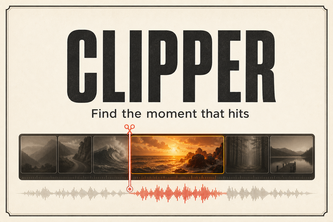
Clipper is a video editing tool that uses AI to assist content producers in creating first cuts from speech-heavy footage (e.g., interviews, podcasts). It allows users to provide a video source and an editorial brief, then applies GPT-5.6 models to interpret transcript segments against that brief. The AI’s role is limited: it annotates transcript segments with fields like “editorial suitability” and “intensity,” but does not control timestamps, rendering, or final edit decisions. A deterministic algorithm selects non-overlapping source intervals based on these annotations and renders them into an MP4.
What changed
The project was submitted as part of the OpenAI 2026 hackathon. It represents a self-contained prototype built using Cloudflare infrastructure and GPT-5.6 models, with emphasis on transparency, determinism, and human control over final output. The product is described as not yet claiming any measured time savings or adoption metrics.
Single most important open question
Is there evidence that the described workflow will be adopted by editors or content teams in real-world use cases, or whether the current prototype reflects a viable commercial model?
Note: This analysis is based entirely on the self-reported project description provided by the authors. No independent verification, traction data, revenue figures, customer names, or third-party sources are available.
What The Product Actually Is
The description states that Clipper:
- Takes a video source (local or public URL) and an editorial brief.
- Uses GPT-5.6 Luna or Terra to annotate transcript segments with fields such as “editorial suitability,” “narrative role,” “intensity,” and “confidence.”
- Applies a deterministic ranking formula to select non-overlapping intervals from the source.
- Renders those exact intervals into an H.264/AAC MP4 using FFmpeg.
- Preserves timestamps, transcript evidence, model explanations, and decision provenance.
- Allows human editors to reorder or omit selected intervals without changing their original timestamps.
- Exports the result as OpenTimelineIO with a diff showing changes from the original.
Inference: The product is not an autonomous editor but rather a tool that augments human editorial control by providing AI-assisted selection of source material, while maintaining deterministic output and traceability.
Positioning & Claim Evolution
The description states:
- Clipper aims to address the problem that “AI video tools can produce clips quickly, but speed is not the only thing an editor needs.”
- It positions itself as a tool that helps make first cuts without taking control away from the editor.
- The goal is not just to generate a short video but to produce one that another person can inspect, challenge, revise, and confidently hand off.
Claim: Clipper is positioned as a workflow tool for content producers working with speech-heavy footage, emphasizing trustworthiness, transparency, and human agency over automation.
Inference: The positioning implies a niche in professional or semi-professional video editing where accuracy and auditability are valued over speed alone.
Target Customer & ICP
The description states:
- Clipper targets “content producers and editors working with interviews, podcasts, presentations, and other speech-heavy footage.”
- It is designed for users who want to create first cuts that can be reviewed and revised by others.
- The tool supports both local uploads and public video URLs.
Claim: The target customer is a content creator or editor using speech-heavy media, likely in professional or semi-professional settings.
Inference: There is no indication of specific verticals (e.g., journalism, education, corporate communications), nor any evidence of market segmentation beyond the type of source material.
Business Model & Pricing Evidence
The description states:
- Clipper uses a “premium path” with a disclosed ranking formula.
- It supports GPT-5.6 Luna or Terra for model selection.
- There is no mention of pricing tiers, subscriptions, or monetization strategy.
- The project was submitted to a hackathon and does not claim any revenue or customer data.
Claim: A premium path exists, but no details are provided about how it would be monetized.
Inference: No evidence suggests a business model beyond the prototype. There is no indication of pricing, usage limits, or commercialization plans.
Technical & Delivery Signals
The description states:
- Built with Cloudflare technologies including Workers, D1, R2, Pages, Workflows, and Containers.
- Uses React 19, TypeScript, Next.js, FFmpeg, OpenAI Responses API, OpenTimelineIO, and GPT-5.6 models.
- Implements structured outputs with runtime validation and store: false.
- Includes durable workflows for long-running tasks and checkpointing to avoid reprocessing.
- Supports private storage, rate limiting, authentication, and cross-account access controls.
- The application is bound to a specific commit and release manifest.
Claim: Clipper is built on a robust, secure, and recoverable infrastructure stack.
Inference: The technical architecture suggests a focus on reliability, privacy, and auditability. However, no evidence of production-scale deployment or performance metrics is provided.
Traction & Maturity Signals
The description states:
- The project was submitted to the OpenAI 2026 hackathon.
- It includes a release manifest and verification gate with 385 tests (384 passed).
- No mention of user adoption, customer feedback, or real-world usage.
- The current public sample requires explicit fixture-distribution authorization before being described as rights-cleared.
Claim: The project is a prototype built for a hackathon with internal validation but no external traction.
Inference: There is no evidence of revenue, customers, or product-market fit beyond the authors' own claims. No data on usage, retention, or user satisfaction is available.
Competitive Context
The description states:
- AI video tools exist that can produce clips quickly.
- Clipper distinguishes itself by not taking control away from the editor and by preserving source evidence and timestamps.
- It does not claim to be a competitor to existing AI editing tools but rather a different approach to the same problem.
Claim: Clipper is positioned as an alternative to general-purpose AI editors, focusing on transparency and human control.
Inference: No information is provided about direct competitors or market positioning relative to them. The competitive landscape remains unexplored in this description.
Open Questions & Risks
The description states:
- The tool does not claim time savings, model superiority, or adoption.
- It uses a limited GPT-5.6 model (Luna or Terra) and does not use models like GPT-4 or others.
- The product is described as a prototype with no production-scale data or user feedback.
- There is no indication of how the tool would scale beyond its current hackathon implementation.
Open Question: The lack of measurable outcomes, adoption, or scalability suggests a high risk that the prototype will not translate into a viable commercial product.
Open Question: No evidence of market demand or customer validation for the described workflow.
Questions the description leaves open
- What is the expected user journey from upload to final cut? How does it differ from current manual workflows?
- Are there any early adopters or pilot users who have tested this workflow?
- How do you plan to monetize the premium path, and what are your pricing assumptions?
- What are the key technical challenges in scaling this solution for production use?
- Have you considered how the tool might integrate with existing editing software (e.g., Adobe Premiere, DaVinci)?
- How do you intend to validate that the model annotations actually improve edit quality over manual selection?
Overall Assessment
Not evidenced
The description does not provide sufficient evidence to assess whether Clipper has investment or partnership potential. There is no indication of traction, revenue, customer data, or commercial viability beyond the prototype stage.
Confidence Level: Low
Reasoning: The project is described as a hackathon submission with no external validation, user feedback, or business model details. It lacks evidence of market demand, scalability, or monetization strategy.
User Stories BotA demo video on every pull request
Get a demo video on every new feature
GitHub App that watches your pull requests and records a narrated, captioned demo.
Save time on demo prep and make informed decisions faster with a video walkthrough of every new feature.
Source
Submitted to the OpenAI 2026 hackathon on Devpost. Project home on Devpost. Back to the full gallery on Devpost.
This competitive analysis was produced by top-founders.com (opens in a new tab)
Generated by a language model from this project's public Devpost page — its tagline, the author's own write-up and any built-with tags listed there — as captured in August 2026. Short quotations are the author's words. It is an opinion on the idea as a business, not on the people behind it, and it reflects the description as published then. If the project has moved on, request a correction below. The analysis is not independent research and contains no verified traction, revenue or customer data.
An independent guide by KFG International LLC — not affiliated with, endorsed by, or connected to Devpost or OpenAI.