

Archive position — measured, not model output
20 likes on Devpost
2 of the 7,850 archived projects have more likes, and 2 share exactly 20 — so this project's #3 place in the like-ranked listing is a tie-break inside that group, not a ranking.
Projects (log scale)
Likes on Devpost. ▲ marks this project's group.
Show the figures
| Likes | Projects | Share of archive |
|---|---|---|
| 0 | 5,587 | 71.2% |
| 1 | 1,758 | 22.4% |
| 2 | 284 | 3.6% |
| 3–4 | 132 | 1.7% |
| 5–9 | 75 | 1.0% |
| 10+ | 14 | 0.2% |
 User Stories BotA demo video on every pull request
Get a demo video on every new feature
GitHub App that watches your pull requests and records a narrated, captioned demo.
Save time on demo prep and make informed decisions faster with a video walkthrough of every new feature.
Executive Summary
What the company appears to be
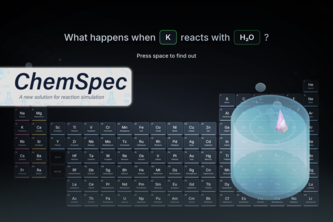
ChemSpec is a self-reported native Rust application designed as a chemical reaction simulator for students and educators. It simulates both molecular-level reactions and observable outcomes in 3D, with optional AI integration via Codex for reaction verification and explanation.
What changed
The project description reflects an early-stage hackathon submission (submitted to OpenAI 2026 hackathon), indicating a prototype or proof-of-concept rather than a commercial product. It was built using a combination of Rust, Iced, wgpu, and Codex, with no evidence of revenue, customers, or traction beyond the author's own account.
Single most important open question
Is there any evidence that ChemSpec has moved beyond an experimental prototype into actual use by students or educators? The description states it is a "chemistry app for students and educators", but does not confirm adoption or usage.
What The Product Actually Is
The description states that ChemSpec is:
- A chemical reaction simulator.
- Designed for users from sixth grade to early undergraduate level.
- Capable of showing both molecular-level simulations and 3D observational views of reactions.
- Built using Rust, Iced, and wgpu.
- Uses Codex for reaction validation and deeper analysis.
- Operates offline, without requiring internet connectivity.
It is described as a native Rust application, with support for 3D rendering and AI-assisted verification of chemical reactions. The app includes:
- A reaction catalogue.
- An algorithmic solver for common reaction families.
- Integration with Codex to validate or suggest reactions when the catalogue does not cover them.
Inference: ChemSpec is a desktop application (or web-based version) that allows users to simulate chemical processes in an interactive way, combining molecular modeling and 3D visualization. It is self-reported as being able to run offline, with no mention of cloud dependencies beyond Codex use.
Positioning & Claim Evolution
The description states:
- ChemSpec aims to bridge a gap in chemistry education where students often memorize equations without seeing reactions.
- It seeks to make chemical reactions more accessible, interactive, and memorable.
- The app is intended for teachers and students from sixth grade through early undergraduate level.
Inference: The positioning is that of an educational tool aimed at improving chemistry learning outcomes by visualizing abstract concepts. It positions itself as a supplement to traditional classroom instruction, especially in resource-constrained environments.
The claim evolution appears to be:
- From a general idea (improving chemistry education) → to a specific solution (a simulation app).
- The use of Codex introduces an AI-enhanced layer that supports reaction validation and explanation.
- The project evolved from a hackathon prototype into a working native application with offline capability.
Target Customer & ICP
The description states:
- ChemSpec is aimed at students and educators.
- It targets users from sixth grade up to early undergraduate level.
Inference: The primary customer segments are likely:
- Educators (teachers, professors) who want to enhance their instruction.
- Students in middle school through early college levels.
The ICP is not explicitly defined beyond the age/grade range. No evidence of segmentation by school type, geography, or institutional size is provided.
Business Model & Pricing Evidence
Not evidenced.
The description does not mention:
- Any pricing model.
- Revenue streams.
- Monetization strategy.
- Subscription plans or licensing terms.
Inference: There is no indication that ChemSpec has a business model in place. It is described as a prototype or hackathon project, with no commercial traction or monetization details.
Technical & Delivery Signals
The description states:
- Built using Rust, Iced, and wgpu.
- Designed to work offline.
- Uses a three-layer architecture: chemical reasoning, rendering, AI integration.
- Includes an algorithmic solver for common reaction families.
- Uses Codex for validation or suggestion of reactions not in the catalogue.
- Supports molecular graph representations and atomic-level transformations.
- Uses typed graphs to represent atoms and molecules.
- Simulates both 2D molecular animations and 3D macroscopic views.
Inference: The technical stack suggests a focus on performance, portability, and offline capability. The use of Rust implies robustness and speed. The integration with Codex indicates an attempt to scale reaction coverage beyond hardcoded rules.
Traction & Maturity Signals
Not evidenced.
The description does not include:
- Any user data or adoption metrics.
- Customer feedback or testimonials.
- Product usage statistics.
- Evidence of a live product or market presence.
Inference: The project is described as a hackathon submission, and there is no evidence of real-world use or traction beyond the authors' own claims.
Competitive Context
Not evidenced.
The description does not mention:
- Competitors in the chemistry education space.
- Existing tools or platforms that ChemSpec might compete with.
- Market positioning relative to other educational apps or simulators.
Inference: No competitive landscape is described. The project appears to be a standalone prototype without reference to existing solutions.
Open Questions & Risks
- No commercial traction: The project is presented as a hackathon submission, with no evidence of real-world adoption or revenue.
- Unverified claims: All statements are self-reported and unverified; there is no third-party validation of the app’s functionality or effectiveness.
- AI dependency: Reliance on Codex for reaction validation introduces potential instability or cost concerns if not managed carefully.
- Limited scope: The description indicates that only high school-level organic chemistry is supported, with plans to expand. This may limit its appeal or utility in broader markets.
- No pricing or monetization strategy: No indication of how the product would be monetized or whether it has a path to profitability.
Questions the description leaves open
- What evidence do you have that students or educators are currently using ChemSpec?
- How is Codex integrated into the app? Is it used for all reactions, or only those not covered by the algorithmic solver?
- Have you tested the app with actual teachers or students in a classroom setting?
- What is your plan to scale beyond the current reaction families and support more complex chemistry?
- Are there any plans to monetize the product? If so, how?
- How do you ensure accuracy of reactions when using Codex?
- Is there any data on user engagement or retention with the app?
Overall Assessment
Not evidenced.
The description does not provide:
- Any financial data.
- Evidence of revenue or customer base.
- Signs of product-market fit or commercial traction.
- Information about funding, team experience, or partnerships.
Inference: Based on the self-reported nature of the project and its status as a hackathon submission, there is no evidence to support an investment or partnership decision at this time. The project appears to be in early development with no demonstrated commercial viability or market presence.
Customer Segments
evidenced
The description states: "ChemSpec is a chemical reaction simulator aimed at teachers and students from sixth grade up to early undergraduate level."
Value Propositions
evidenced
The description states: "ChemSpec allows students to gain an understanding of various chemical reactions at both the molecular and observational level with the molecular simulation and 3D view, respectively." Additionally, it says: "We wanted to bridge this gap by making chemical reactions more accessible, interactive, and memorable, giving every student the opportunity to see chemistry come to life regardless of their school's resources."
Channels
inferred
The description does not explicitly state how ChemSpec reaches its users. However, it mentions that the app is a native Rust application built with Iced and wgpu, and that it works without an internet connection. This implies that distribution may be through direct download or installation, but this is not stated directly.
Customer Relationships
inferred
The description does not explicitly state how ChemSpec interacts with its users post-purchase or delivery. It is implied that the app provides educational content and simulations, but there is no mention of support channels, community features, or feedback mechanisms.
Revenue Streams
inferred
The description does not mention any revenue model for ChemSpec. There is no indication whether it is free, paid, subscription-based, or funded through grants or other means.
Key Resources
evidenced
The description states: "ChemSpec is a native Rust application built with Iced and wgpu, making it portable, light-weight, and accessible without an internet connection." It also mentions: "We built ChemSpec from the ground up using GPT 5.6 Sol."
Key Activities
evidenced
The description states: "ChemSpec checks its brief reviewed reaction catalogue, then runs an algorithmic solver if the reaction is not present in this catalogue. The solver covers common reaction families and activity and solubility rules." Additionally, it says: "Validated reactions are converted into renderer-independent frames containing the structural change. These frames create both a guided 2D molecular animation and a macroscopic 3D simulation."
Key Partnerships
inferred
The description does not explicitly mention any partnerships. It does reference the use of Codex (GPT 5.6 Sol) for certain aspects of development, but this is not framed as a partnership in the traditional sense.
Cost Structure
inferred
The description does not provide information about the cost structure of ChemSpec. There is no mention of development costs, operational expenses, or any financial considerations beyond the technical implementation.
Evidence & Gaps
- Customer Segments: evidenced - The description explicitly states the target audience as teachers and students from sixth grade to early undergraduate level.
- Value Propositions: evidenced - The description clearly outlines the educational value of making chemical reactions more accessible, interactive, and memorable.
- Channels: inferred - No explicit mention of how ChemSpec reaches its users; this must be inferred from the technical implementation details.
- Customer Relationships: inferred - No explicit mention of user interaction or support mechanisms post-delivery.
- Revenue Streams: inferred - No information provided on how ChemSpec generates revenue.
- Key Resources: evidenced - The description lists the technologies used (Rust, Iced, wgpu) and mentions the use of Codex for development.
- Key Activities: evidenced - The description details the core functionalities including reaction catalog checking, algorithmic solving, and simulation rendering.
- Key Partnerships: inferred - While Codex is mentioned, there's no explicit statement about partnerships or collaborations.
- Cost Structure: inferred - No information provided regarding costs associated with development or operation.
To convert the inferred blocks into evidenced ones, we would need:
- Clarification on distribution channels (e.g., app stores, direct downloads)
- Details on user engagement and support mechanisms
- Information on monetization strategy
- Explicit mention of partnerships or collaborations beyond Codex usage
- Financial data or cost breakdowns
User Stories BotA demo video on every pull request
Get a demo video on every new feature
GitHub App that watches your pull requests and records a narrated, captioned demo.
Save time on demo prep and make informed decisions faster with a video walkthrough of every new feature.
Source
Submitted to the OpenAI 2026 hackathon on Devpost. Project home on Devpost. Back to the full gallery on Devpost.
This competitive analysis was produced by top-founders.com (opens in a new tab)
Generated by a language model from this project's public Devpost page — its tagline, the author's own write-up and any built-with tags listed there — as captured in August 2026. Short quotations are the author's words. It is an opinion on the idea as a business, not on the people behind it, and it reflects the description as published then. If the project has moved on, request a correction below. The analysis is not independent research and contains no verified traction, revenue or customer data.
An independent guide by KFG International LLC — not affiliated with, endorsed by, or connected to Devpost or OpenAI.