

Archive position — measured, not model output
1 like on Devpost
505 of the 7,850 archived projects have more likes, and 1,758 share exactly 1 — so this project's #785 place in the like-ranked listing is a tie-break inside that group, not a ranking.
Projects (log scale)
Likes on Devpost. ▲ marks this project's group.
Show the figures
| Likes | Projects | Share of archive |
|---|---|---|
| 0 | 5,587 | 71.2% |
| 1 | 1,758 | 22.4% |
| 2 | 284 | 3.6% |
| 3–4 | 132 | 1.7% |
| 5–9 | 75 | 1.0% |
| 10+ | 14 | 0.2% |
 User Stories BotA demo video on every pull request
Get a demo video on every new feature
GitHub App that watches your pull requests and records a narrated, captioned demo.
Save time on demo prep and make informed decisions faster with a video walkthrough of every new feature.
Executive Summary
What the company appears to be
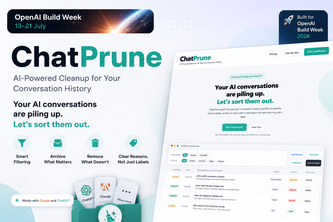
ChatPrune is a self-reported AI-powered tool designed to help users organize, analyze, and clean up their Claude and ChatGPT conversation history. The author describes it as a solution for people overwhelmed by scattered conversations across platforms and time, aiming to recommend what to delete, archive, or keep based on content analysis.
What changed
The project evolved from an earlier hackathon submission into a more robust tool during the Build Week period. It now includes features like privacy risk detection, conversation consolidation, and mobile-optimized UI, with a focus on data privacy and user control over their information.
Single most important open question
Is there any evidence of actual usage or traction beyond the author's own experience? The description states no revenue, customers, or adoption data are available — only self-reported claims about functionality and development progress.
What The Product Actually Is
The description states that ChatPrune:
- Reads Claude and/or ChatGPT conversation exports
- Analyzes conversations to recommend actions: Delete, Archive, Keep, or Review
- Flags potential privacy risks (e.g., shared API keys, passwords)
- Finds related conversations across platforms and timeframes
- Consolidates these into clean documents (e.g., Complaint Brief, Legal Notes, Project Notes)
- Does not store conversation content on its servers; only metadata such as email, license key, topic tags, and final decisions are retained
- Requires users to download files at key points during processing
The tool is built using AWS DynamoDB, Codex, Gemini, GPT-5.6, Groq, Next.js, React, Resend, Tailwind CSS, TypeScript, and Vercel.
Inference The product appears to be a data curation and organization tool for AI chat logs, with an emphasis on privacy and user control over data. It is not described as a SaaS platform or marketplace but rather as a personal utility for managing AI-generated content.
Positioning & Claim Evolution
The author positions ChatPrune as:
- A solution to the problem of "finding a specific decision buried in a conversation from three months ago"
- A tool that helps users avoid discovering the same issue twice
- An answer to the lack of clarity and organization in AI chat history, especially for individuals who use multiple AI tools over time
The evolution of the positioning seems to be:
- From a personal hackathon project (H0) to a more polished product during Build Week
- With emphasis on technical robustness and privacy architecture
- Transitioning from a tool for individual use into one that could support a full production launch
Inference The positioning has shifted from a niche, personal utility to something potentially scalable, though no evidence supports any move toward commercialization or market expansion beyond the author’s own use case.
Target Customer & ICP
The description states:
- The tool is intended for individuals who have used Claude and/or ChatGPT extensively over time
- Users likely include professionals managing large volumes of AI-generated conversations (e.g., job seekers, developers, researchers)
- The user base is described as non-technical but concerned about data ownership and control
Inference The primary customer segment appears to be individuals with significant AI chat histories who are looking for better organization and retrieval mechanisms. No evidence suggests a specific industry or role targeting beyond general users of AI tools.
Business Model & Pricing Evidence
There is no explicit mention of pricing, payment methods, or monetization strategy in the description.
The author notes:
- The tool was initially built during a hackathon
- A full production launch is planned with real payments and account login added
- No revenue, customer, or pricing data are provided
Inference While the author implies a future commercial model, there is no evidence of current monetization or pricing structure.
Technical & Delivery Signals
The description indicates:
- The tool uses Codex for development from plain English task descriptions
- It includes a five-model Groq fallback chain to handle rate limiting issues
- Privacy architecture was carefully designed without compromising data handling principles
- Mobile-specific layout rebuilds were implemented without breaking desktop experience
- Data persistence and download architecture ensures no conversation content is stored on servers
Inference The technical implementation shows deliberate attention to reliability, scalability, and user privacy. However, the lack of performance metrics or system logs prevents assessment of actual delivery quality.
Traction & Maturity Signals
No evidence of traction or maturity:
- No mention of active users, downloads, or engagement
- No customer testimonials or case studies
- No revenue data or funding rounds
- No product roadmap beyond the current build period
Inference There is no indication that ChatPrune has moved beyond prototype or internal use. The project remains in early development stages with no external validation.
Competitive Context
The description does not reference any competitors or existing solutions in this space.
Inference No competitive landscape is described, nor is there evidence of market analysis or differentiation from other tools that might manage AI chat logs or organize conversations.
Open Questions & Risks
Key risks and open questions based on the self-reported description:
- No evidence of actual usage or adoption
- No revenue, customer base, or traction data
- Reliance on AI coding tools (Codex) introduces potential instability in development process
- The author is a solo developer; no team structure or support infrastructure described
- Lack of independent verification of claims about functionality and privacy
Inference The absence of any measurable outcomes raises concerns about viability and scalability. The project may be more of an experiment than a viable business.
Questions the description leaves open
- What is the actual user base or traction beyond your own usage?
- How do you plan to monetize this tool, and what pricing model are you considering?
- Can you provide any data on how many users have interacted with the tool beyond testing?
- What specific challenges did you face in building the privacy architecture, and how were they resolved?
- Are there any known limitations or edge cases that affect performance or accuracy of recommendations?
- How do you intend to scale beyond a single developer’s capacity?
Overall Assessment
Assessment Not evidenced.
The description provides no information about financials, traction, customers, or market validation. It is entirely self-reported and unverified. The project appears to be in early development with no demonstrated commercial viability or user adoption.
This analysis reflects only the author's own claims — not facts confirmed through external sources or data. Any conclusion about investment or partnership potential must be based on additional due diligence beyond this description.
User Stories BotA demo video on every pull request
Get a demo video on every new feature
GitHub App that watches your pull requests and records a narrated, captioned demo.
Save time on demo prep and make informed decisions faster with a video walkthrough of every new feature.
Source
Submitted to the OpenAI 2026 hackathon on Devpost. Project home on Devpost. Back to the full gallery on Devpost.
This competitive analysis was produced by top-founders.com (opens in a new tab)
Generated by a language model from this project's public Devpost page — its tagline, the author's own write-up and any built-with tags listed there — as captured in August 2026. Short quotations are the author's words. It is an opinion on the idea as a business, not on the people behind it, and it reflects the description as published then. If the project has moved on, request a correction below. The analysis is not independent research and contains no verified traction, revenue or customer data.
An independent guide by KFG International LLC — not affiliated with, endorsed by, or connected to Devpost or OpenAI.