

Archive position — measured, not model output
1 like on Devpost
505 of the 7,850 archived projects have more likes, and 1,758 share exactly 1 — so this project's #783 place in the like-ranked listing is a tie-break inside that group, not a ranking.
Projects (log scale)
Likes on Devpost. ▲ marks this project's group.
Show the figures
| Likes | Projects | Share of archive |
|---|---|---|
| 0 | 5,587 | 71.2% |
| 1 | 1,758 | 22.4% |
| 2 | 284 | 3.6% |
| 3–4 | 132 | 1.7% |
| 5–9 | 75 | 1.0% |
| 10+ | 14 | 0.2% |
 User Stories BotA demo video on every pull request
Get a demo video on every new feature
GitHub App that watches your pull requests and records a narrated, captioned demo.
Save time on demo prep and make informed decisions faster with a video walkthrough of every new feature.
Executive Summary
What the company appears to be
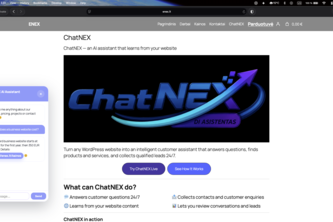
ChatNEX is an AI-powered customer support and sales assistant platform designed for business websites, particularly WordPress sites. It claims to transform any WordPress site into a production-ready AI agent that learns, updates, and adapts automatically using OpenAI models and a custom knowledge management system.
What changed
The project was submitted as part of the OpenAI 2026 hackathon, indicating it is in an early development or prototype stage. It has not yet launched commercially, nor does it show evidence of revenue, customers, or traction beyond its own self-reported claims.
Single most important open question
Is there sufficient evidence that ChatNEX can reliably operate at scale with real-world business data and maintain accurate, context-aware responses across multiple independent businesses?
What The Product Actually Is
- The description states that ChatNEX is an AI-powered customer support and sales assistant platform for business websites.
- It creates a dedicated AI assistant for each business website.
- These assistants are said to:
- Answer customer questions 24/7;
- Explain services and products;
- Collect qualified leads;
- Guide visitors toward contacting the business;
- Use business-specific knowledge instead of generic AI answers.
- The platform includes:
- A knowledge base;
- AI behavior settings;
- Business rules;
- Widget configuration;
- Lead management system.
- It supports automated knowledge monitoring via heartbeat checks to track changes in website content, e.g., product availability, price changes, promotions.
- The system is integrated with WordPress through a plugin, including WooCommerce environments.
- It uses OpenAI models combined with a custom knowledge management and retrieval system (RAG).
- It includes a centralized dashboard called "ChatNEX Director" for managing projects, reviewing conversations, analyzing leads, and controlling AI behavior.
Inference The product appears to be a web-based AI assistant built on top of WordPress, using RAG and OpenAI APIs, with a focus on business-specific content and lead generation. It is not described as a SaaS platform or marketplace but rather as an embedded tool for businesses to enhance their websites.
Positioning & Claim Evolution
- The author states that ChatNEX was built by a non-programmer using ChatGPT.
- The tagline claims it "transforms any WordPress site into a production-ready AI sales and support agent that learns, updates, and adapts automatically."
- The inspiration behind the project is to solve the problem of small businesses losing potential customers due to lack of immediate answers from static websites.
- It positions itself as an alternative to generic chatbots by emphasizing:
- Understanding individual business contexts;
- Continuous improvement with the business;
- Use of real-time data updates;
- Customization per business.
- The platform is described as being already running on real business websites, managing six independent projects.
Inference The positioning suggests a shift from traditional chatbots to more adaptive, context-aware AI agents tailored for small-to-medium businesses. However, the claim of "production-ready" and "already running on real business websites" lacks verifiable data or customer testimonials.
Target Customer & ICP
- The target customer is described as small businesses.
- The platform is intended for business websites, especially those using WordPress.
- It supports WooCommerce environments, suggesting e-commerce-focused clients.
- The author mentions working with local Lithuanian businesses in the next phase of development.
- The system is designed to be flexible enough to support multiple independent businesses while keeping each project's data and settings separate.
Inference The ICP appears to be small-to-medium-sized enterprises (SMEs) operating WordPress websites, particularly those in e-commerce or service-based industries. However, no explicit segmentation or customer personas are provided.
Business Model & Pricing Evidence
- No pricing information is mentioned.
- No revenue model is described beyond a future plan to introduce payment and subscription systems.
- The platform is said to be "already being developed with international use in mind," suggesting a potential SaaS model.
- There is no indication of whether the tool will be free, freemium, or paid.
Inference The business model remains undefined. It appears likely to evolve into a SaaS offering with subscriptions and payments, but this has not yet been implemented or demonstrated.
Technical & Delivery Signals
- Built using:
- OpenAI models;
- JavaScript, Node.js;
- PostgreSQL;
- RAG (Retrieval-Augmented Generation);
- WordPress plugin architecture.
- The system integrates with WordPress and supports older versions like 5.2.21.
- It uses a custom knowledge management and retrieval system.
- Automated website monitoring is implemented via heartbeat checks.
- Conversations are handled, leads collected, and AI behavior controlled through the ChatNEX Director dashboard.
Inference The technical stack shows some sophistication in integrating AI with web platforms and managing dynamic content. However, no details on scalability, performance, or infrastructure architecture are provided.
Traction & Maturity Signals
- The platform is described as being "already running on real business websites."
- It currently manages six independent business projects.
- Each project has:
- Its own AI assistant;
- Separate knowledge base;
- Custom AI behavior settings;
- Website widget integration;
- Lead collection;
- Conversation history.
- The platform is said to be "production-ready" and already being used by businesses.
Inference While the description claims traction, there is no independent verification of actual usage or performance metrics. The presence of six live projects does not confirm commercial viability or user satisfaction.
Competitive Context
- No competitors are explicitly named.
- The product competes with generic chatbot solutions and traditional website support tools.
- It differentiates itself by:
- Using business-specific knowledge;
- Providing automated updates;
- Supporting lead collection;
- Being embedded within WordPress.
- It is positioned against tools that offer static responses or require manual updates.
Inference The competitive landscape includes general-purpose AI chatbots and CRM integrations, but no specific comparison to existing platforms is made. The differentiation lies in automation and contextual awareness, though this is not validated.
Open Questions & Risks
- The author states the platform was built by a non-programmer using ChatGPT — raises concerns about technical depth and maintainability.
- No evidence of revenue, customers, or traction beyond self-reporting.
- The claim that it's "production-ready" lacks independent validation.
- Lack of pricing, monetization strategy, or go-to-market plan.
- No mention of security, data privacy, or compliance measures.
- The system is described as working with WordPress and older versions — this could imply limited scalability or compatibility issues.
Inference There are significant risks related to technical execution, commercial viability, and lack of real-world validation. The reliance on a single founder and lack of external feedback raises questions about product maturity and long-term sustainability.
Questions the description leaves open
- What specific business use cases have been tested in production?
- How is data privacy and security handled for customer information?
- Can you provide examples of how the AI assistant handles edge cases or ambiguous queries?
- What are the actual costs associated with running ChatNEX on a per-business basis?
- How does the system handle updates to business rules or content that may conflict with existing knowledge bases?
- Are there any known limitations in terms of concurrent users or website traffic volume?
- What is the current plan for monetization and pricing structure?
- How do you ensure accuracy and relevance of AI responses over time?
Overall Assessment
- The project is described as a hackathon submission, indicating it is in an early stage.
- It has no demonstrated traction, revenue, or customer base.
- The author’s claim that the system is "production-ready" and already running on real websites lacks corroboration.
- There is no evidence of funding, team size beyond one person, or market validation.
- The product shows some technical ambition but lacks clarity around commercial readiness.
Inference This project is not yet ready for investment or partnership. It requires further development, validation, and demonstration of real-world performance before any serious consideration can be made. The lack of independent evidence makes it difficult to assess its potential or risk profile.
User Stories BotA demo video on every pull request
Get a demo video on every new feature
GitHub App that watches your pull requests and records a narrated, captioned demo.
Save time on demo prep and make informed decisions faster with a video walkthrough of every new feature.
Source
Submitted to the OpenAI 2026 hackathon on Devpost. Project home on Devpost. Back to the full gallery on Devpost.
This competitive analysis was produced by top-founders.com (opens in a new tab)
Generated by a language model from this project's public Devpost page — its tagline, the author's own write-up and any built-with tags listed there — as captured in August 2026. Short quotations are the author's words. It is an opinion on the idea as a business, not on the people behind it, and it reflects the description as published then. If the project has moved on, request a correction below. The analysis is not independent research and contains no verified traction, revenue or customer data.
An independent guide by KFG International LLC — not affiliated with, endorsed by, or connected to Devpost or OpenAI.