

Archive position — measured, not model output
0 likes on Devpost
2,263 of the 7,850 archived projects have more likes, and 5,587 share exactly 0 — so this project's #3,204 place in the like-ranked listing is a tie-break inside that group, not a ranking.
Projects (log scale)
Likes on Devpost. ▲ marks this project's group.
Show the figures
| Likes | Projects | Share of archive |
|---|---|---|
| 0 | 5,587 | 71.2% |
| 1 | 1,758 | 22.4% |
| 2 | 284 | 3.6% |
| 3–4 | 132 | 1.7% |
| 5–9 | 75 | 1.0% |
| 10+ | 14 | 0.2% |
 User Stories BotA demo video on every pull request
Get a demo video on every new feature
GitHub App that watches your pull requests and records a narrated, captioned demo.
Save time on demo prep and make informed decisions faster with a video walkthrough of every new feature.
Executive Summary
What the company appears to be
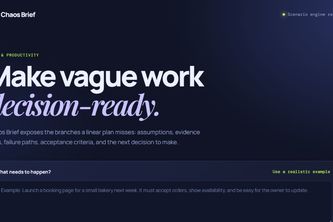
Chaos Brief is a browser-based tool developed by one person (Vasilii Ananii) that processes vague work requests into structured outputs. It aims to make ambiguous tasks more testable and manageable by identifying assumptions, defining next decisions, and outlining scenario paths.
What changed
The project was built as part of an OpenAI hackathon submission. It is described as a prototype with no login or server dependencies, using local browser storage for drafts and evidence tracking.
Single most important open question
Does the tool have any real-world traction or usage beyond its prototype form?
What The Product Actually Is
The description states that Chaos Brief is a privacy-first browser tool. It is described as:
- A dependency-free HTML, CSS, and JavaScript browser prototype.
- It stores drafts and evidence assignments locally in the browser.
- It does not use accounts, servers, analytics, or API calls.
- It uses Codex and GPT-5.6 during development but does not present AI-generated assumptions as facts.
The tool is designed to process messy requests and produce outputs including:
- Explicit next decisions
- Assumptions that must be validated
- Acceptance criteria and evidence gaps
- A local evidence board with ownership, due dates, and verified states
- Change triggers that reopen the plan
- A three-step first-release plan
- Six scenario paths
Inference The tool is a conceptual prototype, not a production-ready product. It is built for demonstration purposes and lacks any indication of deployment or usage beyond its own interface.
Positioning & Claim Evolution
The author states that Chaos Brief addresses the problem of vague work requests causing rework in small teams. The core claim is:
- It turns vague requests into testable first releases.
- It does not invent facts, but instead makes assumptions explicit.
- It focuses on operational topics such as payments, orders, fulfillment, and volatile information.
The positioning evolves from a general idea of helping teams avoid rework to a specific tool that:
- Identifies scope boundaries
- Forces teams to choose one end-to-end flow
- Makes deferred work explicit
Inference The positioning is conceptual, not yet validated in practice. It is framed as a solution to a common problem but lacks evidence of adoption or impact.
Target Customer & ICP
The description states that Chaos Brief targets small teams who lose time due to vague first requests.
It does not specify:
- Industry
- Role (e.g., product managers, engineers)
- Size of team
- Use case beyond general "work requests"
Inference The target customer is undefined beyond small teams, and there is no clear ICP or segmentation strategy. The tool is described as a general-purpose solution, not tailored to specific verticals or roles.
Business Model & Pricing Evidence
There is no evidence of any business model or pricing structure in the description.
The product is presented as:
- A prototype
- A browser-based tool with no login or server dependencies
- Not monetized or sold
Inference No business model or pricing is evident. The tool is described as a hackathon submission, not a commercial offering.
Technical & Delivery Signals
The description states that the app is:
- Built with HTML, CSS, JavaScript
- A dependency-free browser prototype
- Uses Codex and GPT-5.6 during development
- Stores data locally in the browser
- Does not use accounts, servers, or analytics
- Has a deterministic scenario engine
It also mentions:
- The engine recognizes operational topics like payments, orders, fulfillment, volatile information, and user flows.
- It maps these to questions, criteria, triggers, and scenario descriptions.
Inference The technical approach is conceptual and minimal, with no indication of scalability or integration capabilities. The tool is designed for local use and lacks any server-side or API components.
Traction & Maturity Signals
The description states:
- It is a working live prototype
- No login required
- No server, analytics, or API calls
- It was built during an OpenAI hackathon
There is no evidence of:
- Users
- Revenue
- Customers
- Adoption
- Product usage beyond the demo
Inference The tool is in a very early stage, with no traction or maturity signals. It is described as a prototype, not a product in use.
Competitive Context
There is no evidence of any competitive analysis or market positioning in the description.
The author does not mention:
- Competitors
- Existing tools for handling ambiguous requests
- Market size or opportunity
Inference No competitive context is provided. The tool appears to be a novel concept, but there is no indication of whether similar solutions exist or how it would differentiate.
Open Questions & Risks
Key risks and open questions based on the description:
- No traction or adoption: It is described as a prototype with no users or revenue.
- Single-person team: The entire project was built by one person, raising questions about scalability.
- No monetization or business model: No indication of how it would be sold or used commercially.
- Limited functionality: The tool is browser-based and local-only, with no integrations or APIs.
- Unproven concept: It is a hackathon submission, not a tested product.
Inference The project is highly speculative, with no evidence of real-world utility or commercial viability.
Questions the description leaves open
- What specific problems are teams facing that this tool aims to solve?
- How does the tool handle complex, multi-domain requests (e.g., involving legal, design, and engineering)?
- Has there been any user testing or feedback on the prototype?
- Are there plans to move beyond the browser prototype into a scalable product?
- What is the intended path from prototype to commercial product?
- How would you monetize this tool if it were to become a product?
Overall Assessment
The description states that Chaos Brief is:
- A browser-based prototype
- Built during an OpenAI hackathon
- Not yet monetized or deployed for real use
- Designed as a privacy-preserving, assumption-first tool
There is no evidence of:
- Revenue
- Customers
- Traction
- Product-market fit
- Commercial viability
Inference The project is in a very early stage, with no commercial due-diligence signals. It is described as a concept or prototype, not a product in use.
Assessment Not evidenced. This is a conceptual tool with no demonstrated traction, revenue, or business model. It is not ready for investment or partnership consideration at this time.
User Stories BotA demo video on every pull request
Get a demo video on every new feature
GitHub App that watches your pull requests and records a narrated, captioned demo.
Save time on demo prep and make informed decisions faster with a video walkthrough of every new feature.
Source
Submitted to the OpenAI 2026 hackathon on Devpost. Project home on Devpost. Back to the full gallery on Devpost.
This competitive analysis was produced by top-founders.com (opens in a new tab)
Generated by a language model from this project's public Devpost page — its tagline, the author's own write-up and any built-with tags listed there — as captured in August 2026. Short quotations are the author's words. It is an opinion on the idea as a business, not on the people behind it, and it reflects the description as published then. If the project has moved on, request a correction below. The analysis is not independent research and contains no verified traction, revenue or customer data.
An independent guide by KFG International LLC — not affiliated with, endorsed by, or connected to Devpost or OpenAI.