

Archive position — measured, not model output
0 likes on Devpost
2,263 of the 7,850 archived projects have more likes, and 5,587 share exactly 0 — so this project's #3,191 place in the like-ranked listing is a tie-break inside that group, not a ranking.
Projects (log scale)
Likes on Devpost. ▲ marks this project's group.
Show the figures
| Likes | Projects | Share of archive |
|---|---|---|
| 0 | 5,587 | 71.2% |
| 1 | 1,758 | 22.4% |
| 2 | 284 | 3.6% |
| 3–4 | 132 | 1.7% |
| 5–9 | 75 | 1.0% |
| 10+ | 14 | 0.2% |
 User Stories BotA demo video on every pull request
Get a demo video on every new feature
GitHub App that watches your pull requests and records a narrated, captioned demo.
Save time on demo prep and make informed decisions faster with a video walkthrough of every new feature.
Executive Summary
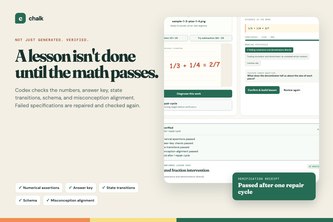
What the company appears to be: Chalk is a self-reported AI-powered educational tool for teachers that analyzes student handwritten math work (specifically fractions) and generates differentiated lesson plans based on identified misconceptions. The author states it uses GPT-5.6 vision for diagnosis, a multi-agent system for lesson generation, and an in-house verifier to ensure correctness.
What changed: The project description indicates a shift from a generic AI worksheet generator to a more trustworthy system with self-verifying lessons, built around the core insight that "a wrong answer isn't just wrong, it's a window into what a kid actually believes."
Single most important open question: Is there evidence of real-world adoption or usage by teachers? The description is entirely self-reported and lacks any traction data, customer feedback, or revenue signals.
What The Product Actually Is
The description states that Chalk:
- Reads handwritten student math work via GPT-5.6 vision
- Matches the work to a fixed library of known fraction misconceptions
- Generates differentiated lesson packs (scaffolded, core, extension)
- Includes interactive fraction-bar models and targeted practice
- Has a self-verifier that checks math assertions and repairs only failed components
- Handles addition and subtraction of fractions
The author claims it was built entirely with Codex, using GPT-5.6 for diagnosis, lesson drafting, and repair loops. It uses a fixed misconception library and avoids generating code directly — instead relying on vetted components to render outputs.
Evidence: Self-reported by the author; no independent verification or demonstration provided.
Positioning & Claim Evolution
The description states that Chalk's positioning evolved from:
- An AI that writes worksheets
- To an AI that won't hand you a lesson it can't prove is right
This shift was driven by the need to build trust in AI-generated educational content. The author emphasizes that the "hard part of an AI teaching tool isn't generating a lesson — models are good at that. The hard part is trusting it."
Inference: The evolution reflects an understanding that trust and verifiability are critical for adoption in education, especially where human judgment is involved.
Target Customer & ICP
The description states:
- Teachers who spend time making multiple versions of lessons for students at different levels
- Specifically, teachers working with middle school students on fraction misconceptions
- The tool is designed to help teachers "take back" time spent preparing lessons
Evidence: Self-reported; no explicit segmentation or customer validation.
Business Model & Pricing Evidence
Not evidenced. The description does not mention any pricing model, monetization strategy, or business structure beyond the author's personal development effort.
Technical & Delivery Signals
The description states:
- Built with: codex, css, gpt-5.6, next.js, node.js, openai, openai-api, react, sharp, typescript
- Uses GPT-5.6 vision for diagnosis and multi-agent drafting
- Has a repair loop that fixes only failed components
- Verifier checks math assertions and ensures correctness
- Privacy is prioritized: images stripped of metadata, no storage, never saved
Evidence: Self-reported; no demonstration or delivery evidence provided.
Traction & Maturity Signals
Not evidenced. The description does not include any data on:
- Number of users
- Adoption rate
- Customer feedback
- Revenue
- Product usage metrics
The project is described as a hackathon submission, and the author notes that it was built by one person (Adeel Tahir).
Competitive Context
Not evidenced. The description does not mention competitors or market positioning beyond the general field of AI-powered educational tools.
Open Questions & Risks
- Trust and adoption risk: The tool is described as a personal project, with no evidence of real-world usage or feedback.
- Technical feasibility: The claim that GPT-5.6 can reliably diagnose misconceptions and generate correct lessons without human intervention is unverified.
- Scalability: The author notes that adding other subjects would make the core function worse — suggesting a narrow focus, which may limit long-term growth.
- Privacy vs. utility trade-off: While privacy is emphasized, it's unclear how this affects the tool’s ability to learn or improve over time.
Questions the description leaves open
- Has the tool been tested with real teachers in a classroom setting?
- What specific fraction misconceptions are included in the fixed library? How was it curated?
- How does the self-verifier handle edge cases or novel misconceptions not in the library?
- Are there any plans for monetization or commercial use beyond the hackathon submission?
- What is the expected time investment for a teacher to use Chalk, and how does this compare to current manual processes?
Overall Assessment
Not evidenced. No information is provided about:
- Revenue
- Customer base
- Market size
- Product-market fit
- Team traction or prior experience
The project is described as a hackathon submission by one individual, with no evidence of commercial viability or traction.
User Stories BotA demo video on every pull request
Get a demo video on every new feature
GitHub App that watches your pull requests and records a narrated, captioned demo.
Save time on demo prep and make informed decisions faster with a video walkthrough of every new feature.
Source
Submitted to the OpenAI 2026 hackathon on Devpost. Project home on Devpost. Back to the full gallery on Devpost.
This competitive analysis was produced by top-founders.com (opens in a new tab)
Generated by a language model from this project's public Devpost page — its tagline, the author's own write-up and any built-with tags listed there — as captured in August 2026. Short quotations are the author's words. It is an opinion on the idea as a business, not on the people behind it, and it reflects the description as published then. If the project has moved on, request a correction below. The analysis is not independent research and contains no verified traction, revenue or customer data.
An independent guide by KFG International LLC — not affiliated with, endorsed by, or connected to Devpost or OpenAI.