

Archive position — measured, not model output
0 likes on Devpost
2,263 of the 7,850 archived projects have more likes, and 5,587 share exactly 0 — so this project's #3,159 place in the like-ranked listing is a tie-break inside that group, not a ranking.
Projects (log scale)
Likes on Devpost. ▲ marks this project's group.
Show the figures
| Likes | Projects | Share of archive |
|---|---|---|
| 0 | 5,587 | 71.2% |
| 1 | 1,758 | 22.4% |
| 2 | 284 | 3.6% |
| 3–4 | 132 | 1.7% |
| 5–9 | 75 | 1.0% |
| 10+ | 14 | 0.2% |
 User Stories BotA demo video on every pull request
Get a demo video on every new feature
GitHub App that watches your pull requests and records a narrated, captioned demo.
Save time on demo prep and make informed decisions faster with a video walkthrough of every new feature.
Executive Summary
What the company appears to be
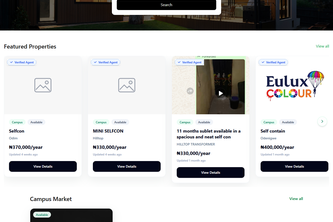
CASA is a self-reported mobile-first housing marketplace platform focused on student accommodation around Nigerian universities. The platform allows users to browse properties, contact agents, view verified agent profiles, and report suspicious listings. It was built by a non-technical founder using AI tools like Codex and GPT-5.6 for development.
What changed
The project is described as an MVP built through a non-traditional development process involving AI-assisted coding. The author states that the platform began before GPT-5.6 became available, but it was used in later stages for debugging and product reasoning.
Single most important open question
Is there any evidence of real user adoption or traction beyond the founder’s own testing and development?
What The Product Actually Is
The description states that CASA is a mobile-first housing and local marketplace platform. It enables users to:
- Browse and search available properties
- View prices, locations, descriptions, images, videos, and virtual tours
- Save properties for later
- Contact property agents directly
- View verified agent profiles and ratings
- Report suspicious listings
- Browse items in the Campus Market
Approved agents can:
- Create and manage property listings
- Renew existing listings
- Post items in the Campus Market
- Build a public agent profile
- Receive ratings from users
- Invite trusted agents using referral links
Administrators can:
- Review and approve agent applications
- Verify trusted agents
- Moderate users and listings
- Review reported properties
- Track referral relationships
- Manage the platform’s early agent network
The product is described as having a responsive mobile-first interface, with features like saved listings, property reporting, and public agent profiles.
Evidence
- The author describes the full set of user and agent functionalities.
- The platform includes authentication, user profiles, agent onboarding, and moderation tools.
Inference The platform appears to be a property discovery and marketplace tool, with a focus on transparency and trust in the Nigerian housing market.
Positioning & Claim Evolution
The description states that CASA was created to make housing discovery more structured, transparent, and accessible. It specifically targets the Nigerian market, where people struggle to compare properties, understand real prices, or identify trustworthy agents.
The platform is currently focused on student accommodation around the University of Nigeria, Nsukka, but the author claims it is not intended to remain student-only. The goal is to expand to renters, buyers, landlords, and property agents across Nigeria.
Evidence
- The author explicitly states that the current MVP focuses on students.
- The platform’s expansion plan includes broader rental and property-sale markets.
Inference CASA positions itself as a trust-based housing discovery tool, starting with students and evolving into a national marketplace. It is not yet positioned as a full-fledged real estate platform but as a first step toward one.
Target Customer & ICP
The current MVP targets students searching for accommodation around Nigerian universities, particularly the University of Nigeria, Nsukka.
The author states that the student market is the first focused demographic used to validate the idea before expanding. Future expansion includes renters, buyers, landlords, and property agents.
Evidence
- The platform’s focus is on student housing.
- The expansion plan includes broader user segments.
Inference CASA's initial ICP is students in Nigerian universities, with a long-term vision of becoming a national marketplace for all housing needs. No evidence of current customer segmentation or targeting beyond this.
Business Model & Pricing Evidence
The description states that CASA’s initial growth strategy is to position the platform as a free lead-generation channel for credible local agents. Agents gain visibility, enquiries, a public business profile, and tools for managing their listings.
As user demand and verified enquiry volume grow, CASA may introduce:
- Paid lead-generation tools
- Premium agent subscriptions
- Enhanced listing visibility
The author does not mention any current pricing or monetization model.
Evidence
- The platform is described as free to use for agents.
- Future monetization plans are speculative.
Inference CASA appears to be in a free-to-use, agent-driven lead generation model, with potential for monetization later. No evidence of revenue or pricing structure exists.
Technical & Delivery Signals
The platform was built using:
- Next.js
- React
- TypeScript
- Tailwind CSS
- Supabase Authentication
- Supabase PostgreSQL
- Supabase Storage
- Vercel
Development was done with the help of Codex and GPT-5.6, which were used for debugging, product reasoning, and improving implementation.
The author describes a development process involving:
- Describing features in plain English
- Codex inspecting code and implementing changes
- Manual testing and feedback loops
- Use of linting and production builds
Evidence
- The tech stack is listed.
- The development process is described in detail, including AI involvement.
Inference The platform was built using a non-traditional, AI-assisted approach, with the founder acting as product lead. This suggests a low-code or no-code strategy, but with technical depth.
Traction & Maturity Signals
The author states that CASA is a working application and includes:
- A functioning property marketplace
- Authentication and user profiles
- Agent onboarding and approval
- Referral-only agent recruitment
- Agent ratings and public profiles
- Property listing creation and management
- Saved listings
- Property reporting
- Campus marketplace listings
- Admin moderation tools
- Responsive mobile-first interfaces
- Supabase database and storage integration
However, there is no evidence of real users, customers, or adoption beyond the founder’s own testing.
Evidence
- The platform has a working MVP.
- Features are described in detail.
Inference The project shows technical maturity, but no evidence of user traction or commercial adoption. It remains an early-stage prototype.
Competitive Context
The description does not mention any competitors, nor does it provide context about the broader Nigerian housing marketplace landscape.
Evidence
- No competitor names or market analysis provided.
Inference There is no evidence of competitive positioning, and no indication of how CASA compares to existing solutions in Nigeria’s housing space.
Open Questions & Risks
- No user traction or revenue: The platform is described as an MVP with no evidence of real users or monetization.
- Founder is non-technical: While AI tools were used, the lack of technical expertise raises questions about scalability and long-term product development.
- Unverified claims: All information is self-reported and unverified.
- No clear path to monetization: The business model is speculative and not yet proven.
- Limited market focus: The platform starts with one university, which may limit early growth.
Evidence
- No revenue or customer data.
- No mention of competitors or market analysis.
- Business model is described as future-oriented.
Inference CASA is at a very early stage, and the lack of traction, monetization, or competitive context raises significant risks for commercial viability.
Questions the description leaves open
- What are the actual user numbers or engagement metrics (if any)?
- How many agents have signed up, and how many listings are active?
- What is the current conversion rate from lead to agent sign-up?
- Are there any partnerships with universities or real estate agents?
- What is the plan for scaling beyond one university?
- How does CASA differentiate from existing platforms in Nigeria (if any)?
- What is the expected timeline for monetization and revenue generation?
Overall Assessment
The description states that CASA is a working MVP built by a non-technical founder using AI tools. It has technical functionality but lacks evidence of traction, customers, or revenue.
Evidence
- No revenue, customer base, or adoption metrics.
- The platform is described as a prototype with no commercial validation.
Inference This is an early-stage idea, not yet a validated business. While the product shows promise in terms of execution and technical feasibility, there is no evidence of commercial viability or traction to support investment or partnership at this stage.
User Stories BotA demo video on every pull request
Get a demo video on every new feature
GitHub App that watches your pull requests and records a narrated, captioned demo.
Save time on demo prep and make informed decisions faster with a video walkthrough of every new feature.
Source
Submitted to the OpenAI 2026 hackathon on Devpost. Project home on Devpost. Back to the full gallery on Devpost.
This competitive analysis was produced by top-founders.com (opens in a new tab)
Generated by a language model from this project's public Devpost page — its tagline, the author's own write-up and any built-with tags listed there — as captured in August 2026. Short quotations are the author's words. It is an opinion on the idea as a business, not on the people behind it, and it reflects the description as published then. If the project has moved on, request a correction below. The analysis is not independent research and contains no verified traction, revenue or customer data.
An independent guide by KFG International LLC — not affiliated with, endorsed by, or connected to Devpost or OpenAI.