

Archive position — measured, not model output
0 likes on Devpost
2,263 of the 7,850 archived projects have more likes, and 5,587 share exactly 0 — so this project's #3,078 place in the like-ranked listing is a tie-break inside that group, not a ranking.
Projects (log scale)
Likes on Devpost. ▲ marks this project's group.
Show the figures
| Likes | Projects | Share of archive |
|---|---|---|
| 0 | 5,587 | 71.2% |
| 1 | 1,758 | 22.4% |
| 2 | 284 | 3.6% |
| 3–4 | 132 | 1.7% |
| 5–9 | 75 | 1.0% |
| 10+ | 14 | 0.2% |
 User Stories BotA demo video on every pull request
Get a demo video on every new feature
GitHub App that watches your pull requests and records a narrated, captioned demo.
Save time on demo prep and make informed decisions faster with a video walkthrough of every new feature.
Executive Summary
CAF (Cloud AI-Agentic FrameWork) is a self-reported developer tool that aims to simplify building production-grade AI agents by abstracting infrastructure complexity into a unified API. The project was built as part of the OpenAI 2026 hackathon and is described as an "AI Operating System for developers". It claims to offer multi-provider support, isolated agent execution, document parsing and embedding, session memory management, and hybrid search capabilities—all behind a simple REST API.
The author states that CAF handles vector databases, RAG pipelines, prompt engineering, tool orchestration, and context limits automatically. It supports multiple LLM providers (Gemini, Groq, OpenAI, Anthropic, Ollama), integrates with FAISS for similarity search, and uses SQLite for local memory management.
Key commercial due-diligence read: The description does not contain any evidence of revenue, customers, or product-market fit. It is unclear whether CAF has been used beyond the hackathon context, nor if there are any real-world applications or adoption. The single most important open question is: Has CAF been tested in production environments, and does it have any users or paying customers?
What The Product Actually Is
The description states that CAF is an AI runtime and execution engine designed to allow developers to build production-ready AI agents using a simple REST API. It provides:
- A centralized platform for managing AI agents
- Multi-provider support (Gemini, Groq, OpenAI, Anthropic, Ollama)
- Document upload and parsing capabilities with automatic chunking and embedding
- Session memory handling
- Hybrid search functionality via local knowledge and web search
- Isolated agent execution environments
It is described as a "Cloud AI-Agentic FrameWork" that abstracts away infrastructure complexity so developers can focus on application logic.
Inference: Based on the technical stack listed (FastAPI, FAISS, SQLite, JavaScript frontend), it appears to be a Python-based backend system with a web console UI and integration points for LLM APIs.
Positioning & Claim Evolution
The author positions CAF as an "AI Operating System for developers", suggesting a platform-level abstraction similar to how operating systems manage hardware resources. The project evolved from a previous name, OrchestraAI, indicating some form of rebranding or refinement in concept.
Claims include:
- Developers should not have to be ML engineers or infrastructure experts
- CAF handles all complex AI agent infrastructure behind a simple API
- Enables developers to integrate fully autonomous agents with minimal code
- Provides strict multi-tenant isolation between agents
Inference: The positioning reflects a shift from generic AI tools toward a more structured, runtime-like abstraction that reduces developer friction in building intelligent applications.
Target Customer & ICP
The description states that CAF targets developers who want to build production-grade AI agents without dealing with the complexity of integrating LLMs manually. It is aimed at teams building chatbots or intelligent assistants for apps, websites, terminals, or mobile platforms.
It also mentions enterprise use-cases where strict agent isolation and secure execution are required.
Inference: The target customer segment appears to be software developers working on AI-enabled applications, particularly those in B2B SaaS, developer tooling, or internal productivity tools. However, no evidence of specific customer personas or market segments is provided.
Business Model & Pricing Evidence
There is no mention of pricing models, monetization strategies, or business model details in the description.
Not evidenced: No information about how CAF intends to generate revenue, whether it's freemium, subscription-based, usage-based, or other models.
Technical & Delivery Signals
The project was built using:
- Backend: Python, FastAPI, Uvicorn
- Knowledge Pipeline: FAISS for vector search, text extraction, chunking, embedding generation
- Memory & Graph: SQLite for session states and metadata
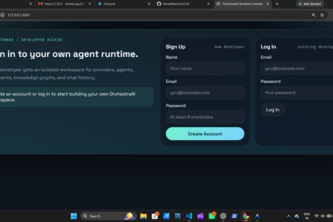
- Frontend: Vanilla JavaScript and CSS with glassmorphism UI
- AI Integrations: Gemini 1.5, Groq (Llama 3), dynamic fallback routing
It includes features like:
- Autonomous web search via DuckDuckGo
- Hybrid search combining local knowledge and web results
- Context window management through background summarization engine
- Cascading delete system to maintain FAISS index integrity
Inference: The technical architecture suggests a lightweight, cloud-native approach with strong emphasis on developer experience and modularity. However, the lack of production deployment details or scalability claims is notable.
Traction & Maturity Signals
The project was submitted to the OpenAI 2026 hackathon, indicating early-stage development and prototype status.
The author mentions accomplishments such as:
- Developer Experience improvements
- Strict multi-tenant isolation
- Successful implementation of agent sandboxing
However, there is no evidence of:
- Real-world usage or adoption
- Customer feedback or testimonials
- Revenue or monetization metrics
- Product maturity beyond the hackathon phase
Not evidenced: No traction data, user base, or market validation.
Competitive Context
The author does not reference any direct competitors. The project is described as filling a gap in AI agent development complexity, implying that existing solutions are too complex for developers to use effectively.
Inference: CAF likely competes with platforms like LangChain, LlamaIndex, AutoGen, or other low-code/no-code AI agent builders, though no explicit comparison is made.
Open Questions & Risks
- No evidence of traction or users: The project exists only in prototype form and has not been tested beyond the hackathon.
- Single-founder team: Only one member listed (Shebin T.R), which may limit execution capacity.
- Unproven scalability assumptions: While it handles context limits, there is no indication of how well it scales to large volumes or complex use cases.
- Limited integration depth: The description doesn’t elaborate on how deeply CAF integrates with enterprise systems or third-party tools.
- No commercial viability evidence: No pricing, monetization, or go-to-market strategy described.
Questions the description leaves open
- Has CAF been used in any real-world applications beyond the hackathon?
- What is the current state of development? Is it ready for production use?
- Are there any existing users or pilot customers?
- How does CAF plan to monetize its platform?
- What are the long-term technical roadmaps and scalability plans?
- How does CAF handle security, compliance, and data privacy at scale?
- What is the competitive advantage over similar platforms like LangChain or LlamaIndex?
Overall Assessment
Not evidenced: No financials, revenue, or customer data are available to assess commercial viability.
The description indicates a promising idea with strong developer-focused positioning but lacks evidence of traction, market validation, or product-market fit. It is unclear whether CAF has moved beyond the prototype stage or if it has any real-world adoption.
Confidence Level: Low — this analysis is based entirely on self-reported information without external corroboration or evidence of performance, usage, or revenue.
User Stories BotA demo video on every pull request
Get a demo video on every new feature
GitHub App that watches your pull requests and records a narrated, captioned demo.
Save time on demo prep and make informed decisions faster with a video walkthrough of every new feature.
Source
Submitted to the OpenAI 2026 hackathon on Devpost. Project home on Devpost. Back to the full gallery on Devpost.
This competitive analysis was produced by top-founders.com (opens in a new tab)
Generated by a language model from this project's public Devpost page — its tagline, the author's own write-up and any built-with tags listed there — as captured in August 2026. Short quotations are the author's words. It is an opinion on the idea as a business, not on the people behind it, and it reflects the description as published then. If the project has moved on, request a correction below. The analysis is not independent research and contains no verified traction, revenue or customer data.
An independent guide by KFG International LLC — not affiliated with, endorsed by, or connected to Devpost or OpenAI.