

Archive position — measured, not model output
0 likes on Devpost
2,263 of the 7,850 archived projects have more likes, and 5,587 share exactly 0 — so this project's #3,076 place in the like-ranked listing is a tie-break inside that group, not a ranking.
Projects (log scale)
Likes on Devpost. ▲ marks this project's group.
Show the figures
| Likes | Projects | Share of archive |
|---|---|---|
| 0 | 5,587 | 71.2% |
| 1 | 1,758 | 22.4% |
| 2 | 284 | 3.6% |
| 3–4 | 132 | 1.7% |
| 5–9 | 75 | 1.0% |
| 10+ | 14 | 0.2% |
 User Stories BotA demo video on every pull request
Get a demo video on every new feature
GitHub App that watches your pull requests and records a narrated, captioned demo.
Save time on demo prep and make informed decisions faster with a video walkthrough of every new feature.
Executive Summary
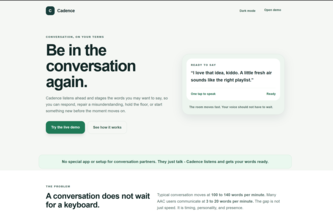
Cadence is a self-reported real-time communication companion for people with ALS and other AAC users, built as a prototype for the OpenAI 2026 hackathon. The product aims to support participation in fast conversations by offering prepared replies, conversation initiation, and offline resilience, all while maintaining user control over speech output.
The project is described as an early prototype, not a medical device or emergency service. It uses browser-based live transcription, GPT-5.6 for reply generation, and local storage for privacy. The team consists of two members and the product is built with Next.js, TypeScript, Tailwind CSS, OpenAI APIs, and MediaPipe.
Key commercial due-diligence read: There is no evidence of revenue, customers, or traction beyond the prototype phase. The self-reported description lacks any data on user adoption, usage metrics, or commercial viability. The product’s positioning as a communication tool for people with ALS may imply a niche market, but there is no indication of how this would scale or monetize.
Single most important open question: Is there a viable path to market beyond the prototype phase, and what are the barriers to adoption by end users or partners?
What The Product Actually Is
The description states that Cadence is a real-time communication companion for people with ALS and other AAC users. It supports:
- Live captions using browser Speech Recognition API
- Prepared replies generated via GPT-5.6 with structured JSON output
- User control over speech, including editing, rejecting, or saving suggestions
- Initiation of conversation topics (not only reaction)
- Offline resilience through local storage and device voice
- Voice options including OpenAI TTS or instant device speech
- Accessible input methods: touch, keyboard, scanning, eye-gaze focus
The system is built with Next.js, TypeScript, Tailwind CSS, OpenAI APIs, MediaPipe, localStorage, and Vercel.
Inference: The product appears to be a web-based application designed for accessibility, with an emphasis on real-time interaction and user agency.
Positioning & Claim Evolution
The description states that Cadence focuses on participation in the whole conversational turn, not just faster typing. It emphasizes:
- Timing, choice, and connection
- Be ready before the moment passes
- Choose language that sounds like the person
- Repair a wrong suggestion or misunderstanding
- Hold the floor when more time is needed
- Initiate something meaningful, not only react
It positions itself as different from other AAC tools by focusing on real-time communication and user control, rather than just text composition speed.
Inference: The positioning evolved from addressing the limitations of existing AAC tools to enabling full conversational agency for users with ALS.
Target Customer & ICP
The description states that Cadence is intended for:
- People with ALS
- Other AAC users
- Users who communicate slowly and need support in fast conversations
It also mentions that it supports caregivers, speech-language pathologists, and assistive-technology professionals through optional partner tips.
Inference: The primary ICP appears to be individuals living with ALS or similar motor impairments, with secondary users being caregivers and professionals involved in AAC support.
Business Model & Pricing Evidence
There is no evidence of a business model or pricing strategy in the description. The project is described as an early prototype and not a commercial product.
Inference: No revenue streams or monetization plans are evident from the self-reported description.
Technical & Delivery Signals
The system is built with:
- Next.js 14 App Router
- TypeScript
- Tailwind CSS
- OpenAI APIs (GPT-5.6, TTS)
- Browser Web Speech API
- MediaPipe Face Landmarker
- localStorage for local memory
- Upstash Redis for rate limiting
- Vercel for deployment
It includes features such as:
- Mock mode for offline behavior
- Structured outputs and API route separation
- Consent checks, input caps, CSP, rate limiting, and server-side secret handling
Inference: The technical stack suggests a modern, web-based, privacy-conscious application with modular design and offline capabilities.
Traction & Maturity Signals
The description states that Cadence is an early prototype, not a medical or emergency tool. It was submitted to the OpenAI 2026 hackathon and has no evidence of revenue, customers, or adoption beyond its own self-reporting.
Inference: There are no traction or maturity signals beyond the prototype stage. No data on user engagement, retention, or product usage is provided.
Competitive Context
The description mentions that many communication tools help compose text faster but Cadence focuses on participation in the whole conversational turn, not just typing speed.
It references research and studies related to AAC, ALS, accessibility, and communication-participation, but does not name specific competitors or market players.
Inference: The competitive landscape is implied to include existing AAC tools, but no direct comparison or differentiation from known products is made.
Open Questions & Risks
- No commercial traction or revenue: The product is described as a prototype with no evidence of adoption or monetization.
- Unverified claims: All features and benefits are self-reported without independent validation.
- Prototype status: Not a production-ready tool, nor a medical device.
- Limited scalability: No indication of how the solution would scale beyond a single prototype.
- Privacy and safety: While privacy-first design is emphasized, there is no evidence of compliance with regulatory standards or clinical trials.
Inference: The lack of real-world usage data, commercial viability, and product maturity raises significant concerns about its readiness for market entry.
Questions the description leaves open
- What are the key user feedback loops from co-design sessions with people who use AAC?
- How do you plan to validate that the AI-generated replies are relevant and accurate in real-world settings?
- Is there any clinical or research validation of the product’s effectiveness in improving communication outcomes?
- What is the path to market beyond the prototype, including regulatory considerations and user adoption strategies?
- Are there any partnerships or pilot programs with caregivers, speech-language pathologists, or assistive-technology organizations?
- How do you intend to monetize this tool if at all?
Overall Assessment
The description states that Cadence is an early prototype, not a commercial product or medical device. There is no evidence of revenue, customers, or traction.
Inference: This project does not meet the criteria for investment or partnership at this stage. It lacks commercial viability, market validation, and any indication of a scalable business model.
The project may be of interest as a proof-of-concept or for further development in collaboration with accessibility-focused organizations or research institutions, but it is not ready for commercial due diligence or investment evaluation.
User Stories BotA demo video on every pull request
Get a demo video on every new feature
GitHub App that watches your pull requests and records a narrated, captioned demo.
Save time on demo prep and make informed decisions faster with a video walkthrough of every new feature.
Source
Submitted to the OpenAI 2026 hackathon on Devpost. Project home on Devpost. Back to the full gallery on Devpost.
This competitive analysis was produced by top-founders.com (opens in a new tab)
Generated by a language model from this project's public Devpost page — its tagline, the author's own write-up and any built-with tags listed there — as captured in August 2026. Short quotations are the author's words. It is an opinion on the idea as a business, not on the people behind it, and it reflects the description as published then. If the project has moved on, request a correction below. The analysis is not independent research and contains no verified traction, revenue or customer data.
An independent guide by KFG International LLC — not affiliated with, endorsed by, or connected to Devpost or OpenAI.