

Archive position — measured, not model output
0 likes on Devpost
2,263 of the 7,850 archived projects have more likes, and 5,587 share exactly 0 — so this project's #3,067 place in the like-ranked listing is a tie-break inside that group, not a ranking.
Projects (log scale)
Likes on Devpost. ▲ marks this project's group.
Show the figures
| Likes | Projects | Share of archive |
|---|---|---|
| 0 | 5,587 | 71.2% |
| 1 | 1,758 | 22.4% |
| 2 | 284 | 3.6% |
| 3–4 | 132 | 1.7% |
| 5–9 | 75 | 1.0% |
| 10+ | 14 | 0.2% |
 User Stories BotA demo video on every pull request
Get a demo video on every new feature
GitHub App that watches your pull requests and records a narrated, captioned demo.
Save time on demo prep and make informed decisions faster with a video walkthrough of every new feature.
Executive Summary
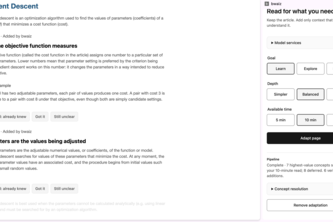
Bwaiz is a self-reported Chrome extension that adapts web articles to a reader’s evolving understanding by identifying concepts, comparing them against an internal model of the reader's knowledge, and selectively inserting contextual information into articles. The product is described as a "personal knowledge layer for the web" that learns what the reader understands and adapts content accordingly.
The project is presented as a hackathon submission with no evidence of revenue, customers, or traction beyond its own description. It is built by one person (Joddy Street) using technologies including Chrome extensions, Node.js, PostgreSQL, TypeScript, and GPT-5.6.
Key open question: Does Bwaiz have any evidence of user engagement or adoption that would suggest a viable product-market fit?
What The Product Actually Is
The description states that Bwaiz is a Chrome extension that:
- Identifies concepts, claims, relationships, and prerequisites in articles.
- Compares these with an evolving model of the reader’s knowledge.
- Selectively inserts context beside relevant paragraphs.
- Preserves the original article content.
- Allows readers to respond to concepts (e.g., “Already knew”, “Still unclear”) which updates the knowledge model.
It is described as not replacing articles with summaries, but instead adapting them in real time based on user feedback and prior understanding.
Inference: The tool appears to be a browser-based personalization engine for reading, using AI to dynamically adjust content presentation.
Positioning & Claim Evolution
The author claims that Bwaiz addresses a mismatch between how articles are written (for an assumed reader) and how people actually read (with varying levels of prior knowledge). It builds on the idea of e-reader vocabulary builders but extends it to the web.
Key positioning elements from the description:
- "Bwaiz is a personal knowledge layer for the web."
- "It learns what you understand and adapts every article to what’s worth your attention."
- "The web should remember concepts, not just words."
These claims position Bwaiz as an adaptive reading experience that evolves with the user — not a static summarizer or AI sidebar.
Inference: The product is positioned as a long-term learning companion for online content consumption, rather than a one-time tool.
Target Customer & ICP
The description does not clearly define a target customer or ideal customer profile (ICP). It implies that Bwaiz is intended for readers who want to learn from articles, explore topics, or evaluate information — but does not specify:
- Who these readers are (e.g., students, professionals, researchers)
- What their goals are beyond general learning
- Whether they have specific needs or pain points
Inference: The product seems aimed at knowledge-seeking individuals who consume online content regularly and want a more personalized experience.
Business Model & Pricing Evidence
There is no evidence in the description of any business model or pricing structure. The author does not mention monetization, subscriptions, freemium tiers, or partnerships.
Inference: No commercial strategy is evident beyond the product’s self-description.
Technical & Delivery Signals
The project is described as:
- A Chrome Manifest V3 extension
- Built with TypeScript, Node.js, and PostgreSQL
- Uses Docker Compose for development
- Leverages GPT-5.6 for document analysis, adaptation generation, and verification
- Includes Codex in the development process
It is also described as:
- Having a persistent side panel
- Being able to modify arbitrary article pages safely
- Producing reliable structured outputs
Inference: The technical stack suggests a modern, scalable architecture for browser-based AI tools. However, no evidence of production deployment or performance data.
Traction & Maturity Signals
There is no evidence of traction or maturity beyond the hackathon submission:
- No revenue
- No customers
- No user base
- No product in production
- No metrics on usage or retention
The project is described as a hackathon submission, and the only indication of progress is that it was submitted to the OpenAI 2026 hackathon.
Inference: The product exists only in concept and prototype form, with no signs of real-world adoption or user feedback loops.
Competitive Context
The description mentions:
- E-reader vocabulary builders (e.g., Kindle)
- Summarizers
- AI sidebars
- Chatbots with conversational memory
It positions Bwaiz as different from these tools because it:
- Does not replace articles
- Learns over time
- Adapts content dynamically based on prior knowledge
- Preserves original content and makes additions removable
However, there is no mention of existing competitors or market analysis.
Inference: The competitive landscape is unclear, but the product appears to aim at filling a gap in adaptive reading tools that don’t forget user context.
Open Questions & Risks
Several risks are evident from the description:
- No traction or adoption: The project is only described as a hackathon submission.
- Single founder: No team or organizational support.
- Unverified technology claims: GPT-5.6 is mentioned, but no validation of its use or performance.
- Lack of commercial strategy: No pricing, monetization, or go-to-market plan.
- Unclear user behavior: No evidence of how users interact with the tool beyond basic feedback actions.
Inference: The risk of failure is high due to lack of product-market fit, no revenue model, and no demonstrated traction.
Questions the description leaves open
- What specific problems are you solving for users that current tools don’t?
- How do you plan to validate the learning loop across different domains or subjects?
- Have you tested Bwaiz with real users? If so, what were the results?
- What is your roadmap for moving from prototype to a scalable product?
- Are there any technical limitations in how the extension interacts with web pages?
- How do you intend to monetize this tool?
- What are the key assumptions behind Bwaiz’s approach that could be wrong?
Overall Assessment
Not evidenced.
There is no evidence of revenue, customers, traction, or a clear business model. The project is described as a hackathon submission with no indication of commercial viability or product-market fit.
The author states that Bwaiz is a personal knowledge layer for the web and adapts content based on user understanding — but there is no proof that this concept has been validated in practice.
Confidence level: Low. This is a self-reported idea, not a tested product.
User Stories BotA demo video on every pull request
Get a demo video on every new feature
GitHub App that watches your pull requests and records a narrated, captioned demo.
Save time on demo prep and make informed decisions faster with a video walkthrough of every new feature.
Source
Submitted to the OpenAI 2026 hackathon on Devpost. Project home on Devpost. Back to the full gallery on Devpost.
This competitive analysis was produced by top-founders.com (opens in a new tab)
Generated by a language model from this project's public Devpost page — its tagline, the author's own write-up and any built-with tags listed there — as captured in August 2026. Short quotations are the author's words. It is an opinion on the idea as a business, not on the people behind it, and it reflects the description as published then. If the project has moved on, request a correction below. The analysis is not independent research and contains no verified traction, revenue or customer data.
An independent guide by KFG International LLC — not affiliated with, endorsed by, or connected to Devpost or OpenAI.