

Archive position — measured, not model output
0 likes on Devpost
2,263 of the 7,850 archived projects have more likes, and 5,587 share exactly 0 — so this project's #2,970 place in the like-ranked listing is a tie-break inside that group, not a ranking.
Projects (log scale)
Likes on Devpost. ▲ marks this project's group.
Show the figures
| Likes | Projects | Share of archive |
|---|---|---|
| 0 | 5,587 | 71.2% |
| 1 | 1,758 | 22.4% |
| 2 | 284 | 3.6% |
| 3–4 | 132 | 1.7% |
| 5–9 | 75 | 1.0% |
| 10+ | 14 | 0.2% |
 User Stories BotA demo video on every pull request
Get a demo video on every new feature
GitHub App that watches your pull requests and records a narrated, captioned demo.
Save time on demo prep and make informed decisions faster with a video walkthrough of every new feature.
Executive Summary
What the company appears to be: The author states that Blood Pressure Log is a native iPhone and iPad app for personal health tracking, focused on recording blood pressure readings and visualizing trends locally on device. It is described as a private, local-first tool with no cloud services or third-party dependencies.
What changed: The project was submitted to the OpenAI 2026 hackathon, indicating a development effort that resulted in a functional prototype. The author used AI tools (Codex + GPT-5.6) for development assistance but did not use any external APIs at runtime.
The single most important open question: Is there evidence of user adoption or market traction beyond the developer's own use? The description contains no data on users, revenue, or customer engagement — only a self-reported account of a personal tool built in a hackathon context.
What The Product Actually Is
- The description states that Blood Pressure Log is a native iPhone and iPad app.
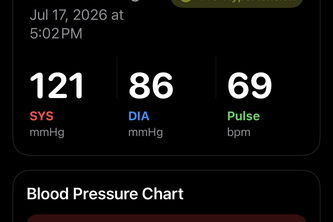
- It allows users to record systolic pressure, diastolic pressure, pulse, date/time, and optional notes.
- It displays the latest reading and an informational category at a glance.
- It enables browsing and deleting reading history.
- It visualizes trends for systolic, diastolic, and pulse.
- It supports exporting history as a text summary or multi-page PDF.
- It shares exports through the standard iOS share sheet.
- It clears all locally stored readings upon user request.
- The app is described as a personal tracking tool, not a medical device.
- Readings remain on the device unless explicitly exported.
Confidence: High — this section is entirely self-reported and directly stated by the author.
Positioning & Claim Evolution
- The description states that Blood Pressure Log was built to make routine blood pressure tracking simple and private.
- It emphasizes no account, subscription, advertising, or cloud service.
- The app is positioned as a local-first tool with strong privacy controls.
- The developer notes that the app does not diagnose conditions, recommend treatment, or replace healthcare professionals.
Confidence: High — these are direct claims from the author, not inferred.
Target Customer & ICP
- Not evidenced. The description does not identify specific customer segments or personas beyond "people" who track blood pressure.
- No mention of demographic, behavioral, or psychographic targeting.
Confidence: Low — no evidence of target customer definition.
Business Model & Pricing Evidence
- The description states that the app is free to use and requires no subscription or account.
- There are no pricing tiers, monetization methods, or revenue models described.
- No indication of paid features, freemium structure, or in-app purchases.
Confidence: Low — no evidence of business model or pricing strategy.
Technical & Delivery Signals
- The app is built with SwiftUI, Swift Charts, Codable models, ObservableObject data store, JSON persistence in UserDefaults, and UIKit's UIGraphicsPDFRenderer.
- It has no third-party dependencies or backend services.
- Readings remain on the device unless exported.
- The developer used Codex + GPT-5.6 for development assistance but did not use OpenAI APIs at runtime.
- The app does not call external APIs or send health data to OpenAI.
- Testing includes setup instructions, manual acceptance checklist, and a successful command-line simulator build.
Confidence: High — these are direct technical claims from the author.
Traction & Maturity Signals
- Not evidenced. There is no mention of users, downloads, usage metrics, or adoption beyond the developer's own use.
- No evidence of revenue, customer base, or market traction.
Confidence: Very low — no traction data provided.
Competitive Context
- Not evidenced. The description does not reference existing apps, competitors, or market positioning.
- No mention of similar tools or platforms in the health tracking space.
Confidence: Low — no competitive analysis or context provided.
Open Questions & Risks
- No commercial traction: The app is described as a personal tool built for a hackathon. There is no evidence of users, adoption, or revenue.
- Single-person team: The project was developed by one individual (Powerusa Palka), which may limit scalability or long-term maintenance.
- No monetization strategy: No indication of how the app would generate revenue if scaled.
- Limited functionality: It is a local-only tool with no cloud sync, sharing beyond export, or integration with health platforms.
- AI dependency: The developer used AI tools extensively for development but did not use them at runtime — this may be an open question for future scalability or product evolution.
Confidence: Medium — these are inferences based on the lack of evidence and the project's nature.
Questions the description leaves open
- What is your intended path to market adoption beyond personal use?
- Have you validated demand from potential users through surveys, interviews, or early feedback?
- Are there plans to monetize the app, and if so, how?
- How do you plan to scale beyond a single developer?
- What are the long-term maintenance and update plans for the app?
- Do you have any plans to integrate with health platforms or devices (e.g., Apple Health, Fitbit)?
- How do you intend to ensure data privacy compliance (e.g., HIPAA, GDPR) if the app expands beyond personal use?
Overall Assessment
- Not evidenced. The description does not provide any information on valuation, funding, or investment interest.
- No evidence of commercial viability, traction, or scalability.
Confidence: Very low — no basis for a commercial due-diligence judgment.
User Stories BotA demo video on every pull request
Get a demo video on every new feature
GitHub App that watches your pull requests and records a narrated, captioned demo.
Save time on demo prep and make informed decisions faster with a video walkthrough of every new feature.
Source
Submitted to the OpenAI 2026 hackathon on Devpost. Project home on Devpost. Back to the full gallery on Devpost.
This competitive analysis was produced by top-founders.com (opens in a new tab)
Generated by a language model from this project's public Devpost page — its tagline, the author's own write-up and any built-with tags listed there — as captured in August 2026. Short quotations are the author's words. It is an opinion on the idea as a business, not on the people behind it, and it reflects the description as published then. If the project has moved on, request a correction below. The analysis is not independent research and contains no verified traction, revenue or customer data.
An independent guide by KFG International LLC — not affiliated with, endorsed by, or connected to Devpost or OpenAI.