

Archive position — measured, not model output
0 likes on Devpost
2,263 of the 7,850 archived projects have more likes, and 5,587 share exactly 0 — so this project's #2,926 place in the like-ranked listing is a tie-break inside that group, not a ranking.
Projects (log scale)
Likes on Devpost. ▲ marks this project's group.
Show the figures
| Likes | Projects | Share of archive |
|---|---|---|
| 0 | 5,587 | 71.2% |
| 1 | 1,758 | 22.4% |
| 2 | 284 | 3.6% |
| 3–4 | 132 | 1.7% |
| 5–9 | 75 | 1.0% |
| 10+ | 14 | 0.2% |
 User Stories BotA demo video on every pull request
Get a demo video on every new feature
GitHub App that watches your pull requests and records a narrated, captioned demo.
Save time on demo prep and make informed decisions faster with a video walkthrough of every new feature.
Executive Summary
What the company appears to be
Big Hero Six (also known as Young Entrepreneurs) is a self-reported educational platform designed to teach aspiring founders core business skills through interactive challenges that simulate real-world startup scenarios. It is described as a gamified learning experience where users complete tasks such as pitching, financial modeling, prioritization, process sequencing, and branching decision-making. The platform uses AI-generated feedback and allows users to earn XP and badges while progressing through challenges.
What changed
The project was built over a short timeframe (likely a hackathon) with an initial focus on five core mechanics. It is described as having evolved from a prototype into a functional MVP, with plans for future expansion into an open-world game-like experience that unlocks new challenges based on user progress and business growth.
Single most important open question
Is there evidence of traction or early adoption beyond the team's own use of the platform? The description does not provide any data on users, revenue, or engagement beyond the authors’ own testing and demonstration.
What The Product Actually Is
The description states that Big Hero Six is a platform with five different challenge types, each teaching a real founder skill:
- Pitching — Users pitch their idea to an AI mentor who gives feedback.
- Financial Modeling — Build out a simple business model and see if it makes sense.
- Prioritization — Organize what matters most when building.
- Process Sequencing — Figure out the right order to do things.
- Story/Decisions — Navigate a branching startup scenario where choices matter (Bandersnatch-style).
Users earn XP and badges as they complete challenges. If they fail, they can try again without losing anything. If they pass, their achievement is locked in. The system supports draft saving, persistent authentication, and multi-user functionality.
The platform was built using:
- Frontend: Next.js
- Database: Supabase
- Deployment: Vercel
- AI tools: Codex (for prototyping), mocked AI responses (no OpenAI API used)
It is described as a gamified educational tool, not a commercial product or service offering.
Inference: The platform appears to be an interactive, self-contained learning environment focused on early-stage founder education. It simulates real-world startup challenges but does not appear to include actual mentorship or live human interaction beyond AI feedback.
Positioning & Claim Evolution
The description states that the team wanted to create something that feels like playing a game, not sitting in a classroom, and aims to teach entrepreneurship through hands-on experience without financial risk. The tagline reads:
“What if learning to run a business felt like leveling up in a game?”
They also claim:
- It started as a way to help teenagers learn entrepreneurship by doing.
- They envision it becoming a place where teenagers actually learn entrepreneurship by doing it.
- Eventually, the platform could be used in schools and available on the App Store.
The positioning has evolved from an educational prototype to a potential scalable platform for teaching entrepreneurship, with ambitions to integrate into formal education systems and become accessible via mobile apps.
Inference: The team positions itself as a gamified learning tool for aspiring founders, aiming to bridge the gap between theoretical knowledge and practical application. However, there is no evidence of market validation or adoption beyond internal testing.
Target Customer & ICP
The description states:
- The platform is intended for aspiring founders.
- It targets teenagers who want to learn entrepreneurship through hands-on experience.
- Long-term, it aims to be used in schools, where teachers can teach entrepreneurship using the platform.
There is no mention of:
- Specific age ranges
- Geographic targeting
- Industry verticals
- Business size or stage of target users
Inference: The primary ICP appears to be young people aged 13–18 interested in entrepreneurship, with a secondary audience being educators looking for tools to teach business concepts.
Business Model & Pricing Evidence
The description does not provide any information about:
- Revenue streams
- Pricing models
- Monetization strategy
- Customer acquisition costs
- Subscription or transactional pricing
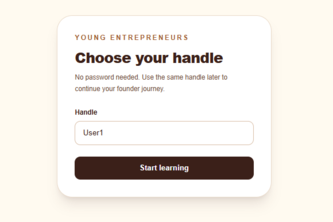
It only mentions that the platform is currently free to use, with users logging in via username handles and completing challenges.
Inference: The business model remains unclear. Based on the description, it seems likely to be either:
- Freemium (with optional paid upgrades)
- Education-focused (possibly funded by schools or grants)
- Not yet monetized
No evidence of commercial traction or pricing structure is provided.
Technical & Delivery Signals
The team built the platform using:
- Next.js for frontend
- Supabase for database
- Vercel for deployment
- Codex for prototyping (with manual corrections)
- Mocked AI responses instead of OpenAI API integration
Key technical decisions include:
- Draft saving: Users can pause and resume challenges.
- XP locking: Once earned, XP cannot be overwritten by re-practicing.
- Persistent auth: Simple username login without passwords.
- Flexible database design to support scaling from 5 to 50+ challenges.
Challenges encountered during development included:
- Codex limitations
- Roleplay API errors
- XP regression bugs
- Scope creep and feature prioritization
Inference: The technical architecture is basic but functional, with a focus on usability and scalability. The team shows awareness of common software engineering issues like state management and data consistency.
Traction & Maturity Signals
The description states:
- The platform was built during a hackathon (OpenAI 2026).
- It includes five mechanics that work.
- Users can log in, play challenges, pause, return, and their progress is saved.
- Multi-user functionality works (different handles show separate progress).
- The team tested it with multiple users ("judge1", "judge2").
- They are proud of the fact that it works and is solid enough for Phase 2.
However, there is no evidence of:
- Real-world usage or user base
- Revenue or monetization
- Customer feedback or retention metrics
- Any external validation or adoption beyond internal testing
Inference: The platform is at a pre-MVP stage, with a working prototype and clear vision for future development. There is no indication of traction or market readiness.
Competitive Context
The description does not mention any competitors or direct comparisons to existing platforms in the educational or entrepreneurship space.
It implies that the team sees a gap in current offerings:
- Textbooks are boring.
- Podcasts don’t teach real decision-making.
- Existing tools lack gamification and hands-on practice.
Inference: The competitive landscape is unclear. The team positions itself as filling a niche for gamified, interactive entrepreneurship education, but no specific competitors or market positioning are identified.
Open Questions & Risks
- No traction or user data: The platform exists only in prototype form with no evidence of real users or adoption.
- Unproven business model: No indication of how the team plans to monetize or scale beyond a hackathon project.
- Limited AI integration: The AI responses are mocked, not integrated with real APIs, which may limit future functionality.
- Scope creep management: While they cut features due to time constraints, there is no evidence of long-term planning or roadmap execution.
- Lack of external validation: No third-party reviews, testimonials, or endorsements are mentioned.
Inference: The biggest risk lies in the lack of commercial viability or traction, which makes it difficult to assess whether this will evolve into a sustainable business.
Questions the description leaves open
- What is your plan for monetization beyond the current prototype?
- Have you tested the platform with real users outside of the team?
- How do you intend to scale from 5 challenges to potentially hundreds?
- Are there any plans to integrate real AI APIs or human mentors in Phase 2?
- What are the key metrics you would track to measure success once launched?
- Do you have a clear path to market entry, especially in schools or educational institutions?
- How do you plan to differentiate from existing platforms that teach entrepreneurship?
Overall Assessment
The description indicates that Big Hero Six is currently at a pre-MVP stage, with a functional prototype built during a hackathon. It has a clear vision for future development, including an open-world game-like structure and potential integration into school curricula.
However, there is no evidence of traction, revenue, or user adoption beyond the team’s own testing. The platform lacks commercial viability indicators such as pricing models, customer feedback, or monetization strategies.
Assessment:
This project is a conceptual prototype with strong foundational design and execution, but it is not yet ready for investment or partnership consideration without further proof of traction, market validation, or business model clarity.
Confidence Level: Low — based on self-reported evidence only.
User Stories BotA demo video on every pull request
Get a demo video on every new feature
GitHub App that watches your pull requests and records a narrated, captioned demo.
Save time on demo prep and make informed decisions faster with a video walkthrough of every new feature.
Source
Submitted to the OpenAI 2026 hackathon on Devpost. Project home on Devpost. Back to the full gallery on Devpost.
This competitive analysis was produced by top-founders.com (opens in a new tab)
Generated by a language model from this project's public Devpost page — its tagline, the author's own write-up and any built-with tags listed there — as captured in August 2026. Short quotations are the author's words. It is an opinion on the idea as a business, not on the people behind it, and it reflects the description as published then. If the project has moved on, request a correction below. The analysis is not independent research and contains no verified traction, revenue or customer data.
An independent guide by KFG International LLC — not affiliated with, endorsed by, or connected to Devpost or OpenAI.