

Archive position — measured, not model output
0 likes on Devpost
2,263 of the 7,850 archived projects have more likes, and 5,587 share exactly 0 — so this project's #2,886 place in the like-ranked listing is a tie-break inside that group, not a ranking.
Projects (log scale)
Likes on Devpost. ▲ marks this project's group.
Show the figures
| Likes | Projects | Share of archive |
|---|---|---|
| 0 | 5,587 | 71.2% |
| 1 | 1,758 | 22.4% |
| 2 | 284 | 3.6% |
| 3–4 | 132 | 1.7% |
| 5–9 | 75 | 1.0% |
| 10+ | 14 | 0.2% |
 User Stories BotA demo video on every pull request
Get a demo video on every new feature
GitHub App that watches your pull requests and records a narrated, captioned demo.
Save time on demo prep and make informed decisions faster with a video walkthrough of every new feature.
Executive Summary
What the company appears to be
BaziLantern is a self-reported project that claims to build an explainable, deterministic engine for BaZi (Four Pillars) astrology. It integrates ancient Chinese texts and schools into a structured system, separating computation from AI narration. The author states it uses a “deterministic TypeScript engine” and an AI layer for explanation, with no silent rewriting of core data.
What changed
The project is described as a departure from typical AI astrology chatbots — aiming to provide inspectable results, confidence scores, and source status rather than open-ended interpretation. It introduces a four-layer memory mechanism and a mobile-first UI for life audit.
Single most important open question
Is there evidence of any real-world usage or testing beyond the 25 friends mentioned? The description does not state whether BaziLantern has been used by users outside the author’s circle, nor if it has been validated in a broader or commercial context.
What The Product Actually Is
The description states that BaziLantern is an engine for BaZi (Four Pillars) astrology. It builds on traditional Chinese systems and integrates ancient texts and schools to produce structured outputs. It includes:
- A deterministic TypeScript engine that calculates charts, hidden stems, Ten Gods, luck cycles, formations, symbolic relationships, scores, confidence, and source status.
- An AI layer that explains the results but does not alter core data.
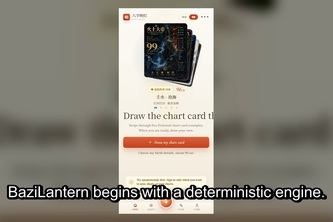
- A mobile-first Life Audit UI presenting results across six dimensions.
- A four-layer memory mechanism for user interaction and dream processing.
The author states this is a “first-ever” engine of its kind, more complex than calculus, integrating all relevant texts and schools for master-agreed readings. It also models chain reactions within an inner circle of events.
Evidence
- The project name, tagline, and description are self-reported.
- The author claims to have built it using GPT-5.6, Next.js, OpenAI Codex, React, and TypeScript.
- The system is described as deterministic with structured evidence contracts consumed by UI, regression tests, and review tooling.
Inference The product appears to be a hybrid of rule-based computation and AI explanation, designed for transparency in an ancient practice.
Positioning & Claim Evolution
The author positions BaziLantern as the inverse of typical AI astrology products — not starting with chat but with calculation and evidence. It claims to offer:
- Deterministic chart generation.
- Inspectable results and confidence levels.
- Source status for major conclusions.
- No silent rewriting by AI.
It also states that it avoids ambiguity by not fabricating certainty, and that the AI layer is used only for narration, not computation.
Evidence
- The author explicitly contrasts BaziLantern with open-ended chatbots.
- It emphasizes traceability, authority boundaries, and semantic versioning.
- The system is described as a “production demo” that judges can test without rebuilding.
Inference The positioning is to offer a more trustworthy, transparent, and structured approach to BaZi astrology than existing tools — especially those relying on chatbots.
Target Customer & ICP
The description does not clearly identify the target customer or ideal customer profile (ICP). It mentions:
- A mobile-first UI.
- Use by 25 friends for testing.
- A dream mechanism and memory system for personal reflection.
It also states that the tool is for “self-reflection and cultural exploration,” not for medical, legal, financial, or predictive advice.
Evidence
- The product is described as a personal life audit tool.
- It targets users interested in BaZi astrology and self-exploration.
- No explicit demographic or segment data is provided.
Inference The ICP likely includes individuals interested in traditional Chinese astrology, seeking structured insights over chatbot-style interaction. However, the lack of customer data makes this speculative.
Business Model & Pricing Evidence
There is no evidence of a business model or pricing structure in the description. The author does not mention monetization, subscriptions, or any revenue-generating mechanism.
Evidence
- No pricing, plans, or monetization strategy is described.
- The project is presented as a hackathon submission and demo.
Inference The business model remains unknown; it may be early-stage or non-existent.
Technical & Delivery Signals
The author states that the system uses:
- A deterministic TypeScript engine.
- GPT-5.6, OpenAI Codex, React, Next.js, and TypeScript for development.
- Evidence contracts and semantic versioning.
- Regression tests and freeze guards to prevent drift.
- AI narration downstream of deterministic computation.
It also mentions a four-layer memory mechanism and dream processing, though it is not yet implemented.
Evidence
- The system is built with specific tech stack (TypeScript, React, Next.js).
- It uses GPT-5.6 as a development and auditing agent.
- A production demo exists that can be tested without rebuilding.
Inference The technical architecture shows an attempt to separate computation from AI narration, which may signal intent toward robustness and traceability.
Traction & Maturity Signals
The description mentions:
- Testing on 25 friends.
- An accuracy rate over 80% in that testing.
- A production demo for judges to test.
- Five English chart-card rarity prototypes generated from a custom prompt system.
- The image generation path is still under validation.
It does not mention any commercial users, revenue, or adoption beyond the author’s circle.
Evidence
- Testing with 25 friends.
- Accuracy rate >80% in that testing.
- Production demo available.
Inference The project shows early maturity and a functional prototype but lacks evidence of broader traction or commercial viability.
Competitive Context
There is no mention of competitors in the description. The author contrasts BaziLantern with typical AI astrology chatbots, but does not name or describe other players in the space.
Evidence
- No competitor names or market analysis provided.
- The author positions it as a novel approach to BaZi astrology.
Inference The competitive landscape is unclear. It may be competing with general AI astrology tools, but no specific comparison is made.
Open Questions & Risks
Key risks and open questions include:
- Lack of external validation or customer data beyond 25 friends.
- No evidence of commercial traction or revenue.
- Unproven scalability or adoption beyond the author’s circle.
- The memory mechanism is described as complete but not yet implemented.
- No mention of localization, localization strategy, or international expansion plans.
- The use of GPT-5.6 as a development tool raises questions about whether it could be used in production or if it's just for prototyping.
Evidence
- No external users or customers.
- No revenue or monetization data.
- The memory system is not implemented.
Inference The project is early-stage and lacks commercial evidence, raising concerns about viability and scalability.
Questions the description leaves open
- What is the source of the 80% accuracy rate in testing with 25 friends? Was it measured against known outcomes or subjective agreement?
- How does the system handle missing data (e.g., birth time, location) — and what are the implications for confidence scores?
- Is there any plan to expand beyond the author’s circle of 25 friends for real-world testing?
- What is the current status of the dream mechanism and memory system? When will they be implemented?
- Are there plans to monetize or commercialize BaziLantern, and what business model are you considering?
- How do you plan to scale beyond a single developer (the author)?
- What is the long-term vision for localization and internationalization?
Overall Assessment
Not evidenced.
The description provides no information on revenue, customers, or commercial traction. It is unclear whether BaziLantern has moved beyond a prototype or hackathon demo.
Confidence Level Low This analysis is based entirely on self-reported claims and lacks any external validation or evidence of real-world usage, adoption, or monetization. The project appears to be early-stage and experimental, with no demonstrated commercial viability or traction.
Inference While the architecture shows promise for a niche market (BaZi astrology), there is insufficient evidence to support investment or partnership interest at this time.
User Stories BotA demo video on every pull request
Get a demo video on every new feature
GitHub App that watches your pull requests and records a narrated, captioned demo.
Save time on demo prep and make informed decisions faster with a video walkthrough of every new feature.
Source
Submitted to the OpenAI 2026 hackathon on Devpost. Project home on Devpost. Back to the full gallery on Devpost.
This competitive analysis was produced by top-founders.com (opens in a new tab)
Generated by a language model from this project's public Devpost page — its tagline, the author's own write-up and any built-with tags listed there — as captured in August 2026. Short quotations are the author's words. It is an opinion on the idea as a business, not on the people behind it, and it reflects the description as published then. If the project has moved on, request a correction below. The analysis is not independent research and contains no verified traction, revenue or customer data.
An independent guide by KFG International LLC — not affiliated with, endorsed by, or connected to Devpost or OpenAI.